Tuesday, 28 December 2021

Further returns from the Getty

White on Red Lidded Pithos
Formerly Malibu inv. 96.AE.135.
The Manhattan DA Office mentioned the return of seven items from the J. Paul Getty Museum; they were seized on April 2, 2021, and the press release specifically states that they "were trafficked by ALMAGIÀ". [press release] 

Only one piece is listed in the Manhattan DA press release: "A Pithos with Ulysses, dating to 7th Century B.C.E. and valued at $200,000".

This is the lidded White on Red pithos decorated with the blinding of Polyphemos.  It was given to the Getty by Barbara and Lawrence Fleischman (inv. 96.AE.135; cat. no. 86). The pithos no longer appears on the online Getty catalogue. 

I am grateful to the Getty for providing details of the other pieces:

a. A White on Red Lidded Pithos. Gift of Barbara and Lawrence Fleischman. Inv. 96.AE.136; cat. no. 87.
b. A pair of Caeretan sub-geometric plate attributed to the circle of the Crane painter. Gift of Barbara and Lawrence Fleischman. Inv. 96.AE.137.1-2; cat. no. 88–89, A–B. 
c. A pair of Caeretan sub-geometric plates attributed to the Heron class. Gift of Barbara and Lawrence Fleischman. Inv. 96.AE.138.1-2; cat. no. 88–89, C–D. 
d. An Attic red-figured stemless cup, attributed to the Marlay painter. 'New York art market'. Inv. 86.AE.479; BAPD 41037.

The stemless cup had already been identified by Chasing Aphrodite.


Bookmark and Share so Your Real Friends Know that You Know

Monday, 27 December 2021

Etruscan White on Red Ware Returning to Italy


Bookmark and Share so Your Real Friends Know that You Know

Friday, 24 December 2021

Merrin Gallery returns terracotta to Italy


Among the returns to Italy was an Etruscan terracotta female head that had been acquired by the Merrin Gallery in 1997. The New York Times reports that it had been derived from Giacomo Medici (Tom Mashberg, "Looking for a Stolen Idol? Visit the Museum of the Manhattan D.A.", New York Times November 17, 2021). The head was seized on June 28, 2021 and returned to Italy in December [press release]

Bookmark and Share so Your Real Friends Know that You Know

The Várez Fisa Collection in Madrid


My summary of the sources for the Várez Fisa collection now in Madrid has appeared in the Fall number of the Journal of Art Crime.


Bookmark and Share so Your Real Friends Know that You Know

San Antonio Museum of Art and returning antiquities

Olpe formerly in the San Antonio Museum of Art

Back in 2012 Chasing Aphrodite identified material in the San Antonio Museum of Art that was linked to Edoardo Almagià. 

It is now clear that a number of items were deaccessioned in February 2021 and have now formed part of a major return of objects to Italy. The museum has an oblique reference in the Manhattan DA Press Release. 

The two pieces that were identified by Chasing Aphrodite are indeed here.

a. An Attic red-figured olpe showing Dionysos and a satyr, attributed to the Florence painter by J.R. Guy (inv. 86.30; cat. no. 60; BAPD 19167). Gift of Gilbert M. Denman, Jr. The deaccessioning statement:  "sold by Edoardo Almagià, New York, to the San Antonio Museum of Art, 1986". 

b. An Attic red-figured plate showing the head of a man (inv. 87.1; cat. no. 87.1; BAPD 19168). Museum Purchase: Grace Fortner Rider Fund. The deaccessioning statement: "found at Barbarano Romano, Italy, according to Edoardo Almagià; with Edoardo Almagià, New York, by 1986; sold by Edoardo Almagià to the San Antonio Museum of Art, 1987". Ian McPhee and A.D. Trendall had earlier suggested that it had been found in Cerveteri (1990). Barbarano Romano is to the south of Viterbo.

The third part of the return consists of 192 fragments of cups, also reported to have been found at Barbarano Romano, and stated to have been sold to Gilbert M. Denman, Jr. by Almagià in 1985.

c. An Attic black-figured Little Master cup (inv. 86.134.196a; cat. no. 178; BAPD 20266). Gift of Gilbert M. Denman, Jr.
d-j. Seven fragmentary Attic red-figured cups (inv. 86.134.196).
k. Other assorted fragments of cups, some red-figured some black-glossed (inv. 86.134.196).


Bookmark and Share so Your Real Friends Know that You Know

Saturday, 18 December 2021

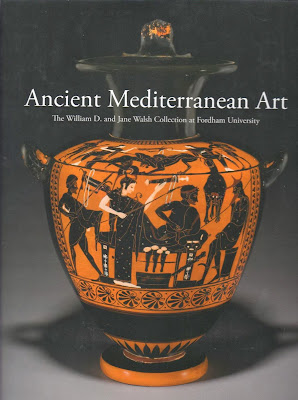
The Fordham Antiquities and the New York Galleries

The announcement that "Ninety-six pieces with an estimated value of $1.8 million [were] seized from the Fordham Museum of Greek, Etruscan, and Roman Art on May 28, 2021" raises new questions (Press Release, Manhattan DA: "Manhattan D.A.’s Office Returns 200 Antiquities to Italy", December 15, 2021). The statement reports, "All but two of the pieces seized from Fordham were trafficked by [Edoardo] ALMAGIÀ." One of these two pieces is probably the Apulian patera attributed to the Baltimore painter that surfaced through Sotheby's in London in December 1983.

It is clear that some of the Fordham objects have a public and published record that they had surfaced on the New York market through Almagià. What is more surprising is that four New York galleries appear to be associated with the returning material: at least 85 of the seized objects are reported to have passed through these routes. (Around 80 objects come from just two of the galleries.)

Separate legal papers present the way that Almagià's material is said to have moved from Italy to north America. Does this mean the bulk of the Fordham material that had allegedly been "trafficked by ALMAGIÀ" had been passed to specific New York galleries? (This would imply that the donor of the material to Fordham had purchased the items from these four New York galleries rather than directly from Almagià.) 

These four galleries are not ones that have featured in the sorry tale that so far has been told about the selling and collecting of cultural property from Italy. This raises the possibility—and I would stress the possibility—that further revelations are likely given that, as the Manhattan DA press release reminds us, Almagià's "Green Book" contained "entries for almost 1,700 looted antiquities that ALMAGIÀ purchased from tombaroli in Italy and then sold in the United States." 

Bookmark and Share so Your Real Friends Know that You Know

Krater fragments in Princeton

Greek, Attic, probably by the Kleophrades Painter, ca. 490–480 BCE, Two non-joining fragments from a calyx-krater (mixing bowl) depicting ar...