Monday, 10 October 2022

The Keros Haul and the Leonard Stern Collection

Figures identified with the Keros Haul in the Stern Collection

Back in 2014 LM noted 5 Cycladic figures (or fragments of figures) that were identified as coming from the Keros Haul. They can be identified in P. Sotirakopoulou, The "Keros Hoard": myth or reality? Searching for the lost pieces of a puzzle (Athens: N.P. Goulandris Foundation - Museum of Cycladic Art, 2005) as:
  • Keros 170: Stern 138. Attributed to the Karlsruhe/Woodner Sculptor.
  • Keros 180: Stern 177. Attributed to the Copenhagen Sculptor.
  • Keros 181: Stern 157. Attributed to the Copenhagen Sculptor.
  • Keros 223: Stern 181. Getz-Gentle, PS pl. 30.
  • Keros 242: Stern 111. Attributed to the Ashmolean Sculptor.
Incidentally one of the Harmon pieces is specifically mentioned in the review article (D.W.J. Gill, AJA 111 [2007] 163-65).

These figures form part of the Leonard Stern collection (linked to Harmon Fine Art) that is to be passed into the Hellenic Ancient Culture Institute (HACI) based in Delaware, and then placed on loan with the Museum of Cycladic Art in Athens, followed by New York's Metropolitan Museum Art. The collection has been the subject of discussion in Greece ("Debate: Cycladic idol deal signals new chapter in heritage management", ekathimerini.com September 13, 2022). The article reports:
The Met first reached out to the Greek Ministry of Culture in June 2020, informing it that Stern had expressed an interest in showing and donated his collection to the American museum and was asking whether the Greek state was aware of its existence.
The answer is, of course, yes, the Stern collection was known. The collection featured in Cycladic Masterpieces (Harmon Fine Arts, 2004), and a selection of Stern's Cycladic figures had been displayed in the exhibition 'Masterpieces of Cycladic Art' at the Merrin Gallery. Further discussion from strongly-held positions appears in the article.

| |
Bookmark and Share so Your Real Friends Know that You Know

Friday, 7 October 2022

From Geneva to the Steinhardt Collection


Source: Manhattan DA

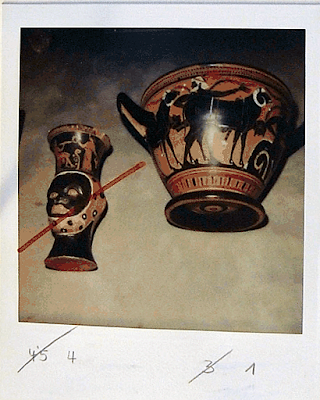
Five objects (Attic head aryballos; Protocorinthian duck and owl; Corinthian bull's head; Ionian ram's head; Apulian head vase) in the seizure of antiquities from the collection of Michael Steinhardt have something in common: they were placed on loan with Geneva's Musée d'Art et d'Histoire (1978–81). And all of them were subsequently placed on loan with the J. Paul Getty Museum (1984–96). And all of them were sold by Robin Symes to the Beierwaltes in 1996. All but the Apulian head vase appear in images from the Medici Dossier: the head vase itself appears in the Becchina archive (with an Attic skyphos now returned from the Shelby White collection).

Such loans to these two museums were used as a response to seizures  in 2018 from another dealer. It is almost as if the loans created an acceptable collecting history. This raid seems to relate to another group of material. 

The Geneva museum has associations with other loans such as the Ka-Nefer-Nefer mummy mask (though the museum does not have a record of the loan). And the Getty accepted loans of fragments from some of these same individuals, as well as complete pots such as the Steinhardt hydria.

It should be noted that the same Geneva museum appears to be linked to the Apulian grave group acquired by Berlin. 

What part did Geneva play in handling recently surfaced antiquities and providing them with a history? What other objects passed this way? The papers relating to the Steinhardt seizure expand on this aspect.

And how many of these objects were then placed on loan with the J. Paul Getty Museum? 

Note: Identifications from the Medici Dossier and the Becchina Archive were made by Christos Tsirogiannis.

| |
Bookmark and Share so Your Real Friends Know that You Know

Wednesday, 21 September 2022

Oscilla from the Steinhardt Collection

Source: Manhattan DA
Among the objects returned to Italy from the collection formed by Michael Steinhardt were four Roman oscilla. The Manhattan DA Statement of Facts expands:
A set of four marble oscillum (collectively “the Marble Oscilla”), or Roman disks suspended on chains between columns in gardens, appear in dirt-encrusted fragments in multiple Polaroid photographs recovered from the Medici Archive. ... Depicting satyrs and female followers of Dionysus, the Marble Oscilla were crafted in Italy between 100 B.C.E. and 100 C.E. The Marble Oscilla first surfaced on the international art market in 1992, when Steinhardt purchased the antiquities from Robin Symes with no prior provenance for $175,000. In 1998, Steinhardt sent the Marble Oscilla to a Brooklyn-based restorer for“cleaning and repair.” 
The suggestion is that these oscilla probably came from the garden of a residence. Was this a residence buried during the eruption of Vesuvius?

Two further oscilla are known from Polaroids: these are now displayed in the Miho Museum, Japan. Concerns about their origins were first raised in 2007. Daniella Rizzo and Maurizio Pellegrini have recently indicated that the oscilla feature, like the Steinhardt ones, in the Medici Dossier. They also suggested that they come from 'the Vesuvian area'. Carlos Picón separately has indicated that the parallels for such items come from the area around Vesuvius.

One wonders if the Steinhardt and the Miho oscilla come from the same complex but we will have to await the definitive publication of the Steinhardt examples. 

Will the return of the Steinhardt oscilla place renewed pressure on the Miho Museum to return their pieces so that the series, perhaps originally displayed in the same garden space, can be reunited in Italy?

The identifications of the Steinhardt oscilla were made by Associate Professor Christos Tsirogiannis. 

Source: Miho Museum


| |
Bookmark and Share so Your Real Friends Know that You Know

The Intellectual Consequences of Collecting an Attic Black-Figured Amphora

Source: Manhattan DA

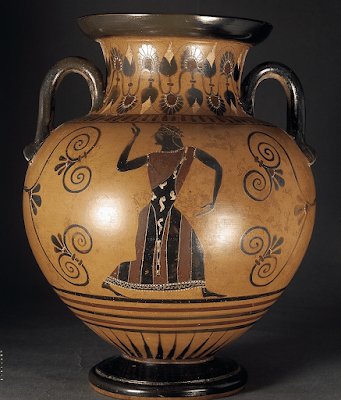
Among the returns to Italy from the Michael Steinhardt collection was an Attic black-figured amphora showing a Maenad. The amphora is known from the Almagià archive (Exhibits 33A and 33B).

The Manhattan DA Statement of Facts notes:
Almagià’s Green Book lists one “Attic BF [Black-Figure] Amphora” purchased from a tombarolo for $6,500, and then sold for $13,000. Almagià’s day planner lists “Steinhardt” on March 18, 1997, preceding a note on April 2, 1997, “prendere vase da [sic] Steinhardt” (take vase of Steinhardt). Although Steinhardt’s records note that there is “no record of purchase,” the records also indicate that Steinhardt accessioned the Attic Black-Figure Amphora in 1997 from Almagià.
Essentially all we know is that Steinhardt acquired this amphora in 1997, and that Almagià had purchased it from a tombarolo.

The mention of the tombarolo suggests that the find-spot was somewhere in Italy: the Statement of Facts suggests both Etruria and Sicily as possibilities. Note that we cannot be sure of the part of Italy where the amphora was found, let alone the specific place or cemetery. That information has been lost for good.

The relatively complete nature of the amphora suggests that it was discovered in a substantial tomb. But what other objects were found alongside it? Was there a single burial or multiple burials? What was the gender of the main person buried in the tomb? If the tomb was in Etruria, were there decorations on the wall? Would other associated finds have helped with the dating? Could it have been older that other pieces in the tomb?

Vasologists may be even now seeking to provide an attribution for the amphora. Perhaps they will note that it has certain characteristics in the potting. Will it be placed in a particular class of pot? But what about the parallels? Where were they found? Or were they, too, without context? 

The looting of this unusual amphora has stripped it of its useful archaeological information. That is one of the intellectual consequences of collecting newly surfaced material.

| |
Bookmark and Share so Your Real Friends Know that You Know

Tuesday, 20 September 2022

Becchina and the Shelby White collection

Source: Manhattan DA

LM noted that two of the objects displayed by the Manhattan DA for return to Italy were in the Shelby White collection. The Attic black-figured skyphos showing Odysseus escaping from the Cave of Polyphemos  clearly appears in one of the photographs seized from the Becchina archive. 

Does this explain why the Italian authorities are revisiting the Shelby White collection? Is it because the previous returns had not taken proper account of the Becchina archive?

It would be interesting to learn how and when Shelby White and Leon Levy acquired the skyphos. Was it directly from Galerie Antike Kunst Palladion? Or was it through another party?

Incidentally, the other piece in the photograph was acquired by a separate New York collection.

It should be noted that the identification of the Shelby White skyphos was made by Associate Professor Christos Tsirogiannis. 

| |
Bookmark and Share so Your Real Friends Know that You Know

The Steinhardt hydria attributed to the Antimenes painter

Source of images: Manhattan DA.

Among the items seized from the Michael Steinhardt collection and returned to Italy was an Attic black-figured hydria attributed to the Antimenes painter. The hydria had been identified from an image in the Medici Dossier.

The Manhattan DA reports that the hydria had first surfaced with Robin Symes in 1983 (when it was advertised in Apollo). The statement then adds:
By 1987, Symes had transferred the object to the New York-based Atlantis Gallery, part-owned by Robert Hecht, who then loaned it to the Getty Museum. From 1987-1996, the object was on view at the Getty Museum prior to its sale to Steinhardt through Sotheby’s New York on December 17, 1996. 
Steinhardt is report to have purchased the hydria from Sotheby's for $169,411.

The Beazley Archive (BAPD 31596) provides the loan number for the Getty (L87.AE.4) as well as the details for the Sotheby's New York sale (17 December 1996, lot 49). It also suggests that the hydria passed through the Royal-Athena Galleries though this information may not be correct.

Christopher Chippindale and I had rehearsed the history of this specific hydria in our review article of The Medici Conspiracy (2007) [see here]. We clarify that the hydria was placed on loan at the Getty in January 1987, and returned in February 1996. This raises a question about the nature and purpose of loans that were placed at the Getty.

It should be recalled that one of the Attic black-figured neck-amphorae seized from Fordham University was attributed to the circle of the Antimenes painter (BAPD 24304).

It should be noted that the identification of the Steinhardt hydria was made by Associate Professor Christos Tsirogiannis. 

| |
Bookmark and Share so Your Real Friends Know that You Know

Monday, 19 September 2022

Robert Hecht and the Princeton painter

Neck-amphora fragments attributed to the Princeton painter
Formerly New York MMA inv. 1991.11.2.

In 1991 the Metropolitan Museum received a gift of a fragmentary black-figured neck-amphora showing Herakles, Athena and Hermes, from Dietrich von Bothmer (inv. 1991.11.2). It was attributed to the Princeton painter by von Bothmer (according to Mary B. Moore); BAPD suggests that the person who attributed the fragments was 'unknown'. Moore observes that the amphora was 'broken and mended with significant parts missing'. The restorer of the amphora is not indicated. The amphora was among a batch of antiquities seized from the museum in 2022 and returned to Italy.

Although the Beazley Archive suggests that the amphora had formed part of the Bothmer collection (BAPD 9023766), the MMA  online catalogue entry suggests that it was in fact purchased from Atlantis Antiquities in 1991. This implies that Bothmer had supplied the funds to purchase the fragments from the gallery that was part owned by Robert Hecht. 

Atlantis Antiquities has already been associated with a number of returns from North American collections that include:
  • An Attic black-figured lekythos attributed to the Diosphos painter from Boston, Museum of Fine Arts
  • An Attic black-figured amphora attributed to the painter of Berlin 1686 from The J. Paul Getty Museum
  • An Attic black-figured amphora attributed to the Antimenes painter from the Steinhardt collection
  • An Apulian amphora attributed to the Darius painter from Boston, Museum of Fine Arts
  • An Apulian loutrophoros attributed to the Metope group from The J. Paul Getty Museum
In some of these cases the restorations had been undertaken by Fritz Bürki. 

It is known that Hecht was the source for some of the pot fragments in Bothmer's collection. 

| |
Bookmark and Share so Your Real Friends Know that You Know

The Afrati Armour in Harvard

Source: Harvard Art Museums The repatriation of the Afrati armour from New York's Metropolitan Museum of Art has implications for other ...