Wednesday, 22 March 2023

Further returns to Greece

Source: Manhattan DA

The Manhattan DA has announced the return of 29 antiquities, worth over $20 million, to Greece ("D.A. Bragg Returns 29 Antiquities to Greece", March 21, 2023 press release; see also here).

The items include a gold coin celebrating the assassination of Julius Caesar that surfaced on the Munich market in 2016.

The press release mentions the seizure of a bronze krater:
The Bronze Calyx Krater, which dates to 350 B.C.E., once held the bones of a deceased individual in a chamber tomb. It was looted and smuggled into Switzerland, where it was cleaned and restored by Fritz and Harry Bürki, the Zurich-based restorers and business partners of Robert Hecht. Hecht then arranged to smuggle the piece into New York, where it was sold to Leon Levy and Shelby White. It was seized by the Office in January of this year.
This seems to be a companion to the krater apparently looted from Pieria that was returned to Greece in 2008.

Unmentioned in the release, but placed next to the krater, was a bronze hydria that appears to be the one from the Shelby White collection (Bronzes no. 8). It is decorated beneath the vertical handle with a relief of Orpheus and a satyr. Chi and Gaunt draw attention to a companion piece in the Michael C. Carlos Museum (inv. 2002.012.001) that was acquired from Robert Hecht.

The release also mentions the return of a Late Neolithic marble group:
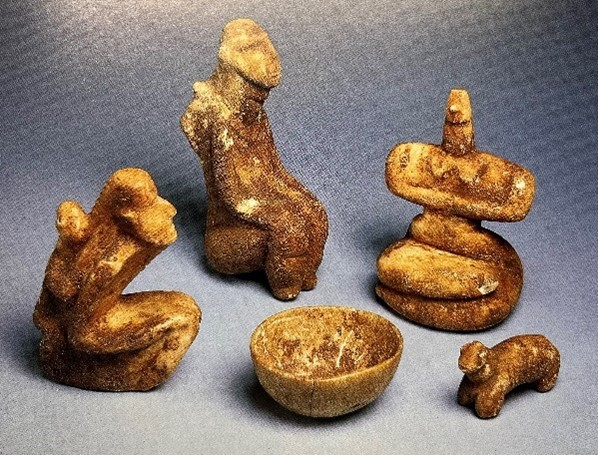
The Neolithic Family Group, which dates to 5000-3500 B.C.E and valued at $3 million. This group of objects compromises five human and animal figures carved from marble, and was looted from the island of Euboea by a Greek trafficker who smuggled the pieces into Switzerland. In 1982 dealer-trafficker Nicolas Koutoulakis sold the group to New York-based collectors Leon Levy and Shelby White. White loaned the group to the Metropolitan Museum of Art in 2000, where they remained on display until March of this year, when it was seized by the Office.
The group had been owned by Charles Gillet and Marion Schuster. They are "said to be from Euboea, or the east coast of Attica opposite, near Porto Raphti, perhaps from an islet attached to the mainland in prehistoric times" (Glories no. 8). It is interesting that the release emphasises the findspot on Euboea rather than Porto Raphti or more generally Attica preferred by Getz-Preziosi and Thimme. There are aspects of the group that make me wonder if they are ancient, a concern raised by Thimme back in 1977.

Next to the Late Neolithic group, but unmentioned in the release, was a double Cycladic figure: a small female figure standing on the head of a larger one. This appears to be the figure in the Shelby White collection (NAC no. 18; Glories no. 9; Katonah no. 15). Next to them was an Early Cycladic II bowl that also appears to be from the Shelby White collection (Glories no. 15).

Among the other items that appear to have been other items that formed part of the Shelby White collection:
  • Glories no. 76: A Late Geometric pair of horses 'said to have been found on Corfu, and for at least twenty years was in a collection in Austria. In October 1970, the group was lent to the Kunsthistorisches Museum in Vienna for restoration.'
  • Glories no. 80: an armlet, two lidded pyxides, and an oinochoe from a hoard of at least 40 pieces found in northern Greece.
  • Glories no. 141: a gold treasure consisting of a pair of coiled snake armbands, a pair of earrings with swans, a gold and carnelian necklace, a gold ring with carnelian intaglio, part of a gold wreath, and a gold diadem. 
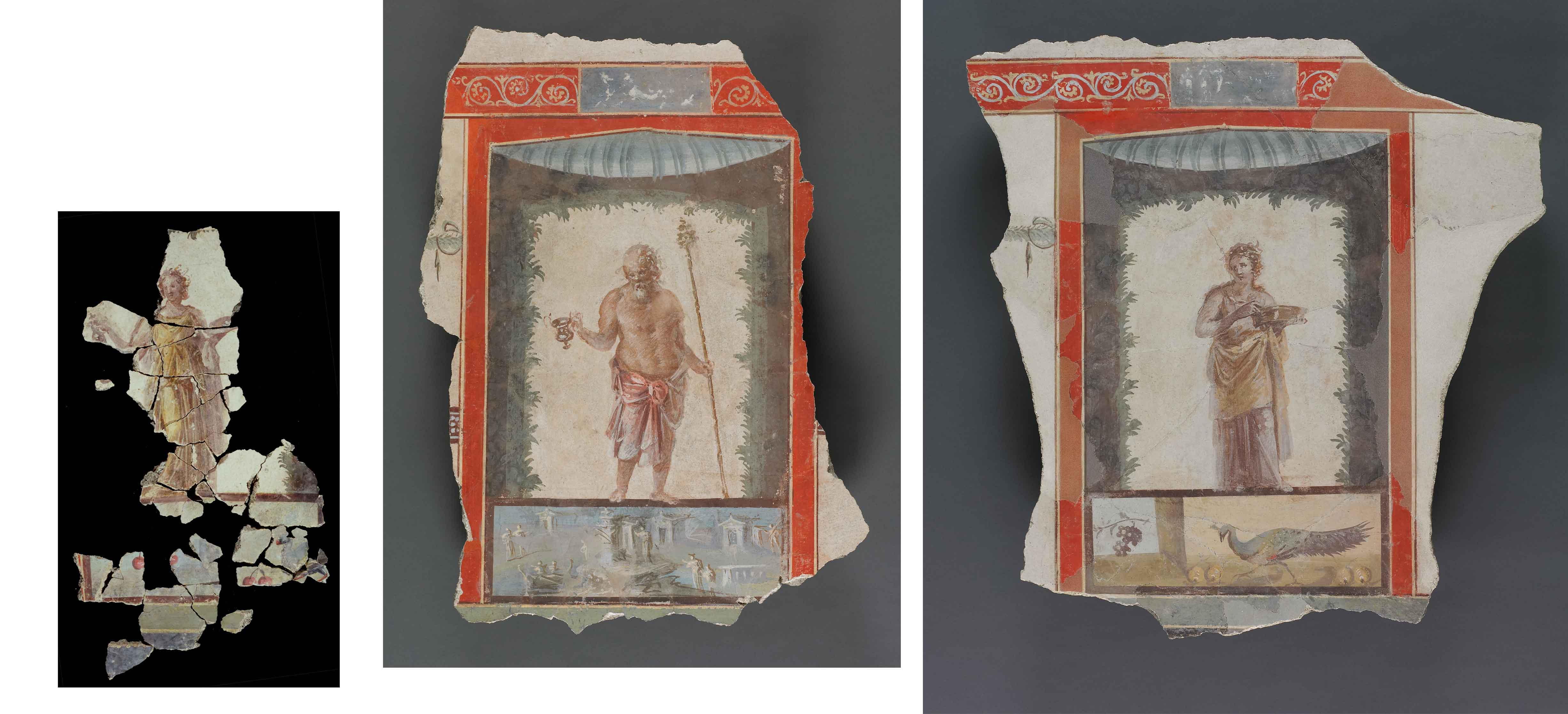
The press release mentions that the Royal-Athena Galleries have co-operated with the investigation suggesting that some of the other items were from that source (perhaps including a fragment of wall-painting).

I note that Christos Tsirogiannis was involved with some of the identifications. 

We await for a full list of the return.

| |
Bookmark and Share so Your Real Friends Know that You Know

Monday, 13 March 2023

UK Government and the Parthenon: Update

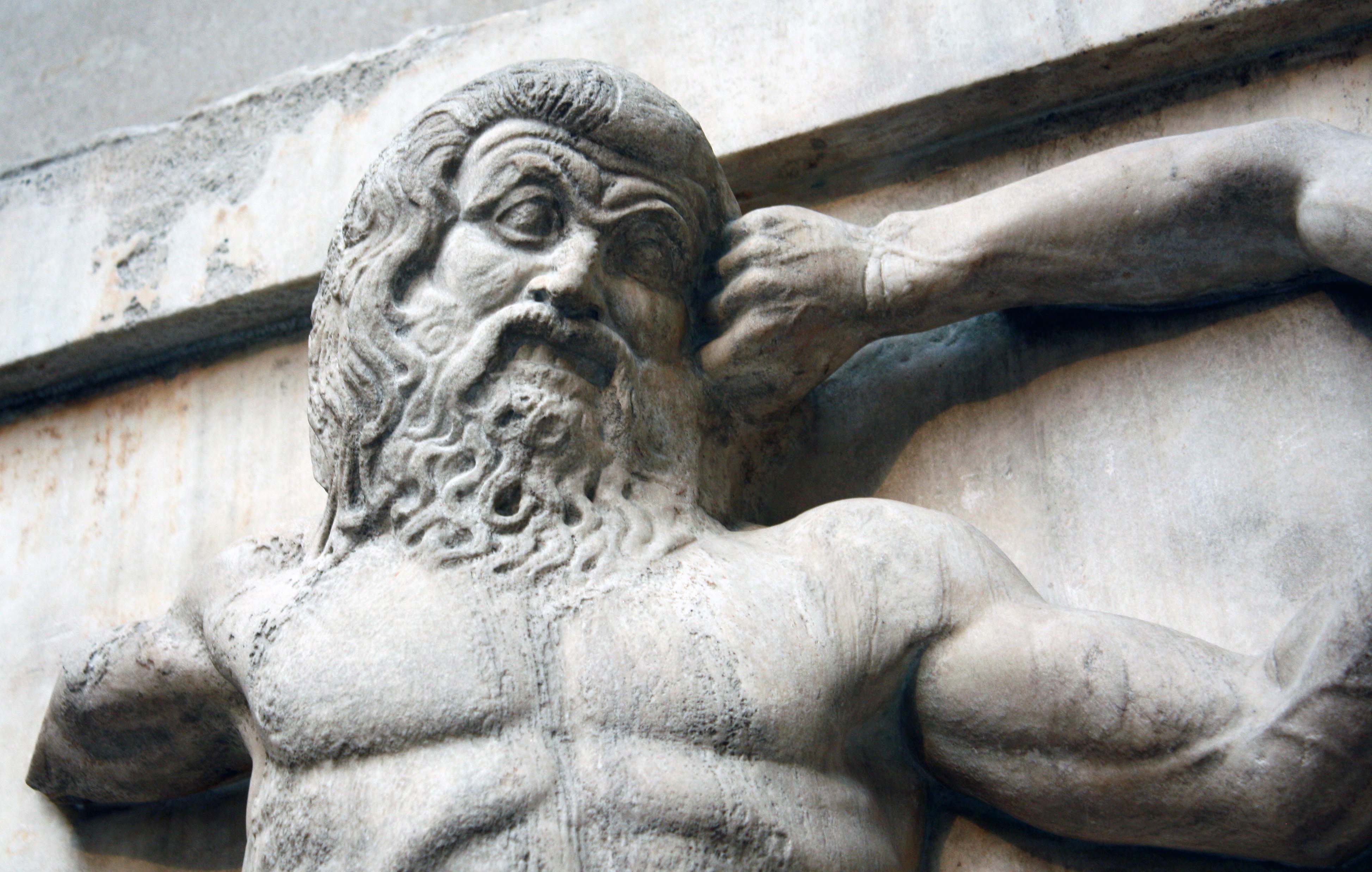
Parthenon metope in the British Museum © David Gill

British Prime Minister, Rishi Sunak, has commented on the proposal that the architectural sculptures from the Parthenon that are currently displayed in the British Museum should be returned to Greece. Nick Gutteridge, writing in the Daily Telegraph ("Elgin Marbles will not stay in Greece, says Rishi Sunak", March 13, 2023), quotes Sunak on the "Elgin marbles" (commenting, "Greece calls [them] the Parthenon marbles" - perhaps overlooking the fact that archaeologists also talk about the building from which they were removed):
“The UK has cared for the Elgin Marbles for generations. Our galleries and museums are funded by taxpayers because they are a huge asset to this country,”
Is he suggesting that because the sculptures have resided in London for 200 years that they should remain here? Is Sunak placing an economic value on the heritage assets that reside in the UK's museums and galleries?

Sunak is also quoted as saying, 
“We share their treasures with the world, and the world comes to the UK to see them. The collection of the British Museum is protected by law, and we have no plans to change it." 
Tourism seems to be the justification for the UK to retain the sculptures. 

The Times (London) indicated that Sunak was in favour of a temporary loan of (some of?) the sculptures to Greece (Chris Smyth, Oliver Wright, Richard Fletcher, "Rishi Sunak latest: PM unveils defence spending boost and submarine deal", March 13, 2023). The report noted:
However, the museum is banned by law from disposing of objects in its collection and Sunak said “we have no plans to change it”. It is understood that Sunak does not believe that a long-term loan would be in the spirit of the British Museum Act.
There is little understanding that the Parthenon architectural sculptures were designed to be part of a specific building that now forms part of the UNESCO World Heritage Site on the Athenian Acropolis.

See also D. W. J. Gill and C. Chippindale, "The trade in looted antiquities and the return of cultural property: a British parliamentary inquiry", International Journal of Cultural Property 11 (2002), 50-64. [DOI].


| |
Bookmark and Share so Your Real Friends Know that You Know

Wednesday, 15 February 2023

A Roman fresco fragment and some apparent cut marks

Malibu 83.AG.222.9
Source: J. Paul Getty Museum

Among the fresco panels and fragments from ‘a wealthy Roman’s seaside villa in the area of the Bay of Naples’ acquired by the J. Paul Getty Museum in 1983 from Palladion Antike Kunst is this panel with two fish (inv.  83.AG.222.9). Someone appears, at some point prior to acquisition, to have tried to cut a square panel from the fragment.  Why would they want to damage the panel in that way? 

Is this evidence of how the panel(s) was (were) removed from the archaeological context?  Or was someone trying to cut down the panel to make it easier to move? What would have happened to the remaining section of the fragment?

Such an indication is reminiscent of the panel returned from the Shelby White collection (no. 142; 86.2 cm by 86.5 cm) that came from the same composition as two fragments from the Fleischman collection and acquired (and returned) by the Getty (nos. 125 and 126; 91 cm by 80.5 cm, 61 cm by 81 cm). [See discussion here.]

| |
Bookmark and Share so Your Real Friends Know that You Know

Tuesday, 14 February 2023

Two octagonal panels probably from the Bay of Naples

Two octagonal panels. Malibu inv. 83.AG.222.5, 7

Yesterday I noted three panels apparently from the same room of a villa that probably stood somewhere in the vicinity of the Bay of Naples. Like the other panels, this pair of frescoes was derived from Palladion Antike Kunst in 1983. Unlike the other pieces these two are not currently on display. 

How did these fragments leave their villa and move to California? Will the curatorial team at the Getty be raising this with their Italian colleagues?


| |
Bookmark and Share so Your Real Friends Know that You Know

Monday, 13 February 2023

The frescoes from a wealthy seaside villa

Three panels acquired by the J. Paul Getty Museum in 1983.
Inv. 83.AG.222.2, 4, 8.

In 1983 the J. Paul Getty Museum acquired a series of Roman frescoes on the 'European market', in fact from Palladion Antike Kunst in Basel. The Getty's handbook suggests that they are derived from ‘a wealthy Roman’s seaside villa in the area of the Bay of Naples’. 

Elizabeth Marlowe has commented on the displayed fragments, suggesting that the panels had been removed from a single room somewhere in the vicinity of Vesuvius. Indeed, there are fragments that were acquired at the same time that clearly come from a third panel, presumably from the same room. Daniela Rizzo and Maurizio Pellegrini have recently drawn attention to the problematic nature of these frescoes and published an image of a further section of the decoration that appears in the Becchina photographic archive. 

How does the Getty interpret the history of the fragments? Is the museum actively seeking to return the sequence of fragments to Italy?


References
Lapatin, K. D. S., and K. Wright. Editors. 2010. The J. Paul Getty Museum: Handbook of the Antiquities Collection. Los Angeles: J. Paul Getty Museum.
Marlowe, E. 2020. "The reinstallation of the Getty Villa: plenty of beauty but only partial truth." AJA 124: 321–32. [Online]
Rizzo, D., and M. Pellegrini. 2021. "The Italian Archaeological Heritage Abroad: Between Agreements, Debates and Indifference." In Stolen Heritage: Multidisciplinary Perspectives on Illicit Trafficking of Cultural Heritage in the EU and the MENA Region, edited by A. Traviglia, L. Milano, C. Tonghini, and R. Giovanelli, Antichistica, vol. 29: 99–114. Venezia: Edizioni Ca’ Foscari. [Online]

| |
Bookmark and Share so Your Real Friends Know that You Know

Monday, 6 February 2023

From Geneva to Athens

L: source, Phoenix Ancient Art
R: source, Hellenic Ministry of Culture

The Hellenic Ministry of Culture has announced the return of 15 antiquities that had been seized from an unnamed antiquities gallery in Geneva [press release]. The Attic black-figured column-krater attributed to Lydos appears to be the one that features in the 2015 catalogue for Phoenix Ancient Art of Geneva and New York. Entry no. 4 shows the krater, reconstructed from 'large fragments', decorated with Herakles and the centaur Nessos. The entry suggests that it formed part of the Lambert collection in Neuchâtel prior to 1972 and then by descent through the family. 

Such histories may have to be treated with caution given the disagreement over the paths taken by the Ka-Nefer-Nefer coffin lid, the head of Drusus, and the Leutwitz Apollo. 

We do not know where the krater was unearthed, but northern Greece seems to be a likely possibility. 

I am grateful to a colleague in Italy who directed me to search the catalogue of Phoenix Ancient Art.

| |
Bookmark and Share so Your Real Friends Know that You Know

Saturday, 4 February 2023

Further returns to Italy from San Antonio Museum of Art and Shelby White

Oinochoe fragment
attributed to the Harrow painter
returned from
the San Antonio Museum of Art.
Source: San Antonio Museum of Art

The Manhattan DA has reportedly returned 14 more antiquities to Italy: though the objects and images presented at the press announcement counted 16 ("D.A. Bragg Returns 14 Stolen Antiquities to Italy", Manhattan DA February 2, 2023). Two sources were acknowledged: Shelby White and the San Antonio Museum of Art. The third, the source of a silver coin, was left anonymous in the press release.

At least three of the objects appear in the Glories of the Past catalogue of the Shelby White and Leon Levy collection. The release gives further information about the Attic black-figured hydria attributed to the Priam painter.
The piece first surfaced in Italy after being looted by Giovanni Franco Becchina, a well-known antiquities trafficker. From Italy, the piece was then smuggled and laundered by Paris-based Robert Hecht. Hecht ultimately sold the piece with false provenance to Shelby White in New York County in 1989.
These add to the 14 pieces featured in the catalogue that have been returned to Greece, Italy and Turkey.

The nine pieces featured in the images at the press statement are derived from the San Antonio Museum of Art. The objects are derived from several sources: Sotheby's in London; Christie's in London and Geneva; Galerie Palladion Antike Kunst; Galerie Günter Puhze; Royal Athena Galleries; Robin Symes. For example, the oinochoe fragment attributed to the Harrow painter surfaced through Galerie Palladion Antike Kunst, and was sold to Gilbert M. Denman, Jr. by Robert Hecht.  The nine objects may be added to other pieces that were handed over in 2022. We are also expecting further details about three other objects derived from Frederick Schultz that have been handed over by the museum. 

Three other objects featuring in the press statement have yet to be linked in a formal way to a specific collection though Christos Tsirogiannis has identified two of them in the Becchina archive and one in the Schinousa archive. 

The final piece is a silver coin.
The Sicily Naxos Coin. Minted circa 430 B.C.E in the Greek colony of Naxos, on Sicily, this silver coin features the bearded Dionysus on one side and his squatting drinking partner, Silenus, on the reverse. The Sicily Naxos Coin first surfaced on the international art market in 2013, when a known trafficker offered the coin for sale with no provenance whatsoever. Prior to its appearance at a London-based auction house, a co-conspirator of the trafficker supplied false provenance for the coin. The Sicily Naxos Coin is currently valued at $500,000 and was among a group of coins seized at JFK airport as it was being smuggled into New York pursuant to an ongoing joint investigation between this Office, HSI, and Italy. At least one individual has been arrested in the course of this investigation with more to follow.
Three Shelby White pieces, nine objects from San Antonio, one silver coin, and three other pieces equal 16 objects (not 14).

Objects from the San Antonio Museum of Art and in the Shelby White and Leon Levy collection were the subject of an extended discussion by Chippindale and Gill in the American Journal of Archaeology back in 2000. 
Chippindale, C., and D. W. J. Gill. 2000. "Material consequences of contemporary classical collecting." AJA 104: 463-511. [DOI]
LM expects to add further detail to this summary in due course.

| |
Bookmark and Share so Your Real Friends Know that You Know

Further returns to Italy from the MMA

Formerly New York MMA 1991.11.6.1–2. Source: MMA New York's Metropolitan Museum of Art has returned another batch of Greek and Roman ant...