Thursday, 6 February 2014

"Looking at persuasive circumstantial evidence"

Returned from Dallas.
Source: Dallas Museum of Art
Julia Halperin and Javier Pes have written about the attitude of North American museums towards repatriation ("US museums' about-face on restitution", The Art Newspaper, February 2014). There are comments from Kaywin Feldman, director of the Minneapolis Institute of Arts, who now holds a more informed position than the one presented in December 2010: "It’s been a landslide change in collecting policy, procedures and ethics". There is a reference to the return of the Athenian red-figured krater (September 2011) that was recognised from the Medici Dossier and thence to hands of Robin Symes. Maxwell Anderson was also interview indicating his proactive position that led to the voluntary return of a range of objects from Dallas.

Feldman reports that some potential donors are "frustrated" by the new AAMD Guidelines. But it has probably saved some potentially damaging acquisitions. And Fordham University would have been wise to have researched a donation from a private collection.

The report mentions the Egyptian mummy mask in the St Louis Art Museum that is known to have been excavated at Saqqara but somehow left its place in an archaeological store. Although the collecting history that was provided cannot be accurate, an official from SLAM was quoted as saying that the museum's "position on its legal ownership of the mask has not changed". This position contrasts with Anderson's transparent ethical stance for Dallas.

I am quoted in the report and call for improved documentation for acquired objects. Published collecting histories need to demonstrate the authenticated sources.

And the Art Newspaper notes that social media allow individuals to identify material that has been acquired my museums. So we can expect more returns.

Bookmark and Share so Your Real Friends Know that You Know

Tuesday, 4 February 2014

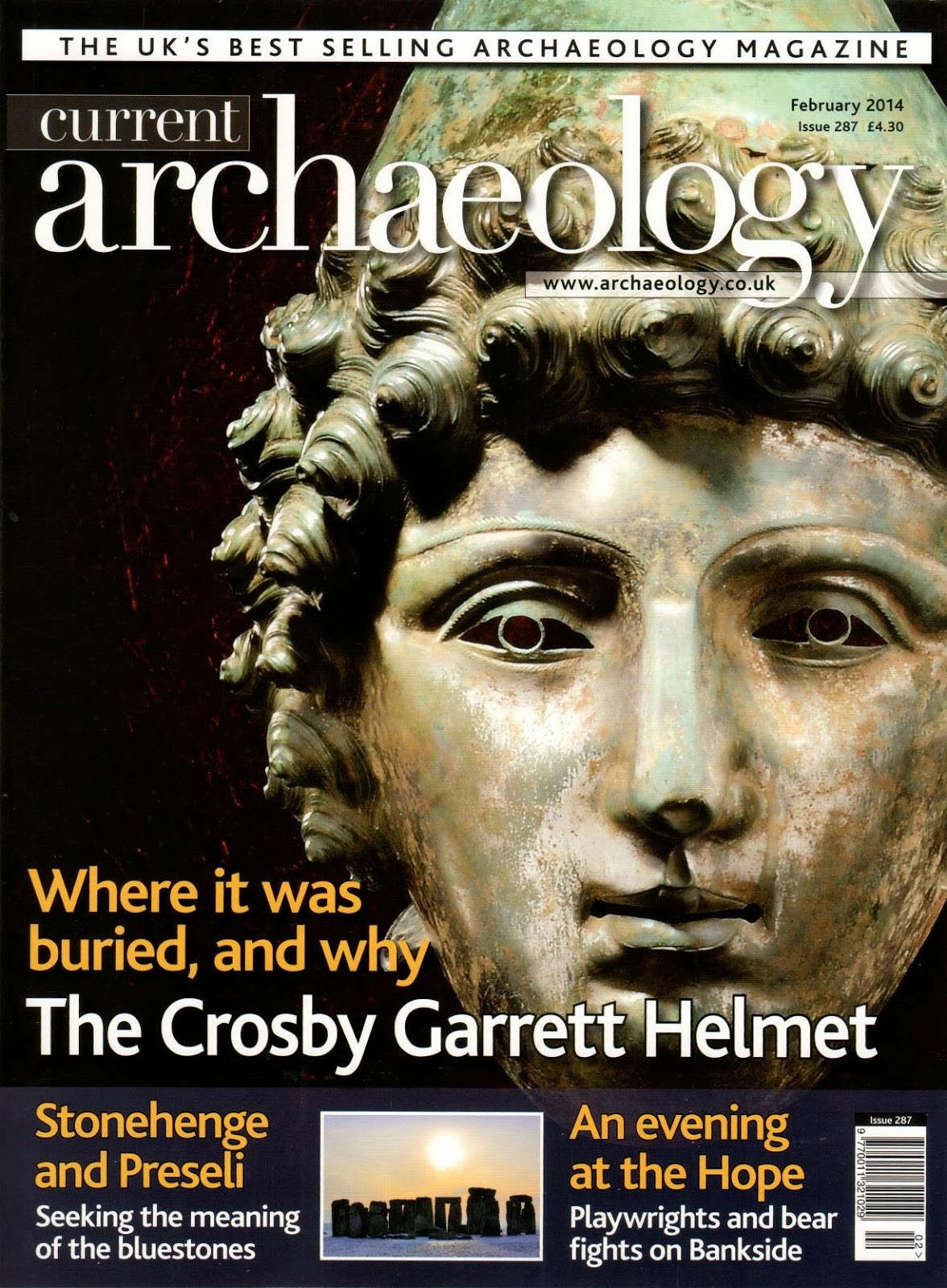
Legal Fibbery and the so-called Crosby Garrett helmet

The Heritage Journal has discussed my scepticism about the alleged find-spot of the so-called Crosby Garrett helmet.

There is an interesting expansion on legal "fibbery" and HJ rightly wonders how many objects in the PAS database have falsified find-spots.

This is a wider issue. Anyone following the Nostoi debate relating to antiquities returned from North American collections will know that collecting histories can be fabricated.

Bookmark and Share so Your Real Friends Know that You Know

Monday, 3 February 2014

The Sappho Papyrus

It would be interesting to know the full and authenticated collecting history of the new Sappho Papyrus fragment that is due to be published in ZPE by Professor Dirk Obbink from Oxford (see press release from Christ Church). A news report (James Romm, "Scholars Discover New Poems from Ancient Greek Poetess Sappho", Daily Beast January 28, 2014) suggests:
The new Sappho papyrus probably came from Egypt and perhaps from Oxyrynchus, but its provenance may never be known. A thriving black market for papyri means that many of them emerge not from archaeological digs but from souks, bazaars and antiquities shops.
Part of the collecting history is known (but not made public): it is owned by an anonymous collector. Where and when did this anonymous collector acquire the fragment? When did it leave Egypt?

The online preprint (to ZPE 189 [2014]) is no longer available. However a translation by Tim Whitmarsh is available from The Guardian and another by Steve Dodson.

ZPE was also due to be the place of publication for the Fordham mosaics apparently derived from a Christian church in Syria. In 2012 there was debate about a new papyrus fragment from a German collection.


Bookmark and Share so Your Real Friends Know that You Know

Saturday, 1 February 2014

The Apollo from Gaza

Vernon Silver has reported on the alleged discovery of a classical bronze in the sea off Deir al-Balah, in the Gaza strip ("The Apollo of Gaza: Hamas's Ancient Bronze Statue", Bloomberg Business Week, January 31, 2014). The bronze statue, nearly 2 m long, was found in 4-5 metres of water in mid-August 2013. The surprising thing, as Silver points out, is that the statue shows little evidence that it was submerged in the sea for centuries. Is the reported find-spot a blind to distract the authorities from a 'productive' site?

Bookmark and Share so Your Real Friends Know that You Know

The Bubon Caracalla at Fordham

The Fire of Hephaistos gives a brief mention of the bronze head of Caracalla that was removed from the Sebasteion at Bubon in Turkey (and others appear in the catalogue). The same head is mentioned in Gill and Chippindale, "Material consequences of contemporary classical collecting", AJA 104 (2000).

And now this head appears in the Fordham University Collection inv. 7.068: "it has been suggested that the Fordham example may have belonged to a large statue group of Roman emperors from a Sebasteion in the city of Bubon". Indeed it has been suggested that the head fits the headless statue in Houston Museum of Fine Arts (also apparently one of the Bubon statues).

The curatorial team at Fordham may be unaware of the issues surrounding Bubon. But I hope that one of them will do the honourable thing and contact the cultural attache at the Turkish Embassy.

Bookmark and Share so Your Real Friends Know that You Know

Friday, 31 January 2014

Fordham, The Walsh Collection and Collecting Histories


I have been working my way through Barbara Cavaliere and Jennifer Udell (ed.), Ancient Mediterranean Art: The William D. and Jane Walsh Collection at Fordham University (New York: Fordham University Press, 2012) [Review in BMCR].

I was disappointed in the presentation of the catalogue. Where are the full collecting histories for each piece? How did they enter the Walsh collection? When? Who were the previous owners?

The limited information is likely to be significant.

The entries for the coins (nos. 93-103) do not contain collecting histories.

Some of the information on the antiquities includes:

Atlantis Antiquities, New York
Greek and Etruscan Art (1988): no. 16, cup fragment

Christie's, New York
1995, December 7, lot 98: inv. 4.016, Faliscan stamnos
1999, June 4, lot 11: no. 11, Attic neck-amphora; lot 26, no. 35, terracotta Eros; lot 32, no. 36, terracotta thymiaterion; lot 52, no. 33, Gnathian situla; lot 72, inv. 7.050, Etruscan kylix; lot 74, inv. 7.024, Etruscan chalice
1999, June 6, lot 42: inv. 5.001, Apulian hydria
2000, December 7, lot 576: inv. 11.002, Roman portrait
2002, December 12, lot 81: inv. 4.018, Etruscan neck-amphora; lot 132 ($11,353): no. 19, Attic bell-krater; lot 134 ($7170), inv. 7.029, Tarentine water-spout; lot 148: inv. 4.004, Apulian volute-krater; lot 260 ($2629): inv. 3.013, marble eagle
2003, June 11, lot 206 ($71,700): no.79, portrait of Caracalla
2003, December 11, lot 233 ($47,800): no. 81, Severan female portrait
2005, June 8, lot 112 ($18,000): inv. 2.006, Canosan askos; lot 113 ($9600): inv. 3.011, 3.014, pair of theatrical masks
2005, December 9, lot 259 ($3840): inv. 7.023, Apulian plate
2008, June 4, lot 146 ($3500): no. 83, glass cosmetic jar, no. 84, glass bottle, no. 85, glass flask, no. 86, glass beaker, no. 87, glass bottle, no. 88, glass amphoriskos, no. 89, glass unguentarium; lot 174 ($6875): no. 10, Attic lekythos; lot 181 ($22,500): no. 16, cup fragment

Charles Ede, London
Prior to July 1992: no. 11, Attic neck-amphora

Galerie Blondeel-Deroyen, Paris
1999: no. 79, portrait of Caracalla

Archeologia, Montreal
1992: inv. 7.023, Apulian plate

Rome market
1966: inv. 7.020, Apulian epichysis

Sotheby's, London
1967, June 12, lot 152: no. 80, bronze portrait of Caracalla
1983, December 12-13, lot 403: no. 25, Apulian patera
1987, July 13, lot 298: no. 25, Apulian patera
1989, December 11, lot 167: no. 25, Apulian patera
1990, December 13-14, lot 288: no. 20, Apulian column-krater

Sotheby's, New York
1989, June 23, lot 419: no. 10, Attic lekythos [not mentioned in catalogue]
1991, June 18, lot 228: inv. 3.013, marble eagle

Collectors
Ambassador Edward Elliot Elson: no. 83, glass jar; no. 84, glass bottle; no. 85, glass flask; no. 86, glass beaker; no. 87, glass bottle; no. 88, glass amphoriskos; no. 89, glass unguentarium
Daniel Friedenberg: inv. 3.013, marble eagle
Sigmund S. Harrison, Philadelphia: no. 10, Attic lekythos [not mentioned in catalogue]
William and Linda Houston, London: no. 11, Attic neck-amphora; no. 33, Gnathian situla
William Suddaby: inv. 7.023, Apulian plate
Alfred Wolkenberg: no. 86, glass beaker

American private collection, acquired in 1983: inv. 2.006, Canosan askos [not mentioned in catalogue]
European private collection: no. 19, Attic bell-krater
German private collection: no. 81, Severan female portrait [not mentioned in catalogue]
New York private collection: no.79, portrait of Caracalla [not mentioned in catalogue]
Turin, private collection: no. 29, Paestan lekythos

Bookmark and Share so Your Real Friends Know that You Know

Thursday, 30 January 2014

Fordham's Villanovan Hut

It appears that Fordham University is not a stranger to "illicit antiquities". It appears that an impasto "cinerary hut urn" (inv. 4.021) given to the university by William and Jane Walsh (presumably in 2006) had an interesting collecting history. Jennifer Udell has stated that the urn was "illegally excavated, exported, and sold at auction". In fact, the urn was not "excavated" but rather "dug up" or "looted". And where was it sold at auction?

In 2010 the legal title to the hut was handed over to Italy, and the Italian authorities have placed the hut on long-term loan at Fordham.

Interestingly there does not appear to be anything in the press releases for Fordham or the Italian Ministry of Culture. But credit to Udell for making this information public.

We should not forget the bronze Villanovan hut in Princeton. Will that be handed over to the Italian authorities?

Bookmark and Share so Your Real Friends Know that You Know

The Afrati Armour in Harvard

Source: Harvard Art Museums The repatriation of the Afrati armour from New York's Metropolitan Museum of Art has implications for other ...