Monday, 28 February 2022

Apulian grave group in Berlin subject to Italian court order

Apulian grave group currently in Berlin
© David Gill

The apparent grave group consisting of Apulian pottery now in Berlin is the subject of a court order from the Tribunale di Roma ("Scoppia la "guerra" dell'arte Italia-Germania. Il tribunale di Roma confisca 21 vasi al museo di Berlino", ItTempo.it February 25, 2022). The group has been the subject of discussion by LM back in 2007. Three of the volute-kraters are attributed to the Darius painter. This painter was the subject of an exhibition in Geneva: 
Aellen, Christian, Alexandre Cambitoglou, and Jacques Chamay. 1986. Le Peintre de Darius et son Milieu: Vases grecs d'Italie méridionale. Hellas et Roma, vol. 4. Geneva: Association Hellas et Roma.
The Berlin pots were acquired in 1983 (and accessioned in 1984), and they appear in the Medici Dossier. 

The acquisition record links the group to Jacques Chamay of Geneva's Museum of Art and History. 
«l’organo giudicante evidenziava una complicità con Medici degli indagati Jacques Chamay, all’epoca direttore del museo archeologico di Ginevra, e Fiorella Cottier Angeli, restauratrice, nella vendita al museo archeologico di Berlino dei 21 vasi».
It has been suggested that the grave group had once resided in a 19th century collection but there does not appear to be any authenticated documentation to support this claim. 

Will Berlin finally return this group to Italy?

| |
Bookmark and Share so Your Real Friends Know that You Know

Thursday, 24 February 2022

Steinhardt Antiquities Returned to Greece

Kouros seized from the Steinhardt Collection
Source: Manhattan DA

Antiquities worth some $20 million that were seized from the collection of Michael Steinhardt have been handed over to Greece (Press Release, "55 Antiquities Valued at More Than $20 Million Repatriated to the People of Greece", February 2022). 

The kouros as well as a Minoan hoard were all acquired from Robert Hecht. 

The release also notes: "Eight other pieces that were seized pursuant to another ongoing investigation were also repatriated." Does this mean that there is due to be another announcement?

LM listed the antiquities that would be returning to Greece back in December 2021. 

Monday, 24 January 2022

The whole history of a Little Master cup

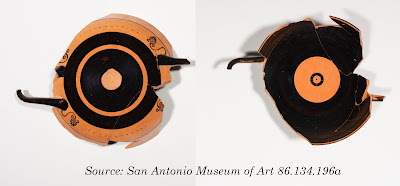
These fragments of an Athenian Little Master cup, decorated with 'nonsense' inscriptions are among the pieces being returned to Italy by the San Antonio Museum of Art.

It is a reminder of the way that museums restrict information. The published catalogue, by H. Alan Shapiro, Carlos A. Picón and Gerry D. Scott III merely note that it was a gift of Gilbert M. Denman, Jr in 1986. The Beazley Archive records nothing about its history (BAPD 20266). Yet now it seems that the fragments, including this Little Master cup, had been found at Barbarano Romano, and had been purchased by Edoardo Almagià in 1985. How was such information deemed to have been unknown to those preparing the catalogue? 

Were these fragments processed by Almagià with the help of an academic?

Are there other pieces remaining in San Antonio that also derive from Barbarano Romano or other sites in Italy?

Why were such large numbers of fragments acquired by San Antonio? Was there an expectation that other fragments from these figure-decorated pots would be acquired in future years? Was the museum following the pattern of other collections? 


| |
Bookmark and Share so Your Real Friends Know that You Know

Friday, 21 January 2022

Weiss coins return to Turkey


LM has covered the story of Arnold Peter Weiss on previous occasions. It was announced today that 14 coins from the collection of Weiss have been returned to Turkey ("D.A. Bragg: 28 Antiquities Repatriated to the People of Turkey", press release January 21, 2022). Alongside the return of antiquities from the Steinhardt collection it was announced: "Twelve of the coins, with a collective value of $58,000, from WEISS’ collection were repatriated to Turkey as part of today’s ceremony."

This is in addition to the coins returned to Greece.

Coin collectors should note the reminder:
As part of his plea agreement and sentence, WEISS agreed to forfeit 23 coins in his possession, pay a criminal fine, perform 70 hours of community service, and author an article for the American Numismatic Society Magazine detailing the dangers of collecting unprovenanced coins.

| |
Bookmark and Share so Your Real Friends Know that You Know

Steinhardt antiquities return to Turkey

Silver rhyton
Source: Manhattan DA

The Manhattan DA has announced that 14 antiquities from the Michael Steinhardt collection have been returned to Turkey ("D.A. Bragg: 28 Antiquities Repatriated to the People of Turkey", press release January 21, 2022).

Among them is an important silver stag's head rhyton that is reported to have been found at Milas, Turkey. Steinhardt purchased the piece from the Merrin Gallery on November 22, 1991 for $2,600,000, and subsequently placed it on loan to New York's Metropolitan Museum of Art on March 11, 1993.

This is not the only ex Merrin piece to have been placed on loan to the Metropolitan Museum of Art. 
| |
Bookmark and Share so Your Real Friends Know that You Know

Thursday, 20 January 2022

The Steinhardt Returns: The Implications for the Michael C. Carlos Museum

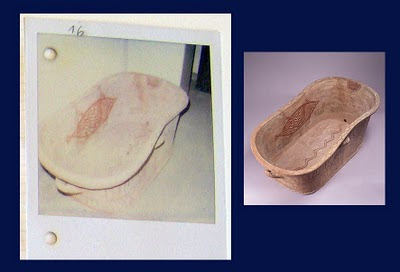
Left: Larnax shown in the Becchina archive
Right: larnax in the Michael C. Carlos Museum

The return of the Steinhardt Minoan larnax to Greece has implications for the Michael C. Carlos Museum at Emory University as it appears in the Statement of Facts. 

Back in 2007 the larnax was identified by Associate Professor Christos Tsirogiannis; it had been acquired by the museum in 2002. 

Why have the authorities at the Michael C. Carlos Museum yet to resolve this long-standing request from the Hellenic authorities? Could the return of the Steinhardt larnax be the prompt that will allow them to take the appropriate action? 

| |
Bookmark and Share so Your Real Friends Know that You Know

Monday, 17 January 2022

The ownership trail of an Apulian krater

Apulian volute-krater
attributed to the Virginia Exhibition painter
Source: Fordham University

In February 2018 I drew attention to the Fordham Apulian volute-krater, attributed to the Virginia Exhibition painter, and its association with Edoardo Almagià (formerly inv. 8.001). I subsequently asked the question, 'Has the curatorial team at Fordham contacted the Italian authorities to check the history of the Apulian krater?' One of my concerns was that the name of the pot-painter is derived from the display, at Virginia, of five pieces all said, according to Dale Trendall, 'to come from the same tomb'. We do not, however, know the location of that tomb.

The krater was presented to Fordham in 2006 by William D. Walsh. Walsh had declared that it had been purchased from Arte Primitivo in 1994. Yet Trendall and Cambitoglou recorded the krater in 1992 as residing with Almagià on the New York market.

What other pieces from the Walsh collection were acquired from Arte Primitivo? When did the Apulian krater pass from Almagià to Arte Primitivo?

| |
Bookmark and Share so Your Real Friends Know that You Know

Krater fragments in Princeton

Greek, Attic, probably by the Kleophrades Painter, ca. 490–480 BCE, Two non-joining fragments from a calyx-krater (mixing bowl) depicting ar...