Showing posts sorted by date for query euphronios. Sort by relevance Show all posts

Thursday, 6 January 2022

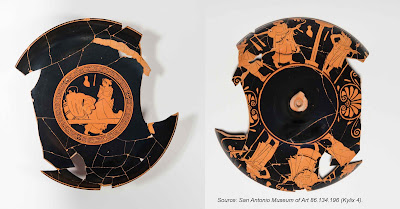
Broken pot fragments matter

Source: San Antonio Museum of Art

Among the material linked to Edoardo Almagià  and returning to Italy are 192 Attic cup fragments from the San Antonio Museum of Art. These are in addition to the calyx-krater fragments attributed to Euphronios that were returned from Princeton University Art Museum. 

These returns challenge the belittling of the issue by James Cuno who used the example of the 200 or so fragments acquired by Harvard as part of his attack on those who would wish to see a more rigorous approach to museum acquisitions. Harvard will no doubt be looking again at the histories of the fragments. Were any acquired from a New York based dealer? Have connections been made with fragments in other collections?

|
Bookmark and Share so Your Real Friends Know that You Know

Tuesday, 31 March 2020

Questions about the source of a dealer's fragments

I am working on the sources of Attic figure-decorated pottery fragments at the moment. I was interested to see that two fragments of a cup attributed to Euphronios by J.R. Guy (Euphronios no. 50) that had been on loan to Princeton University Art Museum (L.1990.134a–b) are now in the Michael C. Carlos Museum (2005.026.004A [and B?]). (I presume that the other fragment was acquired as the kalos inscription naming Lea]gr[os is on the second fragment. (Does the date for Leagros kalos need to be adjusted?)

The history of the fragment is provided as follows:
Ex coll. Peter Sharrer, New Jersey, acquired European art market, 1982-1983. Purchased by MCCM from Sotheby's New York, June 7, 2005, lot 26.
Sotheby's note the following:
acquired together on the European art market in 1982/1983 as part of a group of fragments by various painters
What were the other fragments acquired by Sharrer in 1982/83? Where are they now? Who acquired them?

But the more interesting question relates to the identity of the "European art market". Who was involved?

Why the interest in Sharrer? He supplied a fragmentary Roman relief to Princeton University Art Museum in 1985 that was returned to Italy in 2002 after it was realised that it had been found near Tivoli. Moreover, Sharrer was the source of a fragmentary Attic figure-decorated lekythos attributed to the Pan painter that was donated to Princeton in 1998 and again returned to Italy.

Were any of the pot fragments sold by Sharrer to another major North American university museum also derived from the same "European art market"?

Bookmark and Share so Your Real Friends Know that You Know

Tuesday, 8 November 2016

The Medici Dossier and the James Chesterman collection

Images from Medici Dossier. Source: Dr Christos Tsirogiannis.
Dr Christos Tsirogiannis has made another identification from the Medici Dossier. The piece in question is a 6th century BC Etruscan terracotta antefix that is due to be auctioned in London later this month (Bonhams 30 November 2016, lot 14). The collecting history ("provenance") is given as:
  • James Chesterman Collection (1926-2014), formed in the UK in the 1970s-2000. 
  • With À la Reine Margot, Paris, acquired in December 1986.
The antefix appears in two images, one as a standard Polaroid, the other as a record card for the Hydra Gallery. Hydra Galerie has been associated with Medici and has been discussed before, for example:
It is not clear why Bonham's has not mentioned Hydra Galerie in the collecting history. But note that on the card there is the annotation that the piece was to be assigned "v[ia] Londr[a]" with a value of $1,500.

The association with James Chesterman clearly has implications. I have listed some of his terracottas (and the associated bibliography) in:
  • David W. J. Gill. “Museum Supplement: Recent Acquisitions by the Fitzwilliam Museum, Cambridge, 1971-1989.” The Journal of Hellenic Studies 110 (1990), pp. 290–294. www.jstor.org/stable/631820.
I note that among the three examples I described was one that was acquired from N. Koutoulakis.

This new identification yet again raises issues about the due diligence process conducted by and on behalf of the auction houses. Staff at Bonhams are, I am sure, aware that the Cultural Property (Armed Conflicts) Bill is passing through the UK Parliament at the moment and that it is in the interest of those involved with the sale of archaeological material to be seen to be taking action when concerns are raised about objects that surface on the market.

I understand that the relevant authorities in Italy and the UK have been informed.

For further discussion of the antefix see ARCA.

Bookmark and Share so Your Real Friends Know that You Know

Saturday, 15 November 2014

Nelson Bunker Hunt

The death of collector Nelson Bunker Hunt was announced in October 2014. A number of obituaries have appeared in the British press:


Only the Telegraph mentioned his collections of antiquities and coins:
Forced into personal bankruptcy that required them to liquidate assets, the brothers auctioned off immense collections of Greek, Roman, Byzantine and Islamic coins, raising more than $30 million. Sotheby’s in New York sold their art collections, and they were even forced to offload household items, including an enamel teapot which went for $20.
The frontispiece of the 1983 catalogue was the Etruscan terracotta antefix that was acquired by Laurence and Barbara Flieschman and returned to Italy from the J. Paul Getty Museum. The cover shows the Kyknos krater that was returned to Italy by Shelby White.

The Euphronios cup from the Hunt collection is the starting point for Vernon's Silver's The Lost Chalice.

As I noted back in 2008 the returns to Italy included pieces from significant North American private collectors.

Bookmark and Share so Your Real Friends Know that You Know

Wednesday, 7 May 2014

The Onesimos-Euphronios cup returns to Cerveteri

The Onesimos-Euphronios red-figured cup that was returned from the J. Paul Getty Museum to Italy will be placed on display in Cerveteri (ANSA), the find-spot of further confiscated pieces. The cup is inscribed with a dedicated showing that it had been placed in a sanctuary of Ercle at Cerveteri. Additional fragments are known to have been supplied by Giacomo Medici. (For collecting history see here.)

Will this allow further information to emerge about the Met fragments?

Bookmark and Share so Your Real Friends Know that You Know

Thursday, 3 October 2013

"Why art museums must continue to collect"

David Franklin, Sarah S. and Alexander M. Cutler Director of the Cleveland Museum of Art, has written the foreword to Michael Bennett's provocative Praxiteles: The Cleveland Apollo (Cleveland Museum of Art, 2013). Franklin, whose expertise does not lie in archaeology or "ancient art", claims that the book "makes an important contribution to the current debate over collecting antiquities by presenting a much-need curatorial viewpoint". Franklin, who does not appear to understand the intellectual consequences of collecting (and Bennett overlooks such studies in his bibliography), suggests that the acquisition of recently-surfaced antiquities leads to "the preservation of knowledge".

Bennett would have done well to have read my study of the material and intellectual consequences of collecting the Sarpedon krater [see here] before trotting out a stale and lightweight assessment of the Euphronios krater returned to Italy by New York's Metropolitan Museum of Art [pp. 32-33, fig. 36]. His treatment of the "hot pot" (as it was known) betrays his thinking about how to approach objects that have been removed from their archaeological context.

Bennett fails to take the opportunity in his essay to explain why the Cleveland Museum of Art returned so many classical antiquities to Italy. Indeed there could have been a helpful discussion of why the museum acquired them in the first place. More telling would have been the unwillingness of the museum to disclose the collecting histories of the items. Which dealers were involved?

I am looking forward to reflecting on the book over the next few weeks and to explore the "German" collecting history in more detail, especially in the light of another (apparently flawed) collecting history from the same Swiss dealer.

Bennett may have opened a Pandora's Box of issues that Franklin may wish, with hindsight, had remained firmly closed.

Bookmark and Share so Your Real Friends Know that You Know

Wednesday, 4 September 2013

Euphronios fragments at the Met

The announcement that pot fragments formerly owned by Dietrich von Bothmer have been returned to Italy raises an issue. What are the collecting histories for other Bothmer donations?

I am particularly interested in Euphronios at the moment and note that Bothmer donated the following fragments to the New York MMA.

  1. 1977.192.3a-c. 3 fragments of a red-figured cup. Attributed to Onesimos and signed by Euphronios as potter.
  2. 1983.524.2. Fragment of a neck-amphora. [Euphronios no. 24]
  3. 1983.524.3a-b. 2 fragments of a cup potterd by Kachrylion and attributed to Euphronios. [Euphronios no. 39]
  4. 1983.524.4. Fragment of a cup attributed to Euphronios. [Euphronios no. 40]
  5. 1983.524.5. Fragment of a cup attributed to Euphronios.
  6. 1985.228.8.a-o. 15 fragments of a red-figured neck-amphora. Join Louvre Cp 11187. [Euphronios no. 16]
  7. 1988.233.1. Fragment of red-figured cup attributed to Euphronios.
  8. 1989.382.1. 11 fragments of a red-figured cup. Helen abducted by Theseus. [Euphronios no. 38]
  9. 1989.382.2. Fragment of a red-figured cup. Nessos and Deianeira. [Euphronios no. 52]

Where were these neck-amphorae and cups discovered? Who has handled them? Who were the proprietors before Bothmer? What do they join?

I also note that the fragment formerly owned by Ariel Herrmann and loaned to Princeton (L.1984.56 = Euphronios no. 25) now is New York MMA 2001.563 (Gift of Ariel Herrmann in memory of Lydia Mannara). This was attributed by J.R. Guy, along with a second fragment, Princeton L.1984.57 [Euphronios no. 26].

Bookmark and Share so Your Real Friends Know that You Know

Wednesday, 23 May 2012

The Sarpedon krater: intellectual consequences

My essay on the material and intellectual consequences of the Metropolitan Museum of Art's acquisition of the Sarpedon krater has appeared in a new volume. The research develops the themes explored in earlier published work on Cycladic figures and mapped onto Athenian figure-decorated pottery.

I cover the following themes:

  • History of acquisition
  • The lost archaeological context
  • Find-spots for Euphronios
  • Leagros kalos
  • Interpreting the iconography in an Etruscan context
  • High art?
  • Philippe de Montebello on the Sarpedon krater
  • A motif for recently surfaced antiquities
  • A motif for repatriation: "Successo storico"

There are nine essays in the volume.

Gill, D. W. J. 2012. "The material and intellectual consequences of acquiring the Sarpedon krater." In All the King's Horses: essays on the impact of looting and the illicit antiquities trade on our knowledge of the past, edited by P. K. Lazrus and A. W. Barker: 25-42. Washington DC: Society for American Archaeology.  [SAA website]

Bookmark and Share so Your Real Friends Know that You Know

Thursday, 26 January 2012

What has Princeton returned?

Source: MiBAC
Princeton has been reluctant to provide specific details of what has been returned to Italy. So here is a possible list based on the MiBAC and Princeton press releases. I have also looked back to the original report that appeared in the New York Times (see here). It appears that the returned items were acquired between 1993 and 2002.

a. "a black-glazed askos" / "un askos a forma di astragalo". Apparently 2002-156. "Gift in memory of Emily Townsend Vermeule, Honorary Degree Holder of the Class of 1989". [Published 2003]

b. "a pair of female statuettes" / "due statuette di donna, di cui una che suona un tamburello e l'altra la lira". Apparently y1993-28, and y1993-28. Canosan "statuette of a woman playing a tambourine" and "playing a lyre". Both Museum purchase and source unstated. [Published 1994]

c. "four fragments of a red-figure calyx krater" / "quattro [frammenti] di un cratere a figure rosse" / "a calyx krater attributed to the Attic vase painter Euphronios". I have noted before: "The calyx-krater fragments, attributed to Euphronios by Padgett, appear to be the ones that were acquired in 1997: J. Michael Padgett, "Ajax and Achilles on a Calyx-Krater by Euphronios", Record of the Art Museum, Princeton University 60 (2001) 2-17 [JSTOR]." Acquisition: 1997-488 a-d. "Four fragments from a red-figure calyx-krater, attributed to Euphronios [Padgett]". "Museum purchase, Fowler McCormick, Class of 1921, Fund". Padgett had noted: "The findspot of the fragments is unknown".

d. "fragments of an architectural relief" / "cinque [frammenti] di rilievi architettonici". This appears to be this group: Etruscan "fragment of an architectural relief (joins 1995-127)". Gift of Edoardo C. Almagià, Class of 1973 (1999-4). Edoardo C. Almagià gave four architectural reliefs in 1995: 1995-125, 126, 127, 128. [It should be noted that 1995-129, "Etruscan fragment of a polychrome architectural relief of a centaur", gift of Ali and Hicham Aboutaam, has been returned to Italy on a previous occasion.]

e. "a pithos in white-on-red style" / "un pithos a figure rosse e bianche, raffiguarante animali". Apparently 1999-8. Gift of Edoardo C. Almagià ... in honor of Allen Rosenbaum. [See here]

f. "a group of fragmentary architectural revetments"  / "un gruppo di 157 elementi architetettonici con figure di tori" / "a group of Etruscan architectural terra-cottas". These would appear to be: Group of Etruscan "fragmentary revetments with painted and relief decoration ... Gift of Edoardo C. Almagià, Class of 1973 (1996-343.1-57)" and group of Etruscan "fragmentary revetments with painted bulls ... Gift of Edoarod C. Almagià, Class of 1973 (1996-48.1-100)". This makes 157 fragments.

It appears that the reliefs and the pithos were derived from Almagià. Who sold the krater fragments and the two terracotta statuettes? Who gave the askos?

It is clear from the New York Times that other material appears to have come from the same source.

Princeton now needs to make clear its position on antiquities acquired through Almagià. Readers would do well to read the Princeton interview with Almagià in the light of the recent returns. There was also an interview with curator Michael Padgett who joined the museum in 1992.
Bookmark and Share so Your Real Friends Know that You Know

Tuesday, 4 January 2011

Sarpedon emerges for public display in Rome

Vernon Silver's study of the Euphronios cup is a must-read for anybody interested in the way that antiquities were removed from their archaeological contexts and then passed into the market.

Silver now completes the story of the "lost" cup "signed" by Euphronios showing Hypnos and Thanatos with Sarpedon (a companion piece to the Sarpedon krater returned from New York's Metropolitan Museum of Art). This cup had formed part of the Hunt Collection (Wealth of the Ancient World [1983] no. 5) and had been sold at Sotheby's in 1990 (19 June 1990, lot 6). Silver writes:
Euphronios’ Sarpedon kylix has gone on display at Rome’s Villa Giulia museum with no fanfare or public announcement.
There does not appear to be an official press release from the Italian Ministry of Culture.

The cup is displayed alongside other pieces returned from Italy (including the krater returned by Shelby White) and Silver notes:
Its label, which has no accession number, describes it as coming from the Geneva raid (and doesn’t mention that, technically, it’s still Medici’s property, pending the resolution of his legal cases).


Bookmark and Share so Your Real Friends Know that You Know

Wednesday, 21 July 2010

Madrid: The Galerie Nefer link

Those who have been following the return of antiquities to Italy will know that a pattern is emerging. Galerie Nefer in Zurich was one of the galleries that handled material that has been returned from the J. Paul Getty Museum (see D.W.J. Gill and C. Chippindale. 2007. "From Malibu to Rome: further developments on the return of antiquities." International Journal of Cultural Property 14: 205-40 [abstract and link]).

The objects include:

  • a. An Attic red-figured cup, signed by Euphronios and attributed to Onesimos. Cup restored from various sources including Galerie Nefer during the 1980s; cup returned in 1999; further fragments supplied by Giacomo Medici. [discussion].
  • b. An Attic red-figured phiale, Douris. Cup restored from fragments acquired over several years; first fragment given by Werner Nussberger (1981); further fragments sold by Galerie Nefer; additional fragments on loan [discussion].
  • c. Fragmentary Corinthian olpe, gift of Werner Nussberger (1981).


The cup now in Madrid, attributed to the Euergides painter (no. 85; inv. 1999/99/84; Beazley Archive no. 41408), shows a youth climbing into a pithos. It appeared in Galerie Nefer's catalogue in 1992 (Ancient Art, 10, no. 16) and was subsequently sold by Christie's New York 30 May 1997, lot 108. The cup's collecting history prior to 1992 is undeclared.

Várez Fisa would not be the only private collector to acquire objects that passed through Galerie Nefer; see also the Stanford Place collection.

Galerie Nefer was at one time a member of the International Association of Dealers in Ancient Art (IADAA). It has also been linked to the 'Gospel of Judas' (Codex Tchacos).


Bookmark and Share so Your Real Friends Know that You Know

Thursday, 3 June 2010

Princeton development

In October 2007 Princeton University Art Museum announced that it would be returning some of its antiquities to Italy (list). Hugh Eakin (and Elisabetta Povoledo) have reported on a new development ("Italy Focuses on a Princeton Curator in an Antiquities Investigation", New York Times June 2, 2010). Eakin writes:
an Italian investigation of a second American museum curator, in a case involving similar allegations of criminal conspiracy, seems likely to upend assumptions about any rapprochement. According to a 14-page legal notice from the public prosecutor’s office in Rome, J. Michael Padgett, 56, antiquities curator at the Princeton University Museum of Art, is a focus of a criminal investigation of “the illegal export and laundering” of Italian archaeological objects.
The legal notice is said to cite "a former New York antiquities dealer, Edoardo Almagià, 59, and two other co-defendants". Eakin gives details of the pieces:
The document identifies nearly two dozen works and groups of works — among them pieces of a calyx krater attributed to the Attic vase painter Euphronios and a group of Etruscan architectural terra-cottas — that it describes as having been looted from Italian sites and “sold, donated or lent” by Mr. Almagià to the Princeton museum through Mr. Padgett from the mid-1990s to the early 2000s. According to Princeton nine of these works are in the museum’s collection.
The calyx-krater fragments, attributed to Euphronios by Padgett, appear to be the ones that were acquired in 1997: J. Michael Padgett, "Ajax and Achilles on a Calyx-Krater by Euphronios", Record of the Art Museum, Princeton University 60 (2001) 2-17 [JSTOR].

In addition, "The most recent Princeton acquisition identified by the prosecutor appears to be a sixth-century B.C. Attic vase sold to the museum in 2001". This may be the black-figured Tyrrhenian amphora attributed to the Guglielmi painter purchased in 2001 (inv. 2001-218) [JSTOR].

This new development does not stop at Princeton. Eakin continues:
The document also lists about 20 pieces, including vases, bronzes and sculptures that it says Mr. Almagià obtained illegally and sold to other American institutions in the 1980s and 1990s, including the Museum of Fine Arts, Boston; the Cleveland Museum of Art; the Dallas Museum of Art; the San Antonio Museum of Art; the Toledo Museum of Art; the Tampa Museum of Art; and the Indiana University Art Museum in Bloomington. And it claims that several vase fragments of illicit provenance were “sold and/or donated” on unspecified dates to the Metropolitan Museum of Art in New York.
There appear to be 10 pieces associated with "Edoardo Almagià, 136 East 56th Street, New York, NY 10022" in Boston. They range from a Roman marble head acquired in 1991, to nine pieces of Italian impasto ware that were a "Gift of Jonathan Kagan and Sallie Fried in memory of Strabo CDX, 1995" ("February 15, 1995: purchased by Jonathan Kagan and Sallie Fried from Edoardo Almagià").

A response from Princeton was provided:
Reached by telephone, Mr. Padgett said he was innocent of any wrongdoing and referred all questions to Princeton University. Cass Cliatt, a spokeswoman for Princeton, said the university was aware of the investigation but had not received any communication from Italy about the case. “We are conducting our own investigation and looking into the various elements of the documentation” that has been served to Mr. Padgett, Ms. Cliatt said.
It is not clear what further revelations will be made or what the implications will be for the other museums.

Image
Image courtesy of the Princeton University Art Museum


Red figure loutrophoros (ceramic), attributed to the Darius Painter. South Italian, Apulian, ca. 335-325 B.C. One of four objects to be transferred in title to the Italian government but to remain on loan to the Princeton University Art Museum.

Bookmark and Share so Your Real Friends Know that You Know

Friday, 9 April 2010

The MOU with Italy: the need for an extension

At the end of 2008 three trucks trundled across the Swiss frontier with Italy. Their cargo was 4400 antiquities seized from the warehouses of a Basel warehouse. Each of those objects had lost its original context. Each piece had been ripped from its final resting place to feed a market and ultimately the potential acquirers: public museums and private collectors.


Several thousand lost contexts may seem a lot. But then remember the 350 or so objects that have passed through the hands of a Swiss conservator: the Italian authorities are actively hunting for them. And then there was the case of the warehouse in the Geneva Freeport. Seizures there have led directly to the identification of scores of pieces in public museums, a prominent private collection, a dealer's gallery, and at auction. 

The implications are clear. The cultural heritage of Italy, part of our cosmopolitan heritage, has been severely damaged by the desire of institutions and private individuals to own items wrenched from archaeological contexts across the country.


Italy has taken steps. Items have identified and a selection of objects have been returned without resort to the courts. Major museums (all members of the prestigious Association  of Art Museum Directors) have handed back well over 100 items: Athenian pottery like the Sarpedon krater, Hellenistic silver such as the Morgantina hoard, and Roman sculpture such as the portrait of Sabina. One dealer has been convicted, another is on trial in Rome, and it is reported that a third is likely to be prosecuted. There are even indications that such actions are seeing an impact on the level of looting. 


Yet some are still handling recently-surfaced antiquities from Italy. Only last year, three objects, a Corinthian krater, an Attic pelike, and an Apulian situla were seized in two separate raids from Christie's in New York. A fragment of Roman wall-painting from Boscoreale was seized from an unidentified New York gallery. 

These incidents are a reminder that there is a continuing need for an Extension to the "Memorandum of Understanding Between the Government of the United States of America and the Government of the Republic of Italy Concerning the Imposition of Import Restrictions on Categories of Archaeological Material Representing the Pre-Classical, Classical and Imperial Roman Periods of Italy".

If you want to help protect the archaeological heritage of Italy, please submit your comments to the US State Department (details here). 

Image

Terracotta calyx-krater (bowl for mixing wine and water), Calyx-krater, ca. 515 B.C.; Archaic
Signed by Euxitheos, as potter; Signed by Euphronios, as painter
Greek, Attic
Terracotta; H. 18 in. (45.7 cm), Diam. 21 11/16 in. (55.1 cm)
Formerly lent by the Republic of Italy (L.2006.10)
http://www.metmuseum.org/

Bookmark and Share so Your Real Friends Know that You Know

Thursday, 21 January 2010

Antiquities from Italy: the Bürki connection


Anyone following the return of antiquities will have come across the name of Fritz Bürki of Switzerland. When Boston's Museum of Fine Art returned thirteen antiquities to Italy in October 2006, the name of Bürki featured large. The most prominent piece was a marble statue of Sabina, the wife of the emperor Hadrian. This had been said to have resided in the collection of a Bavarian aristocratic family; its sale to the FMA had been negotiated by Robert Hecht. One of the other pieces was an Apulian amphora attributed to the Darius painter; it was sold by Bürki in 1991 jointly to Shelby White and Leon Levy, and to the MFA (with funds given by the Jerome Levy Foundation).

Bürki reappeared as a vendor to Barbara and Lawrence Fleischman. Among their collection was a Pontic amphora (identified by a polaroid seized in a raid on the Geneva Freeport). Another was an Apulian bell-krater attributed to the Choregos painter. One of the significant pieces was a fragment of wall-painting; this came from the same composition as a fragment returned to Italy by Shelby White. These Fleischman pieces were later passed to the J. Paul Getty Museum; their return was agreed in November 2006.

The J. Paul Getty Museum acquired several items from Bürki. Among them was an Attic black-figured zone cup, attributed (by J. Robert Guy) to the manner of the Lysippidies painter, purchased in 1987. A more elaborate piece was the Attic mask kantharos attributed to the Foundry painter (by J. Robert Guy) and acquired in 1985. The museum acquired an Apulian pelike attributed to the Darius painter in 1987.

Other museums have not been so forthcoming about their sources for objects that have been returned to Italy. However it was reported in November 2008 that Bürki is listed among the vendors for material returned from the Cleveland Museum of Art. Bürki is reported to have conserved the Sarpedon (Euphronios) krater before it was sold to New York's Metropolitan Museum of Art by Robert Hecht.

Now the Italian police have announced that they are actively pursuing some 350 items handled by Bürki. It appears that they are circulating DVDs of the objects to dealers and auction-houses. It will certainly have the effect of dampening down the market. It appears that the objects were recorded as a result of a raid on Bürki's Zurich premises in October 2001.

The renewed interest in Bürki will once again focus on how the looting of archaeological sites in Italy has long-lasting impact on those who acquire archaeological material for public and private collections. The solution is clear: the market should only agree to handle objects that have a documented collecting history that can be traced back to the period before 1970 (the date of the UNESCO Convention).

Image
Portrait of Sabina, purchased from Fritz Bürki of Zurich, through Robert E. Hecht to the Boston Museum of Fine Arts in 1979. Returned to Italy in 2006.


Bookmark and Share so Your Real Friends Know that You Know

Monday, 14 December 2009

The Rosetta Stone: The Times Responds

Graham Stewart, a columnist for The Times (London) has responded to the publicity surrounding the Rosetta Stone ("The booty included the four bronze horses of St Mark's, Venice", The Times December 12, 2009). Stewart confuses two separate issues: significant cultural objects that left their countries long before 1970; and the recent (i.e. post 1970) looting of archaeological sites to provide material for the market.

Stewart presents a simplistic view of those who argue for the return of cultural property:
"To those who believe antiquities must be repatriated to the land that created them it is all about honouring context and respecting national identity."
First, archaeological objects can be understood when they are retrieved from archaeological contexts in a scientific manner. Second, archaeological objects lose their contextual information when looted. Third, recently looted archaeological objects should be returned to the country from which they had been looted. Thus the Athenian Euphronios / Sarpedon krater was not returned to Greece but rather to Italy because it appears to have been snatched from an Etruscan tomb.

Stewart's presents a Cuno-like argument for the universal museum:
"worldclass museums protest that they exist to promote scholarship and cultural understanding far beyond the narrow confines of their own national borders."
But one of the things that we can learn from the returns to Italy is that several "worldclass museums" in North America were more keen to acquire than to put in place ethical acquisition policies.

The British Museum is now faced with requests to return the Parthenon marbles (Stewart insists on using "The Elgin Marbles") and the Rosetta Stone.(And what about the Benin Bronzes?)

Stewart sees the justification for retaining cultural property in the actions of Napoleon:
"The French looted far more from their fellow Europeans than from the Egyptians."
Indeed Stewart cites the bronze horses of San Marco in Venice as examples of material "stolen" by Venetians from Constantinople.

Stewart asks a further question:
ought the British to demand that the Russian National Library returns its copy of the 8th century manuscript of the Ecclesiastical History of the English People by the Venerable Bede? The key work by the father of English history could hardly be of greater significance to the country of its origin. Yet, that it exists at all may be precisely because a Russian diplomat, Peter Dubrovsky, removed it from Paris during the French Revolution, fearing it was not safe in a city being plundered by Jacobin mobs.
Stewart states that the Northumbrian Bede should remain in St Petersburg. There is an implicit statement about the Rosetta Stone and the Parthenon marbles.

Stewart avoids the main questions. Is it better to display the Parthenon marbles in a purpose-built museum within sight of the Parthenon or to let them remain in the Duveen Gallery in Bloomsbury? And is the Rosetta Stone such an icon of Egyptology that it deserves to be displayed in Egypt, the land where it was found?

Bookmark and Share so Your Real Friends Know that You Know

Friday, 11 December 2009

Looting Matters and PR Newswire

Looting Matters has been issuing a series of stories through PR Newswire since May 2009.

The 20 topics are:


Bookmark and Share so Your Real Friends Know that You Know

Thursday, 1 October 2009

Antiquities from North American Collections at the Villa Giulia

The Euphronios krater and its companions sit in a darkened first floor room (Room 23) in the Villa Giulia, Rome. Outside the trams can be heard rumbling their way down the Viale delle Belle Arti.

The immediate museological context for these returned antiquities is the outstandingly important Etruscan collection of the Villa Giulia. Yet each one of the returned pieces has apparently been ripped from its last resting-place; this contrasts with many of the other pieces throughout the building that are derived from excavations.

The Euphronios krater, the intended highlight of Room 23, is not there at the moment. A handwritten note in its empty (but lit) case informs the visitor that it can be seen in the Museo Nazionale Castel Sant'Angelo. It is accompanied by other pieces (see earlier discussion):
  • the Onesimos cup returned from the J. Paul Getty Museum (see earlier comments).
  • Attic red-figured phiale, Douris, returned from the J. Paul Getty Museum (see discussion).
  • Attic red-figured column-krater, attributed to the Geras painter, returned from the Royal-Athena Galleries (see earlier comments).
  • fragment of Attic red-figured calyx-krater, attributed to the Berlin painter, body of Achilles (see earlier comments).
  • Attic red-figured cup, Pamphaios, returned from the J. Paul Getty Museum (see discussion).
  • Attic red-figured psykter, Smikros, returned from the Metropolitan Museum of Art, New York (see earlier comments).
  • Attic black-figured lekythos, attributed to the Disophos painter, returned from the Museum of Fine Arts, Boston (see MFA website).
  • Attic red-figured lekythos, attributed to the Terpaulos Painter, returned from the Museum of Fine Arts, Boston (see MFA website).
  • a black-figured skyphos fragment returned from the Princeton University Art Museums (see earlier comments).
  • a Pontic oinochoe, attributed to the Tityos painter, returned from the Royal-Athena Galleries (see earlier comments).
  • a Pontic amphora, attributed to the Tityos painter, returned from the J. Paul Getty Museum (see discussion).
  • a large Etruscan bronze figure, 2nd century BCE, from a French private collection (earlier reported as coming from a Swiss private collection).
  • a terracotta architectural antefix with centaur returned from the Princeton University Art Museums (see earlier comments).
  • a Protocorinthian olpe, returned from the J. Paul Getty Museum.
  • a duck-shaped askos, returned from the J. Paul Getty Museum (see discussion).
  • Caeretan hydria, attributed to the Busiris painter, returned from the Shelby White collection (see earlier comments).

Bookmark and Share so Your Real Friends Know that You Know

Friday, 31 July 2009

Insinuation, assertions and factoids

I owe a debt to Andrew Sherratt. One of the many discussions over coffee or lunch concerned "factoids", defined by the Oxford English Dictionary as "an assumption or speculation reported and repeated so often that it is popularly considered true". (The word "factoid" seems to have come into use during the 1970s.)

My attention has been drawn to a factoid on Moneta-L (July 24, 2009; the author was John Hooker (author of "The Hooker Papers" available from the ACCG website). In a discussion of "astroturfing" Hooker comments:
David Gill pays a rate of $400 per 400 words for his frequent PR Newswire releases, yet despite many requests by Peter Tompa to reveal the source of his funding, still refuses to do so. It is uncommon, to say the least, for archaeologists to maintain such expensive PR campaigns without outside funding. With the limited funding available to the ACCG, such releases are very infrequent and Wayne Sayles tell me that he is always finding less expensive methods -- one of which actually gets fed through PR Newswire at a greatly reduced rate. Even so, the ACCG with its large membership cannot afford the levels of PR releases enjoyed by David Gill.
So what is the fact? Looting Matters has been issuing near weekly press releases via PR Newswire since mid-May 2009. This has been stated quite openly. Topics have include the Sarpedon (Euphronios) krater, the place of Switzerland in the antiquities market, the return of antiquities to Greece, and changing attitudes in North America towards antiquities and coins.

Notice the language of Hooker: "David Gill pays a rate of $400 per 400 words for his frequent PR Newswire releases". How does Hooker know this? What is the basis of this statement? (Hooker's certainty allows him to avoid writing "David Gill possibly pays a rate / is likely to pay a rate" or even "Does David Gill pay a rate ... ?")

Peter Tompa - he wears several hats, among them legal officer of the Cultural Property Research Institute, and an attorney in Washington ("Cultural Property Lobbying and Advice") - left a comment on my original post about PR Newswire:
I am curious about the source of funding for your effort. As I'm sure you know, PR Newswire is not a free service. To give your effort credibility I would urge you to provide your readers with some information in this regard. Otherwise, we might just suspect that you are merely acting as an undisclosed agent of influence for some nationalistic, repatriation seeking foreign government, like that of Greece.
Tompa's curiosity has drawn comment from European and North American archaeologists. I am sure that Tompa is curious: he would probably like his viewpoint to be distributed as widely as those of Looting Matters.

So has Hooker taken Tompa's insinuation ("we might just suspect that you are merely acting as an undisclosed agent of influence ...") and turned it into a fact ("David Gill pays a rate of $400 per 400 words for his frequent PR Newswire releases")?

Tuesday, 28 July 2009

Italian Action to Reclaim Antiquities Handled by Robin Symes

Suzan Mazur has written about new Italian action to reclaim antiquities once handled by Robin Symes ("Italy Seeks Ancient Loot From Symes Trustees", Scoop July 28, 2009).
Italy is asking for restitution of some 1,000 artifacts from Symes's Trustees in Bankruptcy, according to Maurizio Fiorilli, the lawyer for Italy's Ministry of Culture who negotiated the return of the Euphronios krater and other treasures from America's museums.
It should be remembered that an Apulian krater once in the Symes Collection had to be withdrawn from an auction at Bonhams in 2008. During this show down in October 2008 Francesco Rutelli made a statement about objects that once formed part of the stock of Symes.

Will we also be seeing moves from the Greek Government to reclaim material?

Monday, 29 June 2009

Euphronios: The Lost Chalice by Vernon Silver

Vernon Silver has produced a remarkable book from his Oxford University doctoral research: it is a page turner. (I noted the acknowledgment to lunches with Colin Dexter author of the Inspector Morse novels.) It concentrates on the Euphronios cup that passed into the Bunker Hunt collection. However, the Sarpedon krater also features prominently.

I do not intend to write a full review here, but it would be appropriate to share some of the points. If anybody is in any doubt about the level of destruction caused by the looting process in order to supply the market they need to read The Lost Chalice. The account of the search for antiquities at Greppe Sant'Angelo at Cerveteri in Tuscany is sickening. This does not represent the casual finding of artefacts during agricultural work; it is the deliberate ransacking of ancient tombs in the search for saleable material.

Silver helped me to understand Giacomo Medici and The Lost Chalice provides a different position to that found in The Medici Conspiracy by Peter Watson and Celia Todeschini. It also allowed me to make sense of snippets of information about the market in Rome during the 1960s where "minor" antiquities were fed (relatively) openly onto the market while the major objects were taken for sale outside Europe.

The background to the fragmentary krater showing Herakles and Kyknos that was returned to Italy by Shelby White is reviewed. (I was interested to note who was advising Leon Levy about his purchases of Greek pottery.)

There is also information about the Sabina statue that was returned from Boston. It makes sense of the statement that it had once formed part of "an aristocratic family collection in Bavaria".

One of the strengths of this study is Silver's meticulous interviewing of key figures involved in the saga.


The Afrati Armour in Harvard

Source: Harvard Art Museums The repatriation of the Afrati armour from New York's Metropolitan Museum of Art has implications for other ...