Monday, 6 February 2023

From Geneva to Athens

L: source, Phoenix Ancient Art
R: source, Hellenic Ministry of Culture

The Hellenic Ministry of Culture has announced the return of 15 antiquities that had been seized from an unnamed antiquities gallery in Geneva [press release]. The Attic black-figured column-krater attributed to Lydos appears to be the one that features in the 2015 catalogue for Phoenix Ancient Art of Geneva and New York. Entry no. 4 shows the krater, reconstructed from 'large fragments', decorated with Herakles and the centaur Nessos. The entry suggests that it formed part of the Lambert collection in Neuchâtel prior to 1972 and then by descent through the family. 

Such histories may have to be treated with caution given the disagreement over the paths taken by the Ka-Nefer-Nefer coffin lid, the head of Drusus, and the Leutwitz Apollo. 

We do not know where the krater was unearthed, but northern Greece seems to be a likely possibility. 

I am grateful to a colleague in Italy who directed me to search the catalogue of Phoenix Ancient Art.

| |
Bookmark and Share so Your Real Friends Know that You Know

Saturday, 4 February 2023

Further returns to Italy from San Antonio Museum of Art and Shelby White

Oinochoe fragment
attributed to the Harrow painter
returned from
the San Antonio Museum of Art.
Source: San Antonio Museum of Art

The Manhattan DA has reportedly returned 14 more antiquities to Italy: though the objects and images presented at the press announcement counted 16 ("D.A. Bragg Returns 14 Stolen Antiquities to Italy", Manhattan DA February 2, 2023). Two sources were acknowledged: Shelby White and the San Antonio Museum of Art. The third, the source of a silver coin, was left anonymous in the press release.

At least three of the objects appear in the Glories of the Past catalogue of the Shelby White and Leon Levy collection. The release gives further information about the Attic black-figured hydria attributed to the Priam painter.
The piece first surfaced in Italy after being looted by Giovanni Franco Becchina, a well-known antiquities trafficker. From Italy, the piece was then smuggled and laundered by Paris-based Robert Hecht. Hecht ultimately sold the piece with false provenance to Shelby White in New York County in 1989.
These add to the 14 pieces featured in the catalogue that have been returned to Greece, Italy and Turkey.

The nine pieces featured in the images at the press statement are derived from the San Antonio Museum of Art. The objects are derived from several sources: Sotheby's in London; Christie's in London and Geneva; Galerie Palladion Antike Kunst; Galerie Günter Puhze; Royal Athena Galleries; Robin Symes. For example, the oinochoe fragment attributed to the Harrow painter surfaced through Galerie Palladion Antike Kunst, and was sold to Gilbert M. Denman, Jr. by Robert Hecht.  The nine objects may be added to other pieces that were handed over in 2022. We are also expecting further details about three other objects derived from Frederick Schultz that have been handed over by the museum. 

Three other objects featuring in the press statement have yet to be linked in a formal way to a specific collection though Christos Tsirogiannis has identified two of them in the Becchina archive and one in the Schinousa archive. 

The final piece is a silver coin.
The Sicily Naxos Coin. Minted circa 430 B.C.E in the Greek colony of Naxos, on Sicily, this silver coin features the bearded Dionysus on one side and his squatting drinking partner, Silenus, on the reverse. The Sicily Naxos Coin first surfaced on the international art market in 2013, when a known trafficker offered the coin for sale with no provenance whatsoever. Prior to its appearance at a London-based auction house, a co-conspirator of the trafficker supplied false provenance for the coin. The Sicily Naxos Coin is currently valued at $500,000 and was among a group of coins seized at JFK airport as it was being smuggled into New York pursuant to an ongoing joint investigation between this Office, HSI, and Italy. At least one individual has been arrested in the course of this investigation with more to follow.
Three Shelby White pieces, nine objects from San Antonio, one silver coin, and three other pieces equal 16 objects (not 14).

Objects from the San Antonio Museum of Art and in the Shelby White and Leon Levy collection were the subject of an extended discussion by Chippindale and Gill in the American Journal of Archaeology back in 2000. 
Chippindale, C., and D. W. J. Gill. 2000. "Material consequences of contemporary classical collecting." AJA 104: 463-511. [DOI]
LM expects to add further detail to this summary in due course.

| |
Bookmark and Share so Your Real Friends Know that You Know

Monday, 2 January 2023

2023: Looking Ahead

New York MMA
inv. L.2022.38.47

What stories are likely to dominate LM in 2023? The loan of the Leonard Stern collection of Cycladica to New York's Metropolitan Museum of Art is likely to draw considerable attention. How did the museum accept a loan of material that includes objects that are documented as having been derived from the Keros haul? How did the Greek authorities decline to lay claim to a figure identified from the Becchina archive? The authenticity of some of the items in the collection is likely to be a discussion point. Can material lacking any sort of reliable find-spot be used to contribute to our understanding of the past?

I suspect that we will be returning to the nature of due diligence. What actions need to be taken by auction-houses, galleries, museums and private collections to stop recently surfaced material entering the market and collections? 

The return to Turkey of one of the Bubon Roman imperial bronzes will no doubt bring claims on other pieces from this group: this includes material in New York, Cleveland, the Getty, and Copenhagen. The return of the Düver frieze fragment will probably also prompt Turkish authorities to press for the repatriation of other parts of the frieze now held in North American and European collections. These returns are a reminder that objects acquired prior to 1970 are no longer considered to be 'safe'.

I will be taking a look at a number of university collections to explore how they have acquired material that have had to be returned to Italy. How can such collections present a clearly articulated ethical standard?

Finally, it is likely that there will be renewed claims for the return of the architectural sculptures from the Parthenon. The return of some of the Benin bronzes have set a precedent for such repatriations. I will be looking at the nineteenth century acquisition of architectural sculptures as part of a conference to be held in the summer of 2023. 
| |
Bookmark and Share so Your Real Friends Know that You Know

Thursday, 22 December 2022

Inadequate attributions and Cycladic figures

New York MMA
inv. L.2022.38.47
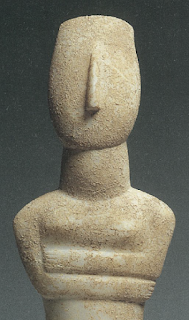
In 1993 Christopher Chippindale and I suggested that some of the attributions to Cycladic 'masters' (as they were then called) were inadequate as not a single piece was derived from a secure archaeological context. Subsequently, the Stafford master was removed from the attributions as key works were considered by Getz-Preziosi / Getz-Gentle to be modern works. In 2002 I returned to the theme of inadequate sculptors in a review of Getz-Gentle's Personal Styles in Early Cycladic Sculpture (2001) noting the introduction of two new entrants to the category (and both represented in the Leonard Stein collection of Cycladic figures): the Karlsruhe/Woodner sculptor and the Rodgers sculptor.

There are three figures attributed to the Rodgers sculptor. Two are reported to have surfaced from the same dealer, 'three years apart', and both were 'encrusted with similar hard deposits' (quotes from Getz-Gentle). One of the figures was in an anonymous North American private collection (NAC no. 52; acq. 1975) and the other in the Stern collection (and previously in the Rodgers collection; acq. 1972). The Stern figure had been reported as being derived 'from English coll., after World War II' though Getz-Gentle qualified this with the dismissive, 'information I distrust'. The third figure is in the Museum of Cycladic Art (inv. 282: Doumas no. 223). Although Getz-Gentle notes 'find-place unknown', Doumas suggested the 'possible' findspot of Koufonisia. This figure was described by Colin Renfrew as achieving 'a rhythmic effect in the curving outlines of the head, shoulders, upper arms, thighs, and calves' (Cycladic Spirit p. 86, pl. 57). No further information is provided by Aegean Waves (no. 24).

The Stern figure appears in the Homecoming exhibition at the Museum of Cycladic Art (no. 13) where it is attributed (inaccurately), along with the Athens figure, to the Rodgers master. 

| |
Bookmark and Share so Your Real Friends Know that You Know

Wednesday, 21 December 2022

Christos Doumas on Cycladic Forgeries

New York MMA
inv. L.2022.38.49
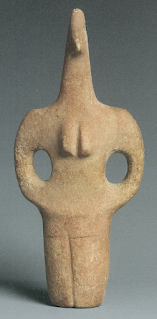
An interview with archaeologist Christos Doumas was published earlier this week. The focus was on the 15 items from the Leonard Stern collection that went on display in the Homecoming exhibition at the Museum of Cycladic Art. Doumas raised questions about the authenticity of some of the figures. When pressed by the journalist he thought that at least 4 or 5 of the figures (out of 10!) were likely to be fakes. (Only one is identified: the Late Neolithic figure [no. 1], though it should be remembered that Getz-Gentle does illustrate this in Personal Styles, pl. 2. The Homecoming catalogue notes, 'It belongs to a type that has not yet been identified among Aegean marble figurines of the Neolithic period'.) Doumas based his view on fakes on the type of marble that was used. He raised the issue why there had not been a panel formed to help authenticate the figures in the Stern collection. 

This raises questions about other figures in the Stern collection especially in the light of recent revelations about the forging of Cycladic figures. 

How will the curators at the Museum of Cycladic Art and New York's Metropolitan Museum of Art respond to Doumas' concerns? There is likely to be unease that accepting all the Stern figures as authentic has the potential of corrupting the corpus of knowledge for Cycladic figurines. 

| |
Bookmark and Share so Your Real Friends Know that You Know

Homecoming and the Stern Collection

New York MMA inv. L.2022.38.22


The Keros Haul is considered to be a notorious example of looting in the Cyclades and in the publication—co-published with the Museum of Cycladic Art—is a figure formerly  in the New York collection of Ian Woodner and now in the collection of Leonard Stern (New York MMA inv. L.2022.38.22). The Stern figure appears in the Keros catalogue (no. 170), and while this publication is referenced in the Homecoming catalogue published by the Museum of Cycladic Art (no. 11) there is no explicit mention that the figure came from the haul. One wonders why this part of the object's history has been suppressed. It is, in fact, one of several pieces in the Stern collection that was derived from Keros.

The figure is attributed by Getz-Preziosi/Getz-Gentle to the Kalrsruhe/Woodner sculptor (/master). The Stern/Woodner figure was paired in Early Cycladic Sculpture (1985) with a figure in the Badisches Landesmuseum in Karlsruhe:
Nearly identical in length and exceptionally large, the two figures share a number of characteristics whose combined presence cannot have been fortuitous even though they differ in obvious ways.
The Karlsruhe figure was subsequently returned to Greece. What is stopping the Greek authorities from requesting the return of the Stern/Woodner figure? Instead they have accepted it as a temporary loan and recognise the validity of the long-term loan to New York's Metropolitan Museum of Art. 

The third figure attributed to this sculptor is in the Museum of Cycladic Art (inv. 724) and is reported to have been found 'in a cave' on Keros. Not one of the three figures has a secure archaeological context.

| |
Bookmark and Share so Your Real Friends Know that You Know

Tuesday, 20 December 2022

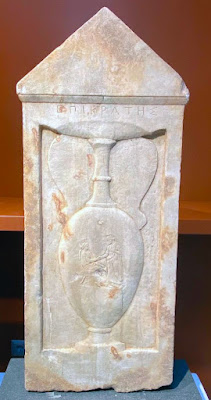
Funerary stele returned to Greece

Stele revealed at the Epigraphic Museum
Athens
It is reported that today, December 20, 2022, that a funerary stele for one Epikrates has been returned to Greece. The stele is stated that it was due to have been offered through Christie's in London (December 2021) but was identified from three photographs in the Becchina archive and was withdrawn after intervention by the Art Squad of the Metropolitan Police. Incidentally, the stele was said to have been handled by Koutoulakis, a name that should have raised concerns. 

These three photographs were considered to be sufficient evidence for the return. (I am grateful to Christos Tsirogiannis for sharing the images with me.) Yet, when photographs of a Cycladic figure were identified with a piece residing in the Stern Collection there appears to have been a reluctance for the Greek authorities to seek the immediate return. Indeed there is currently an exhibition, 'Homecoming', at the Museum of Cycladic Art in Athens that contains 15 Cycladic pieces from the Stern Collection. I understand that questions relating to this inconsistency of policy were asked at the press conference today but were deflected by the Minister. 

| |
Bookmark and Share so Your Real Friends Know that You Know

A volute-krater with a "tremendous provenance"

A volute-krater attributed to the Syriskos painter by J.R. Guy (see BAPD 44988) is said by Michael Padgett to have been found with a psykter...