Showing posts sorted by relevance for query sarpedon. Sort by date Show all posts

Tuesday, 4 January 2011

Sarpedon emerges for public display in Rome

Vernon Silver's study of the Euphronios cup is a must-read for anybody interested in the way that antiquities were removed from their archaeological contexts and then passed into the market.

Silver now completes the story of the "lost" cup "signed" by Euphronios showing Hypnos and Thanatos with Sarpedon (a companion piece to the Sarpedon krater returned from New York's Metropolitan Museum of Art). This cup had formed part of the Hunt Collection (Wealth of the Ancient World [1983] no. 5) and had been sold at Sotheby's in 1990 (19 June 1990, lot 6). Silver writes:
Euphronios’ Sarpedon kylix has gone on display at Rome’s Villa Giulia museum with no fanfare or public announcement.
There does not appear to be an official press release from the Italian Ministry of Culture.

The cup is displayed alongside other pieces returned from Italy (including the krater returned by Shelby White) and Silver notes:
Its label, which has no accession number, describes it as coming from the Geneva raid (and doesn’t mention that, technically, it’s still Medici’s property, pending the resolution of his legal cases).


Bookmark and Share so Your Real Friends Know that You Know

Monday, 14 January 2008

Sarpedon carried from the field of battle


In the Iliad Sarpedon is carried from the field of battle by Sleep (Hypnos) and Death (Thanatos). Yesterday the Attic red-figured krater depicting this scene was removed from display in the Metropolitan Museum of Art in New York ("Ciao to a Met Prize Returning to Italy", New York Times, January 11, 2008).

We have to be grateful to the Met. The acquisition of the krater in 1972 for a record US $1 million was a factor in the decision of the Archaeological Institute of America to pass the December 1973 resolution on the Importation of Antiquities. The siege of Troy was over in a flash compared to the long-running saga of the Sarpedon krater and other disputed antiquities.

But while some museum curators and private collectors were willing to acquire archaeological material ripped directly from tombs and other contexts to fill their cabinets and decorate their sideboards, archaeologists were demonstrating the damage that was being inflicted on the ancient cemeteries of Italy (and elsewhere). The deliberate ignoring of the problem of recently surfaced antiquities has led directly to the return of cultural property to Italy from Boston, Malibu, Princeton and the University of Virginia Art Museum in Charlottesville. And a selection of this array of former trophies is now on display in Rome. (Loans in reverse are also going on exhibition in North American museums.)

Although these museums have accepted the Italian case and returned the objects, some of the key individuals (such as Philippe de Montebello) have continued to defend the original acquisitions.

This is not the end of the matter. Objects in other European, Japanese and North American museums (and private collections) are said to feature in the Polaroids seized in Geneva. Will it take a few months for those institutions to return the items? Or are we looking for another protracted series of requests?

Image
Giacomo Medici and the Sarpedon krater displayed in New York (from a photograph found in the Geneva Freeport).

Wednesday, 23 May 2012

The Sarpedon krater: intellectual consequences

My essay on the material and intellectual consequences of the Metropolitan Museum of Art's acquisition of the Sarpedon krater has appeared in a new volume. The research develops the themes explored in earlier published work on Cycladic figures and mapped onto Athenian figure-decorated pottery.

I cover the following themes:

  • History of acquisition
  • The lost archaeological context
  • Find-spots for Euphronios
  • Leagros kalos
  • Interpreting the iconography in an Etruscan context
  • High art?
  • Philippe de Montebello on the Sarpedon krater
  • A motif for recently surfaced antiquities
  • A motif for repatriation: "Successo storico"

There are nine essays in the volume.

Gill, D. W. J. 2012. "The material and intellectual consequences of acquiring the Sarpedon krater." In All the King's Horses: essays on the impact of looting and the illicit antiquities trade on our knowledge of the past, edited by P. K. Lazrus and A. W. Barker: 25-42. Washington DC: Society for American Archaeology.  [SAA website]

Bookmark and Share so Your Real Friends Know that You Know

Friday, 1 May 2009

Whose Culture? and the returns to Italy

I have already made a preliminary comment on James Cuno's minimalist views (in his 2009 edited volume, Whose Culture?) on the return of antiquities from North American museums to Italy. I have begun to read the book and have been looking (in vain) for a response from Cuno and his like-minded contributors to these returns.

Kwame Anthony Appiah in his (reprinted) essay merely makes the outdated statement, "Italian authorities are negotiating about the status of other other objects from both the Getty and the Metropolitan Museum" (p. 71). Elsewhere he notes that the Metropolitan had at one point been "close to a deal" over the Sarpedon (Euphronios) krater (p. 76) - yet this Athenian krater has been returned to Italy (January 2008) and has even been on exhibition in Athens.

Philippe de Montebello does address the return of the Sarpedon krater (p. 61). He protests at the Italian description of the pot as a cosa morta, but concedes "it would have been clearly preferable to know the totality of the krater's original, found context" (p. 65).

Sir John Boardman also notes the return (p. 121). There is a strange discussion about the krater moving from Athens ("a pagan (in our terms) society whose cultural heritage is nevertheless claimed by a Christian orthodox country") to Etruria (in Italy) ("another pagan society now in a Christian Orthodox (of different persuasion) country"), then being pillaged by "Christian (no doubt) excavators" (sic.) (pp. 121-22). However he does concede, "it would be good to know the details of the krater find and cofinds and we mourn their loss" (p. 122).

Monday, 19 October 2009

Is the debate about reclaiming cultural property?

Are those involved in discussions over cultural property confusing several issues?

Italy has long been concerned about the destruction of its archaeological record. Tombaroli have been entering Etruscan burial chambers for centuries. But the organised, systematic and widespread looting of archaeological sites meant that action had to be taken. The surfacing of the Sarpedon krater in New York was a visual remind of archaeological contexts torn apart to supply the market.

And it was not just Etruscan tombs. Cemeteries in southern Italy were being ripped apart to supply the demand for Apulian pottery.

Turning to Greece, the Early Bronze Age cemeteries of the Cyclades were being pillaged to supply the demand for marble Cycladic figures. On Crete Bronze Age sites were worked over to supply the demands of the market. And in Macedonia, elite tombs served as a supply for high quality items to be sent to market.

So the return of the Sarpedon krater, Apulian pots, Macedonian gold wreaths, or bronze kraters to countries like Greece and Italy send out a clear message: museums and collectors should not handle recently-surfaced antiquities. The collector-driven market leads to the destruction of the finite archaeological record.

Then there is the issue of material stolen from archaeological museums and stores. Mummy masks and bronze statues that have been raided from archaeological collections should be returned.

There are also the long-standing issues that predate the 1970 UNESCO Convention. What about Nefertiti? What about the Rosetta stone? What about the Parthenon marbles? What about the Bubon bronze statues? What about the Benin bronzes? Here the issue is less about looting than the appropriate place to display key archaeological objects. Are the architectural sculptures from a fifth-century BCE temple best displayed in London or within line of sight of the building on which they were once placed?

Such issues also raise concerns about how to preserve our cosmopolitan cultural property. Should there be restrictions on the movement of archaeological material (including coins) across international boundaries? How can those who handle archaeological material (including coins) ensure that they are not handling the proceeds of recent looting? How can we protect our past for the benefit of future generations?

Is the debate about reclaiming cultural property?

Not really. The issues revolve around the material and intellectual consequences of looting.

Image
© David Gill


Bookmark and Share so Your Real Friends Know that You Know

Saturday, 2 August 2008

Returns and Loans

In the aftermath of some of the returns to Italy (and remember that the Polaroids seized in Geneva show 1000s more items), some museum directors in North America have been calling for the creation of a "licit market"; for them "ownership" seems to be a key issue. (See also related observations from Paul Barford dealing with comments from some dealers.)

I prefer a move towards the loan of archaeological material along the lines of Maxwell L. Anderson's EUMILOP project back in the 1980s.

Loan material has of course started to move from Italy to North America. The February 2006 agreement over the Sarpedon (Euphronios) krater allowed for :
... long-term future loans—of up to four years each, as Italian law allows—of works of art of equivalent beauty and importance to the objects being returned. The loans will be chosen from a list of objects submitted by the Metropolitan or by others, with joint approval.
A Laconian cup from the Museo Nazionale, Cerveteri was placed on loan to the Metropolitan Museum of Art in November 2006 (Randy Kennedy, "Italy Lends Antiquities to 2 Museums", New York Times November 29, 2006), and in January 2008 "Three Spectacular Vases" from Italy joined it (see further comments and images from Culturegrrl). Philippe de Montebello described the three as "extraordinary new loans" that would "illuminate the superb achievements of [Euphronios'] contemporaries". Indeed, "these masterpieces will expand significantly our visitors' experience of classical art".

The three further loans were:
  1. An Attic head oinochoe (jug) with the "signature" of Charinos on loan from the Museo Nazionale, Tarquinia.
  2. An Attic red-figured cup "signed" by Euxitheos as potter (see the Sarpedon krater) and Oltos as painter on loan from the Museo Nazionale, Tarquinia.
  3. A Paestan bell-krater attributed to Python on loan from the Museo Archeologico, Naples.

Wednesday, 16 April 2008

Looted Antiquities and Cosmopolitanism

Kwame Anthony Appiah, the Laurence S. Rockefeller University Professor of Philosophy for the Center for Human Values at Princeton University, now features regularly in discussions of cultural property (see Philippe de Montebello in "An Era of Scrupulous Acquisition Policies"). Appiah addresses cultural property in a chapter, "Whose culture is it, anyway?", in his excellent Cosmopolitanism: Ethics in a World of Strangers (2006).

Appiah understands some of the issues raised by archaeologists. In his discussion of terracottas from Mali he accepts the intellectual consequences of the desire to own these "wonderful sculptures". He comments:
They were sold to collectors in Europe and North America who rightly admired them. Because they were removed from archaeological sites illegally, much of what we would most like to know about this culture—much that we could have found out by careful archaeology—may now never be known.
Such a position is equally true for marble Cycladic figures from the Aegean or Athenian sympotic pottery placed in funerary contexts in Tuscany.

Appiah also raises the issue of material stolen from museums in Nigeria: he suggests "hundreds of millions of dollars worth of art".

But can you group Mali terracottas and museum objects from Nigeria?

Consider:
  1. An Attic black-figured amphora stolen from a civic museum collection in Italy.
  2. An Attic black-figured amphora looted from an Etruscan tomb in Italy.
In both cases the amphora is a piece of cultural property which Italy (in my example) rightly could demand back. But in the second instance the removal of cultural property from a sealed archaeological context has destroyed knowledge for all time.

If archaeologists are concerned about intellectual consequences of looting, can "cultural patrimony" take second place? Appiah makes the point that Nok sculpture pre-dates the creation of modern Nigeria. Let me give a further example. The Sarpedon krater was made before the foundation of the modern Greek (it was made in Athens) or Italian (it was probably found in Italy) states. But Italy has the incentive to ask for the krater back because its return is a disincentive for future similar acquisitions. Why? Because such material often (but not always) comes onto the market through the looting of archaeological sites. (See my comment on a proposed "licit trade" in antiquities.)

I get the impression that Appiah would argue that the Sarpedon krater is part of our "cosmopolitan" heritage. Its iconography and design speak to our contemporary world culture. It makes a visual impact whether it is displayed in New York or Mantua. By the same token, its illegal and unscientific removal from its (Etruscan?) context has robbed a little bit of knowledge from the "cosmopolitan" viewing public.

And I am sure Appiah understands this. He writes:
For an object from an archaeological site, after all, value comes often as much from the knowledge to be gleaned by knowing where it came out of the ground, what else was around it, how it lay in the earth.
So is one outworking of cosmopolitanism an increasing awareness of a shared heritage and the need to preserve and secure archaeological contexts for the benefit of all?

Tuesday, 28 October 2008

The Universal Museum

The argument for displaying antiquities outside their country of origin is that these pieces are part of our shared, universal, cosmopolitan culture. Does it matter if archaic Athenian funerary sculptures are displayed in Manhattan? South Italian pottery in Melbourne? Roman imperial portraits in Malibu? Greek architectural sculptures in Munich? Egyptian funerary portraits from the Faiyum in Manchester?

Egyptian, Greek and Roman antiquities can be enjoyed, appreciated, and discussed, whether they are in Cairo, Athens, Istanbul, Rome, or indeed Paris, Berlin or Boston. Indeed they have the power to inspire new generations of students and scholars who have the enthusiasm to engage with their subject. How many students in Cambridge during the 1920s and 1930s were drawn into the study of the prehistoric Aegean by the Prehistoric displays in the Fitzwilliam Museum designed by Winifred Lamb? The pioneering careers of Robert Carr Bosanquet (Palaikastro), Alan Wace (Mycenae) and John Pendlebury (Crete) started with the study of this major university collection.

Then there are the national “universal” collections. From the hub of the Great Court of the British Museum it is possible to gain access to major masterpieces from Mesopotamia, Egypt, Anatolia, and mainland Greece. Hundreds of thousands of visitors flock to see the finds from Ur, the Rosetta stone, or the reliefs from that wonder of the ancient world, the Mausoleum of Halikarnassos. The collections are accessible (and free)—so long as you have a visa to get to the United Kingdom.

How were these collections formed? For the British Museum, the pieces come from a range of sources: from private collectors to expeditions. Grand Tourists acquired Roman copies of Greek sculptures discovered in the remains of Hadrian’s Villa at Tivoli from the antiquities dealers of eighteenth century Rome. Sir Charles Newton had the vision to explore the classical sites around the shores of the Aegean as part of the great competition to develop the holdings of “national” collections. (British excavators on the island of Melos in the mid-1890s were able to pinpoint the spot where the Aphrodite [“Venus de Milo”] had been found.) Excavations at Naukratis in the western Delta provided a range of archaic Greek pottery.

Is the concept of the universal museum under threat? Items from the historic collections are on the shopping list of countries: the portrait of Nefertiti in Berlin, the Parthenon sculptures from the British Museum. This is not to diminish the cultural claims of Egypt or Greece. There is a strong argument for the display of fifth century BCE Athenian architectural sculptures in a gallery that makes a direct visual link with the Parthenon.

But should the internationally important holdings of archaic funerary sculptures in the Metropolitan Museum of Art, many of them acquired by Gisela M.A. Richter, be returned to Athens for display alongside similar pieces in a national archaeological collection? As far as I know there has been no such suggestion and I would not expect there to be.

So why is the concept of the universal museum on the agenda? The successful pursuit of antiquities by the Italian Government has unsettled museum curators. Will cultural property claims remove treasured items from their holdings?

But I do not believe the aim of the Italian Government is to strip all international museums of their holdings of archaeological material that could have been discovered in Italy. We are unlikely to see tens of thousands of Apulian pots, Etruscan mirrors, or Roman sculptures being returned.

The Italian Government is sending out a clear signal that museums need to develop responsible acquisition policies that do not encourage the industrial-scale looting of archaeological sites. Would any curator recommend the acquisition of another “Sarpedon krater” if the museum faced the potential return of the piece (and thereby gaining adverse publicity)? And the Association of Art Museum Directors (AAMD) responded positively to this challenge in June 2008 by reaffirming the importance of checking that antiquities being considered for acquisition had not been looted in recent decades.

Any close observers of the recent return of antiquities to Italy will have noticed that not every piece identified by the Polaroid photographs seized from Giacomo Medici has been requested or returned. Museums have negotiated a short-list of finds to the satisfaction of both sides. There are, of course, high-profile pieces such as the “Sarpedon krater” but there are lesser pieces that emphasise the network of dealers and middlemen that supplied the appetites of the collectors. Patterns are beginning to emerge with the names of particular dealers, galleries and auction houses (from both sides of the Atlantic) appearing time and again. Responsible curators in these universal museums will be checking the histories of “ancient art” acquired since the 1970s.

The concept of the “universal museum” is not dead, but institutions that aspire to that title need to acquire and borrow with a more developed sense of ethical responsibility. Some North American museum directors have been making a case for the development of a “licit market” in antiquities drawing on the reserve collections of museums in Italy, Greece and elsewhere. It is suggested that the revenues raised could help for the display and conservation of the remaining collections. But should tomb-groups held by archaeological museums be broken up merely for the enjoyment of the visiting public? A more creative approach would be to develop a scheme of short- and long-term loans of archaeological material. Museums directors are, perhaps, less keen on this idea, as the antiquities will not in the end be “owned” by their institutions. Yet for the visiting and viewing public, such loans would broaden their enjoyment and understanding of the ancient world.

Universal museums are not dead. But they are seeking a new role in the 21st century. And part of that task is to reaffirm the importance of archaeological context to help with the interpretation of the material culture of the ancient world.

Wednesday, 2 April 2008

Homecomings: The Metropolitan Museum of Art

One of the first agreements to return antiquities to Italy was made with the Metropolitan Museum of Art in New York (February 21, 2006) [Press Release]. The discussion has tended to centre around the Sarpedon krater but there were other pieces as well.

The current Nostoi exhibition in the Palazzo Poli in Rome contains the following pieces (with the number in the previous Nostoi exhibition):
  • Laconian cup with warrior. Attributed to the Hunt painter. Formerly New York 1999.527. Gift from the family of Howard J. Barnet. "Lent to the Museum periodically since 1981" (Mertens). Publ. Joan R. Mertens, in "Ancient World", The Metropolitan Museum of Art Bulletin, New Series, 58, No. 2, Recent Acquisitions: A Selection 1999-2000 (Autumn, 2000), 13 [JSTOR]. (Nostoi no. 3; old no. 3).
  • Attic red figure psykter with young horsemen. Attributed to Smikros (attributed by J. Robert Guy). Formerly New York L1980.104 (loan from Mr & Mrs Spears, Riverdale [NY]); 1996.250. Gift of Thomas A. and Colette Spears. Publ. Dietrich von Bothmer, in "Ancient World", The Metropolitan Museum of Art Bulletin, New Series, 55, No. 2, Recent Acquisitions: A Selection 1996-1997 (Autumn, 1997) 12 [JSTOR]. (Nostoi no. 15; old no. 14).
  • Attic red figure amphora with cithara player. Attributed to the Berlin painter. Sold at auction, Sotheby's (London), December 13-14, 1982, lot 220. Formerly New York 1985.11.5. Publ. Dietrich von Bothmer, in "Greek and Roman Art", Recent Acquisitions (Metropolitan Museum of Art) (1985-1986), 9 [JSTOR]. (Nostoi no. 17; old no. 16).
  • Apulian red-figured dinos with Herakles and Busiris. Attributed to the Darius painter. Formerly New York 1984.11.7. Purchase, The Bothmer Purchase Fund, Rogers Fund, and Norbert Schimmel and Helen H. Mertens Gifts, 1984; Anonymous Gift, 1989. Dietrich von Bothmer, "Greek and Roman Art", Notable Acquisitions (Metropolitan Museum of Art) (1984-1985), 6-7 [JSTOR]. (Nostoi no. 57; old no. 51).
Not included this time:

Entry revised: August 21, 2008.

Image courtesy of New York, Metropolitan Museum of Art (www.metmuseum.org).

Dinos with Herakles and Busiris, ca. 340–320 B.C.; Red-figure. Greek, South Italian, Apulian. Attributed to the Darius Painter. Terracotta; H. 9 3/4 in. (24.79 cm). Purchase, The Bothmer Purchase Fund, Rogers Fund, and Norbert Schimmel and Helen H. Mertens Gifts, 1984; Anonymous Gift, 1989 (1984.11.7).

La Forza del Euphronios: Sarpedon Carried to Mantua

Four antiquities returned from the Metropolitan Museum of Art in New York are on display in Rome. However the Sarpedon krater is now in an exhbition, "La Forza del Bello", in the Palazzo Te, Mantua ("Ancient Greek art dazzles Mantua", ANSA, March 31, 2008).

The press release provides further information:
The exhibition also features a small ''bonus'' section at the end, showcasing three masterpieces that US museums have recently returned to Italy after lengthy negotiations.

These include a marble ceremonial basin decorated with Nereids and a striking painted marble sculpture of griffons attacking a doe, both returned from the J. Paul Getty Museum in Los Angeles.

The third piece - returned from New York's Metropolitan Museum this January after decades of discussions - is a terracotta drinking cup [sic.] painted by the 5th-century BC Greek master Euphronios.

Wednesday, 8 February 2012

Death of Robert Hecht announced

It appears that Robert Hecht died in Paris earlier today (February 8, 2012). Details have been posted by Jason Felch on LA Times (Culture Monster) ("Robert E. Hecht Jr., figure in antiquities case involving the Getty, is dead") although I have had separate confirmation from Rome.

Hecht, whose final years of life were dominated by his trial in Rome, was linked with a number of antiquities that were returned to Italy from North American collections (such as the Sarpedon krater and the Morgantina hoard plus antiquities in Boston, Cleveland and Princeton), as well as the infamous Athena II Fund. Other items include the Butrint Livia and antiquities in Copenhagen and other north European collections (including the UK).

Did the sale of the Sarpedon krater to New York's Metropolitan Museum of Art in 1972 lead directly to the passing of the 1973 AIA resolution? So perhaps Hecht was responsible (unintentionally!) for setting in motion the line of enquiry that led to the unmasking of the Medici Conspiracy, the return of well over 100 antiquities to Italy, and the damage to the reputation to some of North America's most prestigious museums.

Bookmark and Share so Your Real Friends Know that You Know

Saturday, 18 January 2014

Buying from the Lebanon market

Those buying antiquities that had once allegedly passed through the Lebanese market need to be on their guard when conducting their due diligence search. Items include the major silver hoard, the Morgantina treasure, that was clearly derived from Sicily. The Sevso treasure was claimed to have been derived (among a number of locations). The Sarpedon krater was reported to have a Beirut connection. Likewise the statues of the Dioskouroi on loan to New York's Metropolitan Museum of Art are linked to Sidon when other documentary evidence points to a findspot in Syria.

Back in 2010 I even draw attention to Late Antique (Byzantine) mosaics with a Lebanon link. Does this sound familiar?

Bookmark and Share so Your Real Friends Know that You Know

Tuesday, 3 February 2009

Nostoi in Athens


I noticed that the webteam for Mihalis Liapis, the former Hellenic Minister of Culture, has posted a news clip about the Nostoi exhibition in the New Acropolis Museum. You get glimpses of the returned fragment of the Parthenon frieze from Palermo as well a shot of the reverse side of the Sarpedon krater.

Monday, 21 January 2008

Culture Wars, Spoils and Archaeological Contexts

Lee Rosenbaum addresses the implications of the return of cultural property from North American public and private collections to Italy ("Make art loans, not war", LA Times, January 21, 2008).
To the victor in the cultural-property wars belong the spoils. But now that American museums have acceded to demands for restitution, it's time to ask not only what "universal museums" can do for antiquities' countries of origin, but also what the source countries can do for the world's encyclopedic museums.
"Universal museums" can and do hold archaeological material derived from scientific excavations. If we take some British examples, museums hold excavated material from British work in Cyprus, Crete, the Cyclades and Laconia. These items have inspired and trained new generations of archaeologists.

But the returns from North America have not been about objects derived from scientific excavations. They are objects that have surfaced on the antiquities market without a documented history. And P. Watson and C. Todeschini (see review by Gill and Chippindale) have demonstrated in some detail the route by which these items were ripped from their archaeological contexts to provide spoils for what Rosenbaum and others call "universal museums".

"Universal museums" have a place: but not at the expense of destroying unrecorded archaeological sites. And that is what lies at the heart of the issue about the recent returns to Italy. Wherever the Sarpedon krater resides, we will never known its precise last resting place and the complete archaeological assemblage.

So these returns are symbolic of unethical curatorial behaviour that was indifferent to the material and intellectual consequences.

Rosenbaum concludes:
In the bad old days, acquirers of antiquities knew, or at least suspected, that what they were doing was problematic. What's changed now, thanks to aggressive enforcement by the source countries, is that it's become much harder to get away with it.
Are curators really this reformed? If there is a new spirit of transparency, why are the previous histories of objects from the Metropolitan Museum of Art, New York, and Princeton not in the public domain (as far as I know)? Which other North American museums and private collections hold material sold to them by, say, Robin Symes or Robert Hecht? And what about European and Japanese collections? And why are antiquities still being presented as a good investment? I suspect the requests for returns will continue.

Thursday, 28 August 2008

Intellectual Consequences of Collecting Antiquity

It is easy to be disturbed by the destruction of archaeological sites to supply antiquities. But what are the intellectual consequences as the pieces enter the corpus of knowledge?

Here are some of the topics covered so far:
Image
One of the pieces returned to Italy: an Attic red-figured column-krater showing Dionysos, attributed to the Geras painter.

Saturday, 27 March 2010

Renfrew on Post-disjunctive Forensic Re-contextualisation


Lord Renfrew has issued a summary of the paper ("Combating the Illicit antiquities trade: progress and problems") he gave at the International Meeting on Illicit Traffic in Cultural Property organised by the Ministero per i Beni e le Attività Culturale, in Rome in December 2009. He acknowledged the "real international progress" that has been made, including the return of antiquities from major returns (see our earlier discussion).

Renfrew alludes to other ongoing cases:

Renfrew emphasises 1970 as the benchmark for collecting histories. This is certainly now recognised by the North American community as a key date for acquisitions, though, in my opinion, there is still the issue of long-term loans.

Renfrew touches on the issue of cultural property claims that pre-date 1970 such as the Parthenon marbles and the Benin bronzes. He also discusses the Martin Schøyen collection of incantation bowls that were on loan to UCL.

There is a useful reflection on the return of the marbles allegedly found at Ascoli Satriano and returned by the J. Paul Getty Museum. These are now on display in Rome. Renfrew writes:
I had seen the extraordinary marble sculpture of the Griffins at Malibu, both at the Villa where they were originally exhibited by the J. Paul Getty Museum and then at the inaugural installation at the new Getty Museum in Los Angeles. Indeed so striking and unexpected was the impression then made on me that I was quite doubtful of their authenticity. That is one of the prices which one pays when antiquities are clandestinely removed from their context of discovery.
And now, at the Palazzo Massimo I saw not only the Griffins and the remarkable painted marble basin but a whole assemblage of marble artefacts, including the painted calyx crater and the splendidly severe group of marble vessels (loutrophoros, epichysis, oinochoe) which apparently formed part of the original tomb group. A single de-contextualised artwork now had an important series of accompanying pieces. These added greatly to the significance of the extraordinary Griffin piece. But in addition they themselves became of vastly greater importance.
But the marbles are only part  of the "assemblage". It has been reported elsewhere that they were found with "a number of vases by the Darius Painter" (see earlier discussion). One of the interesting features of the returns from North America have been the pots attributed to the Apulian pot-painter dubbed the Darius painter: from Boston's Museum of Fine Arts,  the Cleveland Museum of Art, Malibu's The J. Paul Getty Museum, New York's Metropolitan Museum of Art, and the Princeton University Art Museum. And we must not forget the tomb-group incorporating pots attributed to this painter in Berlin. Could the marbles have been associated with any of these pots? Indeed is it possible that they were found with Apulian cavalry armour?  The answer is we just do not know details of the tomb and its original contents.

Renfrew turns to other re-contextualised material; he dubs it "post-disjunctive forensic re-contextualisation". (Surprisingly, he does not mention Morgantina where Malcolm Bell appears to have discovered the holes from which the silver hoards appear to have been removed.) Renfrew suggests other examples such as the Sarpedon krater for Cerveteri, and the fragmentary marble figures from Keros in the Cyclades ("the Keros haul").

The summary of Renfrew's lecture makes it clear that Italy has been able to address the issue of looting. Now it is the turn of museums, collectors, and dealers to avoid acquiring or selling pieces that do not have a recorded collecting history that can be traced back to the period before 1970.

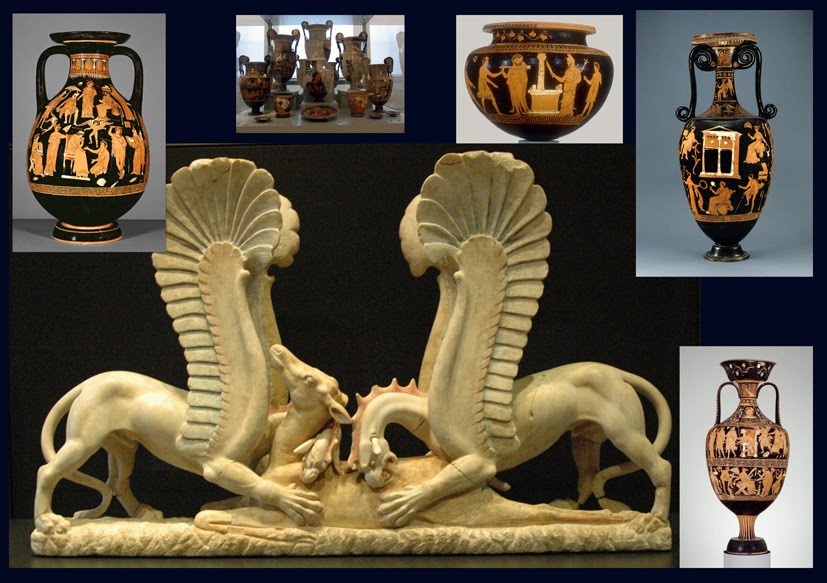
Image
Composite of some of the returns from North America and other items on display in a European Collection.

Bookmark and Share so Your Real Friends Know that You Know

Thursday, 3 October 2013

"Why art museums must continue to collect"

David Franklin, Sarah S. and Alexander M. Cutler Director of the Cleveland Museum of Art, has written the foreword to Michael Bennett's provocative Praxiteles: The Cleveland Apollo (Cleveland Museum of Art, 2013). Franklin, whose expertise does not lie in archaeology or "ancient art", claims that the book "makes an important contribution to the current debate over collecting antiquities by presenting a much-need curatorial viewpoint". Franklin, who does not appear to understand the intellectual consequences of collecting (and Bennett overlooks such studies in his bibliography), suggests that the acquisition of recently-surfaced antiquities leads to "the preservation of knowledge".

Bennett would have done well to have read my study of the material and intellectual consequences of collecting the Sarpedon krater [see here] before trotting out a stale and lightweight assessment of the Euphronios krater returned to Italy by New York's Metropolitan Museum of Art [pp. 32-33, fig. 36]. His treatment of the "hot pot" (as it was known) betrays his thinking about how to approach objects that have been removed from their archaeological context.

Bennett fails to take the opportunity in his essay to explain why the Cleveland Museum of Art returned so many classical antiquities to Italy. Indeed there could have been a helpful discussion of why the museum acquired them in the first place. More telling would have been the unwillingness of the museum to disclose the collecting histories of the items. Which dealers were involved?

I am looking forward to reflecting on the book over the next few weeks and to explore the "German" collecting history in more detail, especially in the light of another (apparently flawed) collecting history from the same Swiss dealer.

Bennett may have opened a Pandora's Box of issues that Franklin may wish, with hindsight, had remained firmly closed.

Bookmark and Share so Your Real Friends Know that You Know

Thursday, 19 January 2012

Robert Hecht trial expires

Those following the trial of Robert Hecht in Rome will remember the predictions back in 2006: "For a man accused of crimes punishable by as many as eight years in prison, Mr. Hecht seems relatively unperturbed by the trial. (The reason may be that even if he is convicted, he is unlikely to spend a single night in prison, if only because of his age, legal experts say)" (Elisabetta Povoledo, "Antiquities Dealer on Trial in Getty Case Is Vexed but Unbowed", New York Times June 21, 2006). He was linked to the sale of the Sarpedon krater to New York's Metropolitan Museum of Art, as well as a hoard of Hellenistic silver ("The Morgantina hoard"). The article reminds us that objects sold through Atlantis Antiquities, co-owned by Jonathan Rosen, have been returned to Italy. Indeed Shelby White and Leon Levy were apparently numbered among his clients.

Povoledo now reports that the Hecht trial has expired due to the statue of limitations ("Italian Trial of American Antiquities Dealer Comes to an End", New York Times blog, January 18, 2012).
The court ruling, issued Monday, came in response to a request from Mr. Hecht’s lawyer to dismiss the case because the statute of limitations on the charges had elapsed in 2011. The lawyer, Alessandro Vannucci, said he had hoped the trial would fully exonerate his client, who has always maintained his innocence, “but it was cut short.” This decision “does not do Bob justice,” he said, using Mr. Hecht’s nickname.

The judges did not express an opinion on culpability or innocence. But they ruled that a series of objects that had been confiscated from Mr. Hecht’s homes should return to their “rightful owner,” which was identified as the Italian state, a decision Mr. Vannucci said he would contest.
The trial may be inconclusive but it has reminded those who collect antiquities that they need to check the documented histories prior to purchase as part of a rigorous due diligence search.

Hecht also appears to have supplied antiquities to the Ny Carlsberg in Copenhagen, as well as to public collections in the United Kingdom. Objects that were acquired directly or indirectly from Hecht are likely to appear in the thousands of photographs in the various photographic archives derived from dealers in Greece and in Switzerland.


Bookmark and Share so Your Real Friends Know that You Know

Tuesday, 18 December 2007

Homecomings: Recovered Masterpieces

An exhibition, "Nostoi. Capolavori ritrovati", is about to open in the Palazzo del Quirinale, Rome (press statement; Elisabetta Povoledo, "After Legal Odyssey, Homecoming Show for Looted Antiquities", New York Times, December 18, 2007; Ariel David, "Looted Art Displayed in Rome", AP). Some 68 antiquities will be displayed. They include material returned from the J. Paul Getty Museum, the Metropolitan Museum of Art in New York, the Museum of Fine Arts in Boston, and the Princeton University Art Museums. Among the pieces is the ivory mask handled by Robin Symes and seized in 2003. Some of the objects had passed through private collectors such as Barbara and Lawrence Fleischman. Five pieces were returned from the Royal Athena Galleries.

Missing from the display is the Sarpedon krater on loan to the MMA. It is perhaps the acquisition of this krater by the MMA that generated such intense debate about the collecting of recently surfaced antiquities.

There are still some outstanding questions. Although it has been possible to understand the routes by which some of these antiquities passed to the MFA or the J. Paul Getty Museum, the information on other items has not been made so freely available.

It needs to be remembered that the archaeological contexts for each one of the pieces on display in this exhibition has been lost for ever. Greed and the desire to collect have snatched this information away.

Have museum attitudes in North America changed? Philippe de Montebello's interview with Richard Lacayo in late November 2007 hints that old positions are hard to shift. And what about the disputed items in the Cleveland Museum of Art, the Minneapolis Institute of Arts and the Shelby White collection?

Image
Portrait of Sabina, purchased from Fritz Bürki of Zurich, through Robert E. Hecht to the Boston Museum of Fine Arts in 1979. Returned to Italy in 2006.

Thursday, 7 November 2013

Art Forgery and Provenance

I attended the ARCA (Association for Research into Crimes against Art) Art Crime Symposium at the V&A in London today. There were two sessions:

  • a. Art Recovery and Reward: Det Sgt Claire Hutcheon (Metropolitan Police), Charlie Hill, Richard Ellis, Jonathan Jones.
  • b. Art Forgery and Provenance: Vernon Rapley, Christopher Marsden, Christos Tsirogiannis, Noah Charney.

I tweeted some of the themes here.

I was very struck by Jonathan Jones' point that art can be displayed in its original context (e.g. a church) rather than the sanitised environment of a museum. (It reminded me of the Houghton Hall exhibition --- and interestingly Peter Watson alluded to the exhibition during the discussion.)

During the discussion, Richard Ellis reminded us that due diligence meant that we needed to ensure that we left no stone unturned as we researched past collecting histories.

Vernon Rapley kept coming back to the Amarna Princess as well as other pieces from the same forger. He reminded us of little clues that would send curators down carefully laid false trails. Christopher Marsden (Senior Archivist at the V&A) reminded us of the forging of documentation to support "provenance".

Christos Tsirogiannis (U Cambridge) discussed a range of forged paperwork and collecting histories drawing on examples from the Medici Dossier, as well as the Sarpedon krater that had been acquired by New York's Metropolitan Museum of Art. He explored the background to the Getty kouros.

Bookmark and Share so Your Real Friends Know that You Know

The Afrati Armour in Harvard

Source: Harvard Art Museums The repatriation of the Afrati armour from New York's Metropolitan Museum of Art has implications for other ...