Tuesday, 6 September 2022

Becchina and the Louvre


Lynda Albertson reminded us that an Attic black-figured calyx-krater / psykter in the Louvre was purchased from Gianfranco Becchina in 1988 (MNE 938; BAPD 26150).

Pasquier, A. 2000. "Un cratère-rafraîchissoir au musée du Louvre : du vin frais pour un banquet de luxe." Monuments et mémoires de la Fondation Eugène Piot 78: 5–51.

Other pieces in the Louvre acquired from Becchina include a Capuan bell-krater attributed to the Ixion painter in 1985 (CA7124). It was apparently published by Alain Pasquier in 1978, long before is was acquired. There are also two South Italian terracottas that were both purchased in 1982 (CA 6823, CA 6824). 
Besques, S. 1988. "Deux reliefs apuliens en terre cuite." Monuments et mémoires de la Fondation Eugène Piot 69: 1–28.

A further fragment for the pelike attributed to Euthymides that had formed part of the Campana collection was purchased in 1980 (inv. G 31 ; Cp FR 269 ; Cp FR 295 ; Cp FR 72). 

| |
Bookmark and Share so Your Real Friends Know that You Know

Saturday, 3 September 2022

Search Warrant for the Met

Castor and Pollux previously on loan to New York's Metropolitan Museum of Art
© David Gill


Some of the pieces on the search warrant have been discussed by LM in the past:

Bookmark and Share so Your Real Friends Know that You Know

Friday, 12 August 2022

Further returns from the Getty announced


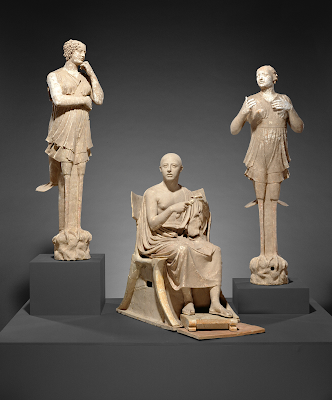
The items include three terracotta figures known as 'Orpheus and the Sirens' acquired in 1976 (inv. 76.AD.11). They were purchased from Bank Leu in Zurich. (For further information see the catalogue of terracottas at the Getty.)

Four other items from the Getty will be returned:
Recent research by Getty and independent scholars also determined that it is appropriate to return a second-century AD colossal marble head of a divinity; a second-century AD stone mold for casting pendants; an oil painting entitled Oracle at Delphi, 1881, by Camillo Miola; and a fourth-century BC Etruscan bronze thymiaterion. The first three of these objects were acquired by J. Paul Getty and the Getty Museum in the 1970s; the fourth in 1996. None of these objects have been on public view in recent years. Getty is currently working with the Ministry of Culture to arrange their returns.
There is no indication in the press statement about the sources though I understand that several feature in the photographic archives seized in Switzerland and Greece. 

The colossal marble head (inv. 72.AL.96) was acquired from Robin Symes. An Etruscan bronze thymiaterion was acquired in 1996 from the Fleischman collection (inv. 96.AC.253). It was sold to the  Fleischmans in 1987 by Edoardo Almagià. (This would be the second Almagià piece to be returned by the Getty.)

The story also appears in The Art Newspaper (incorrectly stating that the thymiaterion was purchased in 1996).


Bookmark and Share so Your Real Friends Know that You Know

Monday, 1 August 2022

Parthenon Partnership Proposed

Pedimental Sculptures from the Parthenon © David Gill
Jonathan Williams, the Deputy Director of the British Museum, has called for a 'Parthenon Partnership' to encourage discussion about where the architectural sculptures from the Parthenon should be displayed ("British Museum calls for ‘Parthenon partnership’ with Greece over marbles", The Guardian 31 July 2022). Williams was interviewed by Sarah Baxter of The Sunday Times ("Will the Marbles Finally Go Home?"). 

The museum seems to be restating its ownership of the sculptures though opening up opportunities for dialogue.

The issue is simple. Should architectural sculptures created for a specific building in Athens be displayed within line of sight of that structure? Or should they be retained in London?

| |
Bookmark and Share so Your Real Friends Know that You Know

Saturday, 23 July 2022

Myson krater returning to Italy

Back in 2014 I commented on an Attic column-krater attributed to Myson that had been identified by Christos Tsirogiannis from the Swingler collection of photographs (see here).  Tsirogiannis has subsequently published the krater and discussed its links with the Royal-Athena Galleries:
Source: Manhattan DA
Tsirogiannis, C. 2020. "The antiquities market we deserve: 'Royal-Athena Galleries' (1942-2020)." Acta ad archaeologiam et artium historiam pertinentia 32: 147–75. [Online]
Tsirogiannis has spotted that the same krater appears prominently in the Manhattan DA repatriation ceremony that took place this week. 

The krater itself surfaced in 1980 (Royal-Athena Galleries) and then had passed through the John Kluge collection (BAPD 9032028 [though without complete history]). The presence of its image in Swingler's photographic archive may suggest that it arrived in the US with consignments of pasta. Did Royal-Athena Galleries receive other consignments from this same source? 

Myson krater in Swingler archive
Image source: Christos Tsirogiannis
Is the krater one of the 60 pieces that are being returned from the stock of the now closed Royal-Athena Galleries? Or is it one of the 34 from other investigations? 

We look forward to the Manhattan DA listing the returned pieces.
| |
Bookmark and Share so Your Real Friends Know that You Know

Thursday, 21 July 2022

Crustumerium material


I am aware of an impasto amphora in a North American university collection that appears to come from Crustumerium and was handled by Edoardo Almagià. I presume that curators are checking their items for material from these sources.

| |
Bookmark and Share so Your Real Friends Know that You Know

Wednesday, 20 July 2022

New Returns to Italy Announced: Some Linked to Edoardo Almagià

Source: Manhattan DA

It was announced today that 142 antiquities will be returning to Italy (Press Release, "D.A. Bragg Returns 142 Antiquities Valued at Nearly $14 Million to the People of Italy", July 20, 2022). The returns consisted of 
"60 were recovered from Royal-Athena Galleries, 48 were recovered from STEINHARDT, and an additional 34 were seized pursuant to other ongoing investigations".
The Steinhardt material included:
Among the items being repatriated today is the Ercolano Fresco, which was seized as part of the investigation into STEINHARDT. Depicting an infant Hercules strangling a snake, the piece dates to 50 C.E. and was looted in 1995 from a villa in Herculaneum, an archaeological site that was buried for millennia under volcanic ash from the fiery eruption of Mount Vesuvius. STEINHARDT purchased the Ercolano in 1995 for $650,000 with no verifiable prior provenance. It is currently valued at $1,000,000.
Other items identified include:
Three fresco paintings dating to the 4th century B.C.E. from Paestum, an ancient Greek city located in southern Italy, which were seized pursuant to an ongoing investigation. These paintings depict scenes of mourning women, and were hacked from the wall of a tomb by looters.
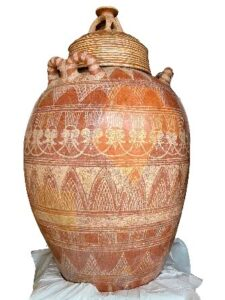
An Archaic pithos (storage jar) dating back to 700 B.C.E. that was seized pursuant to an ongoing investigation into Edoardo ALMAGIÀ, an Italian native and former New York resident.
The press release also acknowledges the following museums and a single gallery:
Indiana University’s Eskenazi Museum of Art, the Museum of Fine Arts-Boston, Royal-Athena Galleries, and the Toledo Museum of Art
One wonders if the Indiana material is linked to Almagià. 

The Boston material includes 9 pots apparently derived from Crustumerium in Latium that was acquired in 1995:
Probably about 1993/1994, illicitly excavated from Crustumerium, Italy and sold to Edoardo Almagià, New York; 1995, sold by Almagià to Jonathan Kagan and Sallie Fried, New York; 1995, year-end gift of Jonathan Kagan and Sallie Fried to the MFA (Accession Date: January 24, 1996); December 16, 2021, deaccessioned by the MFA for transfer to the New York County District Attorney and return to the Republic of Italy.
So far Boston is the only museum that appears to have provided full information.

| |
Bookmark and Share so Your Real Friends Know that You Know

Another Bürki object returns to Italy

Source: MMA A psykter column-krater attributed to the Troilos painter was deaccessioned by New York's Metropolitan Museum of Art in June...