Showing posts sorted by relevance for query royal-athena. Sort by date Show all posts

Wednesday, 14 November 2007

Jerome Eisenberg returns antiquities: a correction

On Saturday I commented on the return of eight antiquities to Italy by Jerome Eisenberg. In it I posed the questions:


What was his due diligence process? Had he consulted and obtained clearance from the Art Loss Register?

Dr Eisenberg has responded to me (and his letter has been attached in full to the original posting). He leads with this statement:
It should be brought to your attention that the Art Loss Register was not established until 1991.

He is right (see ALR website) though there was an earlier archive established by The International Foundation for Art Research (IFAR) in 1976. I must apologise for giving a misleading impression.

The earlier history for six of the eight antiquities is available:

a. The neck-amphora surfaced at Sotheby's (London) in 1985, passed through the Freiburg market, and was in the possession of the Royal-Athena Galleries by 1992.
b. The hydria surfaced in the Royal-Athena Galleries in 1990.
c. The column-krater surfaced at Sotheby's (London) in 1987 and then passed to the Royal-Athena Galleries, featuring in the catalogues for 1991 and 2006.
d-f. The three bronzes are reported by the Italian authorities to have been stolen from Italian collections in 1970, 1971 and 1975. I do not know when the Royal-Athena Galleries acquired them (though they are said to have been sold to a North American collector during the 1980s).


Dr Eisenburg would not have been able to check the histories of these six objects with the Art Loss Register (ALR) as the Royal-Athena Galleries acquired them before the formation of that organisation in 1991. (I include within the six the neck-amphora and the column-krater that were in his possession by 1991 and 1992.)

I do not know when the Royal-Athena Galleries acquired the other two pieces.

However some of the pieces were in the possession of Royal-Athena Galleries after 1991 and the creation of the Art Loss Register. The column-crater (Beazley Archive no. 19523), for instance, featured in a 2006 catalogue (Art of the Ancient World vol. 17).

Lee Rosenbaum ("Italian Criminal Charges Possible in Connection with Antiquities Recovery from Private Collector; Accord Reached with Princeton Museum", Culturegrrl, June 28, 2007) has commented specifically on two of the bronzes (the Nike and the athlete):
Eisenberg told me [sc. Rosenbaum] that he had sold the bronzes in the 1980s to collector John Kluge, who put them up for auction at Christie's on June 8, 2004. Eisenberg repurchased them there (for $6,573 and $9,560, respectively). He said that he had also voluntarily returned other pieces, when he learned that they had been illegally taken from Italy.

The Royal-Athena Galleries are members of the International Association of Dealers in Ancient Art (IADAA). Their "Code of Ethics and Practice" states:

All members undertake to check objects with a purchase value of Euro 3000 or over (or local currency equivalent) with the Art Loss Register unless the item has already been checked.

Did the Royal-Athena Galleries consult the ALR database once the bronzes had been re-acquired? Or was the fact that they had owned the pieces back in the 1970s or 1980s deemed to be sufficient? Or had Christie's run a check on the bronzes prior to the 2004 sale?

I have commented elsewhere on the use and limitations of the ALR ("The Art Loss Register and Antiquities").


Thursday, 1 December 2016

An Etruscan bronze athlete from an old Swiss collection

Source: Schinousa archive
Dr Christos Tsirogiannis has drawn attention to four items in the December sale of antiquities at Gorny & Mosch in Munich.

I am particularly interested in the fifth century BC Etruscan bronze figure of a youth. The collecting history is given as follows:
Ex Sammlung R.G., Deutschland. Bei Royal Athena Galleries, New York, Catalogue XXI, 2010, 43. Ex Sotheby´s Catalogue of Antiquities 13. Juli 1981, 341.
If we tidy this up, it could be presented as:
R.G. Collection, Germany; Sotheby's (London) 13 July 1981, lot 341; Royal Athena Galleries, New York, Catalogue XXI, 2010, no. 43.
However if you check the Royal-Athena Galleries catalogue for 2010, the following collecting history is provided:
Athos Moretti collection, Bellinzona, Switzerland; Royal-Athena Galleries, 1985; R.G. Collection, Calodyne, Mauritius, 1985-2008.
From my notes on the piece I can provide a little more information:
Athos Moretti collection, Bellinzona, Switzerland; Sotheby's (London) 13-14 July 1981, lot 341; Royal-Athena Galleries, Catalogue IV, 1985, no. 185; Dr Leo Mildenberg for the R.G. Collection; R.G. Collection, Calodyne, Mauritius, 1985-2008.
I am curious about the information in the Gorny & Mosch catalogue:

  • Why is there no mention of the Athos Moretti collection in Bellinzona? What is the authenticated documentation that it was in this collection?
  • Why is there no mention of the Royal-Athena Galleries catalogue of 1985?
  • Why is there no mention of Dr Leo Mildenberg?
  • Why place the R.G. collection in Germany rather than Mauritius?

The more intriguing question is when was the bronze handled by Robin Symes? And why is there no mention of this?

It would be interesting to learn more about the collection of Dr Athos Moretti, not least because the Dallas Museum of Art is reported to have acquired a large part of his collection of jewellery in 1991.

It does suggest that the due diligence process for Gorny & Mosch needs to be tightened. For previous mentions of this auction house see Operation Ghelas.

Bookmark and Share so Your Real Friends Know that You Know

Monday, 28 November 2022

Bronze Attis Returns to Turkey

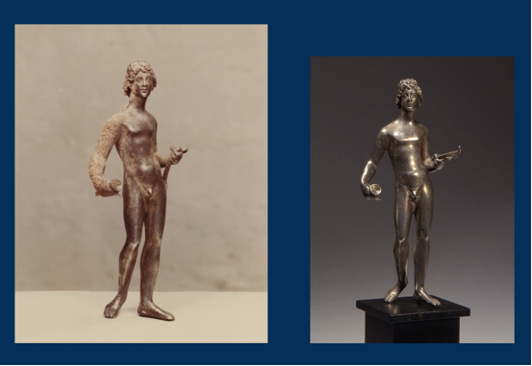
L: Bronze returned to Turkey. R: Bronze in Royal-Athena Galleries


Among the objects returned to Turkey was a small bronze identified as Attis. This appears to be the bronze acquired from Galerie Nefer in July 1984 and then sold through Royal-Athena Galleries (Art of the Ancient World 4 [1985] no. 144) to the J.H. collection, Dearborn, Michigan. It was then placed on loan with Ohio State University; Picker Art Gallery, Colgate University; and Fitchburg Art Museum. It was then back on sale at the Royal-Athena Galleries (Art of the Ancient World 29 [2018] no. 18).

Note that the 2018 catalogue entry mentions the oriental 'costume and cap' but rather than identifying it as Attis suggests Orpheus.

What other material did the Royal-Athena Galleries acquire from Galerie Nefer? 

I presume that the Manhattan DA will at some point issue a list of material that has been returned to Italy and Turkey from the stock of the Royal-Athena Galleries. Should those museums and collectors that acquired material from this source now be checking the histories of the objects? 

| |
Bookmark and Share so Your Real Friends Know that You Know

Saturday, 23 July 2022

Myson krater returning to Italy

Back in 2014 I commented on an Attic column-krater attributed to Myson that had been identified by Christos Tsirogiannis from the Swingler collection of photographs (see here).  Tsirogiannis has subsequently published the krater and discussed its links with the Royal-Athena Galleries:
Source: Manhattan DA
Tsirogiannis, C. 2020. "The antiquities market we deserve: 'Royal-Athena Galleries' (1942-2020)." Acta ad archaeologiam et artium historiam pertinentia 32: 147–75. [Online]
Tsirogiannis has spotted that the same krater appears prominently in the Manhattan DA repatriation ceremony that took place this week. 

The krater itself surfaced in 1980 (Royal-Athena Galleries) and then had passed through the John Kluge collection (BAPD 9032028 [though without complete history]). The presence of its image in Swingler's photographic archive may suggest that it arrived in the US with consignments of pasta. Did Royal-Athena Galleries receive other consignments from this same source? 

Myson krater in Swingler archive
Image source: Christos Tsirogiannis
Is the krater one of the 60 pieces that are being returned from the stock of the now closed Royal-Athena Galleries? Or is it one of the 34 from other investigations? 

We look forward to the Manhattan DA listing the returned pieces.
| |
Bookmark and Share so Your Real Friends Know that You Know

Wednesday, 7 November 2007

Jerome Eisenberg returns antiquities: further details

Further details on the return of eight antiquities from Jerome Eisenberg to Italy are beginning to emerge [Italian press release]

a. Attic black-figured neck-amphora showing Hephaistos. Attributed to the Leagros group. Said to be from Etruria.
b. Attic red-figured hydria showing women. Said to be from South-Central Italy.
c. Attic red-figured column-krater showing Dionysos. Geras painter. Said to be South-Central Italy.
d. Pontic oinochoe showing warriors. Tityos painter. Said to be from Etruria.
e. Roman marble nymph from fountain. Said to be from Central Italy.

The neck-amphora (a) appears to be listed on the database of the Beazley Archive as surfacing at Sotheby's in London (17-18 July 1985, lot 257). It then passed through Galerie Günter Puhze in Freiburg, and was in the hands of the Royal-Athena Galleries in 1992.

The hydria (b) is listed on the database of the Beazley Archive. It surfaced in the Royal-Athena Galleries in 1990.

The column-krater (c) appears to be listed on the database of the Beazley Archive as surfacing at Sotheby's in London (14 December 1987, 295). It subsequently featured in the Royal-Athena Galleries catalogues in 1991 and 2006.

The three Etruscan bronzes had all apparently been stolen from museums in Italy:

f. Etruscan bronze figure. Stolen from Museo Nazionale Etrusco di Chiusi on 28 April 1971.
g. Etruscan bronze Nike. Stolen from la Soprintendenza archeologica di Ercolano (Napoli) on 23-24 July 1975.
h. Etruscan bronze athlete with strygil. Stolen from Museo Archeologico Nazionale “Spina” di Ferrara on 3 August 1970.

Lee Rosenbaum had in fact already anticipated this announcement in her posting back in June ("Italian Criminal Charges Possible in Connection with Antiquities Recovery from Private Collector; Accord Reached with Princeton Museum", Culturegrrl, June 28, 2007). She noted,
Giovanni Nistri ..., commander of the carabinieri's special unit for cultural patrimony, told me that two of the recovered objects---a ... bronze Etruscan figure of a nude athlete, and a ... bronze Etruscan figure of Nike, had been discovered by Italian investigators on the website of Eisenberg's Royal-Athena Galleries, which voluntarily restituted them when shown evidence of their theft from an Italian museum and an archeological site, respectively. Nistri explicitly stated that Eisenberg had had no prior knowledge of the works' problematic histories and had cooperated in their restitution.

Eisenberg told me [sc. Rosenbaum] that he had sold the bronzes in the 1980s to collector John Kluge, who put them up for auction at Christie's on June 8, 2004. Eisenberg repurchased them there (for $6,573 and $9,560, respectively). He said that he had also voluntarily returned other pieces, when he learned that they had been illegally taken from Italy.

Eisenberg should be praised for these returns. But it confirms that some items that passed through Sotheby's in London during the mid-1980s (and exposed in Peter Watson's Sotheby's: Inside Story [1997]) were derived from looted archaeological sites in Italy. And what other potentially looted material was also moving through the market in the same way?

Friday, 5 December 2014

Pasta, Swingler, Christie's and the Krater

Image reported to have been seized from Swingler
Source: Tsirogiannis
Back in 2000, Christina Ruiz reported on "Artefacts Smuggled in Spaghetti" for the Art Newspaper. In June of that year:
The other major group of works presented to the [Italian] Ministry of Culture was confiscated from the California home of David Holland Swingler, a food importer, by US Customs officials collaborating with the Italian police. The Swingler cache was returned to Italy in June. 
... When US Customs officials searched Swingler's home in Laguna Hills they discovered a similar hoard of artefacts. 
The investigation into Swingler has revealed just how easy the business of smuggling artefacts can be. It seems that during trips to Italy, Mr Swingler made direct contact with tombaroli by visiting archaeological sites and simply asking around. 
Artefacts looted from Etruscan and Apulian sites by tombaroli collaborating with Swingler were passed onto his Italian partner and shipped to the US hidden among bundles of pasta in food containers. 
... 
In 1996 Swingler was sentenced in absentia by an Italian court to four years and eight months in prison and he was ordered to pay around $6,000 for damages to the archaeological heritage, the first time Italy has imposed such a fine.
During the raid in Laguna Hills a number of images were seized, among them an Attic red-figured krater attributed to Myson. The krater was reported to have been sold to 'a major East Coast collector'.

Source: Tsirogiannis
This krater is clearly the same one that is due to be auctioned at Christie's Rockefellar Plaza next week on December 11 (lot 95; $60000-$90000 estimate).

And Glasgow University researcher, Dr Christos Tsirogiannis, spotted the link.

Christie's note that the krater is the property of 'a New Jersey Private Collection', and provide the following collecting history:
  • with Royal-Athena Galleries, New York, 1980. 
  • John Kluge, Charlottesville. 
  • The Morven Collection of Ancient Art; Christie's, New York, 8 June 2004, lot 320. 
  • with Royal-Athena Galleries, New York, 2005 (Art of the Ancient World, vol. XVI, no. 86). 
The krater sold for $38,240 in 2004. At that time, it was sold as part of the Morven Collection of Ancient Art, and its collecting history was provided as follows:
  • with Royal-Athena Galleries, New York, 1980
What is the documented and authenticated collecting history of the krater prior to 1980? Who was the 'major East Coast collector' who is reported to have acquired it?

And is The City Review right to note that 'Morven' was the Virginia home of Kluge? And if so, why does Christie's add John Kluge as a separate entry in the collecting history?

This is not the first Royal-Athena Galleries --- Kluge krater that has attracted the attention of LM. And we know that there are issues relating to the Kluge collection, and that two bronzes formerly in that collection have been returned to Italy.

In the 2004 sale, Max Bernheimer of Christie's wrote in the catalogue that "Many [of the lots] have renowned provenance". Does the "renowned provenance" include the "Swingler collection"?

We presume that Christie's will now be contacting the Italian authorities.


Bookmark and Share so Your Real Friends Know that You Know

Thursday, 16 February 2017

Sarcophagus fragment: Greece, Basel, and New York

Source: Becchina archive
One month ago I was informed that a sarcophagus fragment had been seized from a New York gallery. The identification of the piece with an image in the Becchina archive had been made by Dr Christos Tsirogiannis.

It is worth reviewing the collecting history for the piece:

  • piece handled by Greek trafficker, Giorgos Ze[ne...]
  • 25 May 1988: Gianfranco Becchina paid SF 60,000 to Zene[]
  • Object placed in the Basel Freeport
  • Andre Lorenceau cleaned and then drilled the fragment to create holes for mount
  • April 1991: Swiss art market
  • Attributed by Dr Guntram Koch [date of attribution not provided]
  • 1992: Royal-Athena Galleries, Art of the Ancient World vii, no. 57
  • 2000: Royal-Athena Galleries, Art of the Ancient World xi, no. 30
  • April 2000: Dr H collection, Germany
  • 2016: Royal-Athena Galleries, Art of the Ancient World xxviii, no. 6 [online] Price on Request
  • 2017, 14 January: fragment seized
  • 2017, 10 February: sarcophagus returned to Greece
The identity of the vendor on the Swiss art market in April 1991 is not made clear in the history. Who sold the sarcophagus fragment to the Royal-Athena Galleries? What other pieces have been derived from the same source? When did those transactions take place?

Will there be further clues in the Becchina archive showing how material passed from Switzerland to North America?

For further information and images see ARCA.

Bookmark and Share so Your Real Friends Know that You Know

Monday, 20 May 2013

Additional collecting histories for an Attic krater

It appears that further information can be added to the Athenian black-figured column-krater due to be auctioned at Christie's on June 6, 2013 (lot 546). The catalogue entry tells us:

  • Art Market, Freiburg, 1988. 
  • with Royal-Athena Galleries, New York, 1990 (One Thousand Years of Ancient Greek Vases from Greece, Etruria & Southern Italy, no. 35). 
  • Patricia Kluge, Charlottesville, Virginia. 
  • with Royal-Athena Galleries, New York, 2010 (One Thousand Years of Ancient Greek Vases II, from Greece, Etruria & Southern Italy, featuring the Patricia Kluge Collection, no. 50).

The present proprietor is stated as a Midwest Private Collector.

The Royal Athena Gallery informs us of a parallel collecting history:

  • Ex German collection; Patricia Kluge collection, Charlottesville, Virginia, acquired from Royal-Athena in 1991.

The Beazley Archive (no. 44199) omits the "old German collection" as well as the anonymous Midwestern private collection.

The dealer in Freiburg is perhaps one noted elsewhere on LM but we cannot be sure.

But the main omission is that the krater also seems to appear in the photographic archive of Gianfranco Becchina.

Did Becchina supply material to the Freiburg market? If so, what other material from the Freiburg market can be traced to Becchina?

Kluge is also interesting as a collector.

But is this the only piece in the New York sale that can be identified from the photographic archives?

Can we presume that the head of Christie's antiquities department will be contacting the Italian authorities as soon as possible?

I am grateful to Cambridge researcher Christos Tsirogiannis who made the identification. 

Bookmark and Share so Your Real Friends Know that You Know

Saturday, 3 December 2022

Identifications at Sotheby's in London

Image from the Becchina archive courtesy of Christos Tsirogiannis

Professor Christos Tsirogiannis has identified three objects from the Becchina, Medici and Symes archives that were due to be auctioned at Sotheby's in London on December 7, 2022. His identifications are covered in a report by Dalya Alberge, "Archaeologist urges Sotheby’s to cancel auction of ‘illicit’ artefacts", Daily Telegraph December 3, 2022.

Take for example the Roman bronze protome spout in the form of a dog or spout (lot 121). The history of the piece is provided:
  • Swiss private collection 
  • Royal-Athena Galleries, 
  • New York John W. Kluge, acquired from the above in 1989 (Christie's, New York, The Morven Collection of Ancient Art, December 10th, 2004, no. 590, illus.)
Notice on the image the annotation 'V[ia]/Jer[ome Eisenberg]' confirming the link with the Royal-Athena Galleries. The image is taken from the Becchina archive and records show that it was derived from Mario Bruno. Presumably one of these two sources is to be identified as the 'Swiss private collection'.

In the report in the Telegraph it is noted:
A Sotheby’s spokesman said that they “uphold the highest standards of due diligence”.
How did Sotheby's conduct a rigorous due diligence test on the anonymous Swiss private collection? Had they considered the possibility that Becchina or another such individual was the origin? 

Royal-Athena Galleries should also have raised an alert. Only in November three antiquities from this source were returned to Turkey: e.g. silver Apollo. Or in July this year an Attic krater from the Gallery was returned to Italy. This was among 60 antiquities from Royal-Athena Galleries. Again, had Sotheby's taken this into account as part of their rigorous due diligence process? 

In May 2017 a Paestan lekythos was provided with a nearly identical history to the bronze spout. Did this raise concern? Indeed it is clear that the Kluge collection has been linked to several antiquities that have been returned to Italy. This in itself should have alerted those preparing the catalogue entry for Sotheby's.

Will Sotheby's in London tighten up its processes? Is there a need to raise the standard of the due diligence approach to a more rigorous level?


| |
Bookmark and Share so Your Real Friends Know that You Know

Monday, 28 November 2022

Kusura Type Figure Returned to Turkey

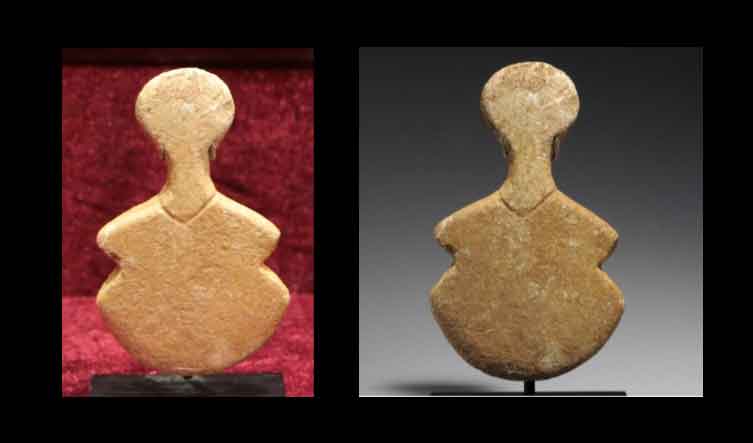
L: Figure Returned to Turkey. R: Figure from Royal-Athena Galleries

Among the recent items returned to Turkey was a Kusura type marble figure. Although there was no statement about the origin of the figure it seems to be the one offered by the Royal-Athena Galleries in New York in 2006 (Art of the Ancient World 17, no. 218) and 2017 (Art of the Ancient World 28, no. 166). It is said to have resided in an anonymous French private collection. 

It will be recalled that 60 items from the Royal-Athena Galleries were returned to Italy in July 2022. Was this Kusura type figure seized at the same time or has it been residing elsewhere? The Manhattan DA does not yet seem to have issued an informative press release about these latest returns to Turkey. 

| |
Bookmark and Share so Your Real Friends Know that You Know

Wednesday, 31 May 2017

Paestan lekythos from "an old Swiss collection"

Source: New York County District Attorney's Office
Paestan lekythos. Source: Google

One of the pieces seized from an as yet unnamed Manhattan gallery is a Paestan lekythos attributed to the Asteas-Python workshop. It has a stated collecting history:

  • Swiss private collection
  • Royal-Athena Galleries (1987-1988)
  • John Kluge private collection
  • Patricia Kluge private collection, Charlottesville, Virginia (1990-2010)
  • Royal-Athena Galleries: One Thousand Years of Ancient Greek Vases II ... Featuring the Patricia Kluge Collection (2010) no. 164

It would be interesting to learn the name of the anonymous Swiss private collection in which this lekythos once resided. (And note that this information is derived not from Royal-Athena Galleries but from the present vendor.)

We also note the appearance of the Kluge collection.

Bookmark and Share so Your Real Friends Know that You Know

Saturday, 10 November 2007

Minerva: holding back on the detail?

I confess that Minerva: The International Review of Ancient Art & Archaeology has not been one of my favourite magazines. I have not changed my views since 1990 when Kevin Butcher and I published a review article of the first few numbers.

Its founder, editor-in-chief, and publisher is Dr Jerome Eisenberg. And it is Eisenberg, wearing his other hat as founder and director of Royal-Athena Galleries in New York, who has returned eight antiquities to Italy.

It now looks as if some of the material handled by Eisenberg --- but purchased at auction in London --- could have derived from Giacomo Medici. The impact of the "Medici Conspiracy" is immense. The last two years have seen major North American museums agreeing to return objects with little apparent fight --- and one suspects the evidence was too compelling.

So what does a dealer and magazine editor-in-chief like Eisenberg make of the returns to Italy? He has helpfully published lists of the returns but has held back on the detail. There are clear implications for private collectors. The Fleischman collection, sold or donated to the Getty, has featured prominently in the returns. And one of the pieces illustrated by Eisenberg (no. 14) is recorded as coming from the same room as a fragment in the Shelby White collection. But Eisenberg makes no reference to the link.

And there appears to be no mention in Minerva that some of the antiquities returned to Italy from Boston and Malibu had passed through the Royal-Athena Galleries.

Perhaps all that was intended was to provide a simple list and to reassure the readers of Minerva that the antiquities market was stable.

But everything has now changed.

Eisenberg himself is in the spotlight. And he will have the opportunity to explain the eight antiquities. How was he able to acquire items stolen from museums in Italy? Had he been suspicious of items surfacing at Sotheby's (London) in the mid-1980s? What was his due diligence process? Had he consulted and obtained clearance from the Art Loss Register?

And is it just coincidence that a red-figured column-krater returned to Italy by Eisenberg is attributed to the same Geras painter as an amphora returned from the Getty? (I have noted elsewhere the thread of the Darius painter running through the other returns to Italy.)

And Eisenberg's explanations need to be convincing. Why?
Over the past 50 years we [sc. Royal-Athena Galleries] have sold more than 600 works of ancient art to many of the country's leading museums, including the Metropolitan Museum of Art, the Boston Museum of Fine Arts, the Sackler Art Museum at Harvard University, the Yale University Art Gallery, the Princeton University Art Museum, the Newark Museum, the Detroit lnstitute of Arts the Cincinnati Art Museum, the Minneapolis Institute of Arts, the Milwaukee Public Museum, the New Orleans Museum of Art, the Virginia Museum of Fine Arts, the Los Angeles County Museum of Art, and the J. Paul Getty Museum, as well as the British Museum, the Louvre, and a number of museums in Canada, Germany, Greece, the Netherlands, Spain, Switzerland, Australia, and Japan. (quote from website)

Museum curators and trustees will be wanting to ensure that they made sound and secure acquisitions.

Reference
Butcher, K., and D. W. J. Gill. 1990. "Mischievous pastime or historical science?" Antiquity 64: 946-50.
Eisenberg, J. M. 2007. "Italy & the J. Paul Getty Museum Antiquities Repatriation." Minerva 18: 19-20.
Gill, D. W. J., and C. Chippindale. 2006. "From Boston to Rome: reflections on returning antiquities." International Journal of Cultural Property 13: 311-31 (abstract).
Gill, D. W. J., and C. Chippindale. 2007. "The illicit antiquities scandal: what it has done to classical archaeology collections." American Journal of Archaeology 111: 571-74 (pdf).
Gill, D. W. J., and C. Chippindale. 2007. "From Malibu to Rome: further developments on the return of antiquities." International Journal of Cultural Property 14: 205-40 (abstract).

Wednesday, 16 May 2012

Thoughts on a pair of Apulian kraters

Source: Schinoussa archive
Conversations over the last few months have made me reflect on a pair of Apulian kraters that have been on offer on the New York market (and now sold).

The pair show Amphiaros before an enthroned Pluto, and Aphrodite and Zeus flanking Adonis. They are nearly equal in height: 1.14 m and 1.12 m.

The pair of kraters follow a parallel collecting history. The kraters appeared in the Hesperia Arts Auction Ltd. sale of November 27, 1990, Part II, no. 40, and were sold for $75,000 (less than the estimated $80,000-$100,000). They were sold at the Royal-Athena Galleries in 1991 (Art of the Ancient World 6 [1991] nos. 74 and 75). They then featured in A.D. Trendall and Alexander Cambitoglou's The Red-Figured Vases of Apulia suppl. II, part 2 (London 1992) 274-75, nos. 22a1, 23f. The kraters were sold by Royal-Athena Galleries in 1991 to the "S.B. collection" in San Diego, CA. Both pieces were being resold by the same New York gallery in Art of the Ancient World (2012) nos. 116 and 117.

It is significant that images of both kraters appear in the photographic archive seized by Greek authorities on the island of Schinoussa. A North American dealer has informed me that the London-based dealer represented by that photographic archive supplied much of the material for Athena Fund II.

The same London-based dealer handled the Athenian krater that is to be returned to Italy by the Minneapolis Institute of Art. There is material from the same dealer appearing on the New York auction market. (Indeed the same auction-house had material from the same London dealer in their October 2011 London sale.)

This raises a further issue. Who handled the material prior to the London-based dealer? Will another photographic archive shed light on the answer?

I am grateful to Cambridge University researcher Christos Tsirogiannis for his identifications of these two kraters.


Bookmark and Share so Your Real Friends Know that You Know

Saturday, 3 September 2022

Search Warrant for the Met

Castor and Pollux previously on loan to New York's Metropolitan Museum of Art
© David Gill


Some of the pieces on the search warrant have been discussed by LM in the past:

Bookmark and Share so Your Real Friends Know that You Know

Wednesday, 16 November 2022

A Silver Apollo Returns to Turkey

Left: Symes-Michaelides archive; Right: Royal-Athena Galleries


In November 2022 the US authorities returned a silver statuette of Apollo to Turkey. This was recognised as the figure that had been identified by Christos Tsirogiannis in 2007 as appearing in the Symes-Michaelides archive. It receives a full discussion in his PhD thesis, Unravelling the Hidden Market of Illicit Antiquities: The Robin Symes - Christos Michaelides Network and its International Implications (Cambridge University, PhD Dissertation, 2012). 

The history can be traced through the various sale catalogues in which it appeared.

The figure seems to have surfaced in an exhibition organised by Marie-Louise Vollenweider, Musées de Genève in January 1987 (no. 274), and then featured in the exhibition for Numismatic Fine Arts, Treasures from an Ancient Jewelbox: Gold and Silver of the Ancient World (1992): the catalogue was prepared by Robert Hecht. 

The figure next appeared in the exhibition organised in memory of Michaelides by Robin Symes, Royal Portraits and Hellenistic Kingdoms (New York 1999) no. 24, and then passed into a New York private collection. It was offered at Sotheby’s (New York) on December 7, 2001, lot 76 but was unsold; it entered an Australian private collection in 2002, and was offered at Sotheby’s (New York) June 5, 2008, lot 22 but again was reportedly unsold. It was purchased by Jerome Eisenberg and appeared in Royal-Athena Galleries, Art of the Ancient World 20 (2009) no. 134; Art of the Ancient World 28 (2017) no. 27. It is not clear when the Apollo was seized.

The evidence used to associate the Apollo with a findspot in Turkey has not been disclosed as part of the return, but it has been associated with rulers from Pontus and Cappadocia.

Note. The label in the Antalya Museum states that the figure is bronze but this is incorrect. I am grateful to Christos Tsirogiannis who was able to confirm the material.

| |
Bookmark and Share so Your Real Friends Know that You Know

Tuesday, 6 November 2007

Jerome Eisenberg returns antiquities: new deal with Italy

Reports are breaking that Jerome Eisenberg of the Royal-Athena Galleries in New York has returned eight antiquities worth US$510,000 to Italy (Alessandra Migliaccio and Adam L. Freeman, "Art Dealer Eisenberg Returns Antiquities to Italy", Bloomberg.com, November 6, 2007; Ariel David, "Looted Art Returns to Italy From NY", Guardian Unlimited, November 6, 2007).

This comes hard on the heels of the news that Princeton has come to an agreement with Italy.

The items, some of which had already been sold, include "three bronze Etruscan statues, four vases" and "a 1st century Roman statue of a reclining woman that was used to decorate a fountain". Two items are reported to have been returned to Italy in the fall of 2006.

Ariel David notes that most of the returning items were acquired at auction in London during the 1980s.

Eisenberg, who has been exhibiting at the Basel Ancient Art Fair over the last few days, is quoted as saying:

It was the right thing to do and maybe it will set an example for other people.

Who are the other people? Fellow dealers or private collectors?

Royal-Athena Galleries, which handled some of the antiquities that have been returned from the Museum of Fine Arts in Boston and the J. Paul Getty Museum in Malibu, belong to the International Association of Dealers in Ancient Art (IADAA).

It is now clear that the Code of Ethics and the due diligence processes conducted by members of the IADAA are not rigorous enough.

Perhaps more significant is the fact that members of the IADAA agree to the following action:
All members undertake to check objects with a purchase value of Euro 3000 or over (or local currency equivalent) with the Art Loss Register unless the item has already been checked.

Antiquities worth over half a million US dollars are likely to have fallen into this category.

Did the Art Loss Register (ALR) --- an organisation also present at Basel --- issue certificates to say that the items had been checked? And if so, does the ALR need to address, as a matter of urgency, the issue of researching antiquities ?

Saturday, 25 February 2017

Attic amphora from 'old Swiss collection' seized in New York

Source: Becchina archive
I understand that an Attic red-figured Nolan amphora attributed to the Harrow painter was seized from a New York Gallery on Friday. It shows a satyr with thyrsos.

The amphora features in Royal-Athena Galleries, Art of the Ancient World xxvii (2016) no. 100.

The collecting history is as follows:

  • Swiss private collection
  • Royal-Athena Galleries 2000, sold in 2002; Art of the Ancient World xi (2000) no. 90.
  • C. H. collection, Ann Arbor, Michigan
  • 2003-2015: exhibited, Yale University Art Museum

The Becchina archive suggests that it was acquired on 15 March 1993.

I am grateful to Dr Christos Tsirogiannis for the information about the seizure.

Beazley archive: 23408

Bookmark and Share so Your Real Friends Know that You Know

Wednesday, 29 May 2013

Ex-Kluge Collection on the market

Antiquities that formed part of the John Kluge collection are not without interest on LM. I see that three ex-Kluge pots are up for auction at Christie's Rockefeller Centre on June 6, 2013:

  • lot 546: Attic black-figured column-krater, attributed to the Bucci painter. Surfaced on the Freiburg market, 1988. [Unstated: Becchina Archive.]
  • lot 594: Apulian amphora, attributed to the Edinburgh exhibition painter. Surfaced in Royal-Athena Galleries, 1981.
  • lot 595: Apulian volute-krater, attributed to the Baltimore painter. Surfaced in Royal-Athena Galleries, 1979.
What are their full collecting histories (prior to their first stated appearances)?

Readers of LM should re-read Lee Rosenbaum's observations about Kluge dating back to 2007. 


Bookmark and Share so Your Real Friends Know that You Know

Thursday, 1 October 2009

Antiquities from North American Collections at the Villa Giulia

The Euphronios krater and its companions sit in a darkened first floor room (Room 23) in the Villa Giulia, Rome. Outside the trams can be heard rumbling their way down the Viale delle Belle Arti.

The immediate museological context for these returned antiquities is the outstandingly important Etruscan collection of the Villa Giulia. Yet each one of the returned pieces has apparently been ripped from its last resting-place; this contrasts with many of the other pieces throughout the building that are derived from excavations.

The Euphronios krater, the intended highlight of Room 23, is not there at the moment. A handwritten note in its empty (but lit) case informs the visitor that it can be seen in the Museo Nazionale Castel Sant'Angelo. It is accompanied by other pieces (see earlier discussion):
  • the Onesimos cup returned from the J. Paul Getty Museum (see earlier comments).
  • Attic red-figured phiale, Douris, returned from the J. Paul Getty Museum (see discussion).
  • Attic red-figured column-krater, attributed to the Geras painter, returned from the Royal-Athena Galleries (see earlier comments).
  • fragment of Attic red-figured calyx-krater, attributed to the Berlin painter, body of Achilles (see earlier comments).
  • Attic red-figured cup, Pamphaios, returned from the J. Paul Getty Museum (see discussion).
  • Attic red-figured psykter, Smikros, returned from the Metropolitan Museum of Art, New York (see earlier comments).
  • Attic black-figured lekythos, attributed to the Disophos painter, returned from the Museum of Fine Arts, Boston (see MFA website).
  • Attic red-figured lekythos, attributed to the Terpaulos Painter, returned from the Museum of Fine Arts, Boston (see MFA website).
  • a black-figured skyphos fragment returned from the Princeton University Art Museums (see earlier comments).
  • a Pontic oinochoe, attributed to the Tityos painter, returned from the Royal-Athena Galleries (see earlier comments).
  • a Pontic amphora, attributed to the Tityos painter, returned from the J. Paul Getty Museum (see discussion).
  • a large Etruscan bronze figure, 2nd century BCE, from a French private collection (earlier reported as coming from a Swiss private collection).
  • a terracotta architectural antefix with centaur returned from the Princeton University Art Museums (see earlier comments).
  • a Protocorinthian olpe, returned from the J. Paul Getty Museum.
  • a duck-shaped askos, returned from the J. Paul Getty Museum (see discussion).
  • Caeretan hydria, attributed to the Busiris painter, returned from the Shelby White collection (see earlier comments).

Bookmark and Share so Your Real Friends Know that You Know

Friday, 9 January 2009

CPAC, Italy and Hindsight

On January 19, 2001, the Government of the United States of America and the Government of the Republic of Italy signed an Agreement to protect pre-Classical, Classical and Imperial Roman archaeological material. (CPAC)
The background to the agreement was provided:
This U.S. action is in response to a request from the Government of Italy under Article 9 of the 1970 UNESCO Convention on the Means of Prohibiting and Preventing the Illicit Import, Export and Transfer of Ownership of Cultural Property. Reports from the Carabinieri Nucleo Tutela del Patrimonio Artistico and in the Italian national and regional press indicate that looting is a current and severe problem, particularly in southern Italy, Sicily, and Etruria. The quantity and nature of Italian archaeological material on the market further indicate that the archaeological heritage of Italy is being pillaged to meet the demand for U.S. and international trade in artifacts. The Agreement offers the opportunity engage in a partnership to help protect the cultural heritage of Italy and to enrich American cultural life through research and educational programs and loans between Italian and American institutions.
On 12 October 1999 there was a public session of CPAC to gather views. We should be grateful to Peter K. Tompa for his eyewitness account of the proceedings ("State Department Advisory Committee Meets on Italian Request for Import Restrictions", Celator 13, 12 (December 1999) [available from ACCG]). He noted some of the contributors to the debate:
Jerome Eisenberg of Royal Athena Galleries showed slides of Italian auction catalogues selling archaeological items. ... he argued that it would be patently unfair to require importers of such items into the United States to prove more than their Italian counterparts.

Arielle Kozloff, a gallery owner, and Rena Moulopoulos, Sotheby’s Worldwide Director of Compliance, both made particularly eloquent statements. Ms. Kozloff charged that Italy was gripped with "Millennium Fever." She questioned the rights of the modern nation state of Italy to the cultural objects of the entire Roman Empire that encompassed most of Europe, parts of Africa, and parts of the Middle East. She also charged that there is a "dirty little secret" that archaeologists are afraid to speak against the claims of host governments for fear of losing permits to excavate. Ms. Moulopoulos indicated that Sotheby’s always seeks to confirm the provenance of items it auctions; however, most consignors do not want the provenance to be published due to concerns about confidentiality. ...

While the museum community is divided on the issue, the only museum representative that spoke, Marion True, agreed that museums should research provenance before procuring objects for their collections. Ms. True is the curator for antiquities at the Getty Museum. The Getty’s acquisitions policy for classical antiquities evidently states that the museum will only purchase items from established, well-documented (i.e., published) collections.
Since 1999 there have been a number of returns of antiquities to Italy:
CPAC was wise to sign the agreement given what we now know about the market in recently looted antiquities.

Another Bürki object returns to Italy

Source: MMA A psykter column-krater attributed to the Troilos painter was deaccessioned by New York's Metropolitan Museum of Art in June...