Showing posts sorted by relevance for query schimmel. Sort by date Show all posts

Thursday, 22 May 2025

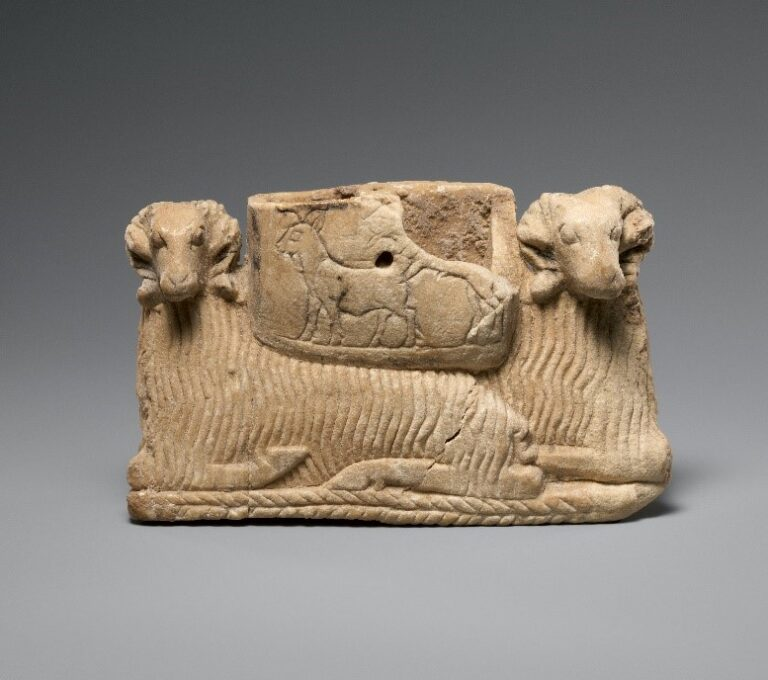
The Met returns three antiquities to Iraq

Source: Manhattan DA


New York's Metropolitan Museum of Art has returned three antiquities to Iraq (Manhattan DA Press Release). The three pieces are:
a. a Sumerian gypsum alabaster vessel supported by two rams, acquired from the Norbert Schimmel Trust in 1989. The history of the piece is provided:
By 1956, with N. Koutoulakis who bought it in Baghdad; from 1966, collection of Cecile de Rothschild; [by 1979, Robin Symes, London]; 1984, purchased by Norbert Schimmel from Robin Symes/ Xoilan Trader Inc., Geneva; from 1984, on loan to the Museum by Norbert Schimmel (L.1984.15.1); acquired by the Museum in 1989, gift of Norbert Schimmel Trust. 

b. a Mesopotamian terracotta female head, acquired from the Norbert Schimmel Trust in 1989. The  history of the piece is provided:
Before 1972, collection of Elie Borowski; by 1972, collection of Norbert Schimmel, New York; from 1983, on loan to the Museum by Norbert Schimmel (L.1983.119.12); acquired by the Museum in 1989, gift of Norbert Schimmel Trust. Deaccessioned for return to Iraq in May 2025.

c. a Mesopotamian terracotta male head, purchased from Robin Symes in 1972. It is reported to have been removed from the site of Isin. The history of the piece is provided:
By 1971, Robin Symes, London; acquired by the Museum in 1972, purchased from Robin Symes, London.

These returns renew the focus on antiquities handled by Robin Symes. The Met's "provenance" team could usefully look at the other Symes material currently on display in the museum. 

| |
Bookmark and Share so Your Real Friends Know that You Know

Tuesday, 20 March 2012

Norbert Schimmel as the model collector

News that Turkey has requested the return of part of the Norbert Schimmel collection is likely to have repercussions. I note Shelby White's comment: "Norbert Schimmel set a high standard for us as beginning collectors, not only for the quality of his collection but for his belief that it was to be shared with others" (Shelby White, "Building American museums: the role of the private collector." In Who owns the past? Cultural policy, cultural property, and the law, edited by K. Fitz Gibbon: 165-77. New Brunswick: Rutgers University Press / American Council for Cultural Policy, 2005: p. 171).

An eye of Amenhotep III from the Norbert Schimmel collection has now been returned to Egypt. Norbert Schimmel's name was linked to the Apulian dinos that was returned to Italy from New York's Metropolitan Museum of Art. Norbert Schimmel helped to fund the Met's purchase of the Morgantina hoard that has now been returned to Italy.

It looks as if there are precedents for the return of material from the Norbert Schimmel collection.

Bookmark and Share so Your Real Friends Know that You Know

Monday, 27 April 2026

Further returns to Italy from the MMA

Formerly New York MMA 1991.11.6.1–2.
Source: MMA
New York's Metropolitan Museum of Art has returned another batch of Greek and Roman antiquities as a result of investigations by the Manhattan DA into objects handled by Frieda Tchacos, Gianfranco Becchina, and Fritz Bürki [see Manhattan DA press release].

Only one piece is highlighted in the press release, a fragmentary Sicilian terracotta relief:
Two additional adjoining fragments of the votive relief were found in the archaeological excavations of the temple of Demeter Malophoros at Selinunte, Sicily, less than ten miles from Becchina’s hometown. Those fragments remain in the Palermo Museum.
This is linked to the Becchina investigation. The relief had formed part of the Norbert Schimmel collection. One other Schimmel piece is among the repatriated objects, a bronze handle attachment in the form of a mask. Other Schimmel items appeared in earlier returns.

The two Bürki linked pieces were objects presented by Dietrich von Bothmer, an Attic bilingual cup attributed to near Psiax, and a fragmentary cup attributed to Epiktetos.

The Tchacos pieces include a pair of spherical Greek gold earrings, a pair of Roman silver cups —one carries a weight inscription for the pair — and an inscribed lid of a Roman cinerarium (Sextus Flavius Pencarpus). There is also a forged Roman funerary inscription.

These latest returns have implications for other material. A batch of material from Selinunte is discussed in my Artwashing the Past (2025) [chapter 11]. The Tchacos investigation will lead to the numerous fragments acquired by other museums (as well as the nearly 300 fragments in the Bothmer collection: and these are just the ones identified in the sample).

I am grateful to Jason Felch for drawing my attention to one of the Schimmel pieces.

Bookmark and Share so Your Real Friends Know that You Know

Saturday, 3 September 2022

Search Warrant for the Met

Castor and Pollux previously on loan to New York's Metropolitan Museum of Art
© David Gill


Some of the pieces on the search warrant have been discussed by LM in the past:

Bookmark and Share so Your Real Friends Know that You Know

Friday, 2 November 2007

Apulian pottery: the significance of the Darius painter

The limited information being released by Princeton on the objects being transferred to Italy is raising questions ("More on the Princeton Give-Backs: "Looting Matters" Digs for Provenance", CultureGrrl).

Yesterday I drew attention to the three Apulian pots attributed to the Darius painter which will be returned to Italy from Boston, Malibu and Princeton. The three were significant because all had been listed as recent surfacings of the "painter's" work in Boston's catalogue of South Italian pottery.

But I did not mention the Apulian dinos, also attributed to the Darius painter, which had been returned from the Metropolitan Museum of Art in New York (inv. 1984.11.7). The piece, showing Herakles and Busiris, was a purchase from "The Bothmer Purchase Fund, Rogers Fund, and Norbert Schimmel and Helen H. Mertens Gifts, 1984; Anonymous Gift, 1989" [see press release]. The piece was apparently identified by Polaroids seized during a police raid in Geneva (see Elisabetta Povoledo and Randy Kennedy, "Confrontation With Italy Looms at the Met", New York Times November 21, 2005).

Nor did I note that a volute-krater, attributed to the same painter, in the Cleveland Museum of Art (inv. 1988.41) is also apparently under suspicion (Suzan Mazur, "Italy Will Contest Medea Vase At Cleveland Museum", Scoop.co.nz, October 9, 2006).

What these pots appear to indicate is that there was a brisk movement of Apulian pottery from previously undisturbed tombs in Southern Italy to North American institutions. And the details of the transactions are beginning to emerge.

Image courtesy of New York, Metropolitan Museum of Art (www.metmuseum.org).

Dinos with Herakles and Busiris, ca. 340–320 B.C.; Red-figure. Greek, South Italian, Apulian. Attributed to the Darius Painter. Terracotta; H. 9 3/4 in. (24.79 cm). Purchase, The Bothmer Purchase Fund, Rogers Fund, and Norbert Schimmel and Helen H. Mertens Gifts, 1984; Anonymous Gift, 1989 (1984.11.7).


Wednesday, 2 April 2008

Homecomings: The Metropolitan Museum of Art

One of the first agreements to return antiquities to Italy was made with the Metropolitan Museum of Art in New York (February 21, 2006) [Press Release]. The discussion has tended to centre around the Sarpedon krater but there were other pieces as well.

The current Nostoi exhibition in the Palazzo Poli in Rome contains the following pieces (with the number in the previous Nostoi exhibition):
  • Laconian cup with warrior. Attributed to the Hunt painter. Formerly New York 1999.527. Gift from the family of Howard J. Barnet. "Lent to the Museum periodically since 1981" (Mertens). Publ. Joan R. Mertens, in "Ancient World", The Metropolitan Museum of Art Bulletin, New Series, 58, No. 2, Recent Acquisitions: A Selection 1999-2000 (Autumn, 2000), 13 [JSTOR]. (Nostoi no. 3; old no. 3).
  • Attic red figure psykter with young horsemen. Attributed to Smikros (attributed by J. Robert Guy). Formerly New York L1980.104 (loan from Mr & Mrs Spears, Riverdale [NY]); 1996.250. Gift of Thomas A. and Colette Spears. Publ. Dietrich von Bothmer, in "Ancient World", The Metropolitan Museum of Art Bulletin, New Series, 55, No. 2, Recent Acquisitions: A Selection 1996-1997 (Autumn, 1997) 12 [JSTOR]. (Nostoi no. 15; old no. 14).
  • Attic red figure amphora with cithara player. Attributed to the Berlin painter. Sold at auction, Sotheby's (London), December 13-14, 1982, lot 220. Formerly New York 1985.11.5. Publ. Dietrich von Bothmer, in "Greek and Roman Art", Recent Acquisitions (Metropolitan Museum of Art) (1985-1986), 9 [JSTOR]. (Nostoi no. 17; old no. 16).
  • Apulian red-figured dinos with Herakles and Busiris. Attributed to the Darius painter. Formerly New York 1984.11.7. Purchase, The Bothmer Purchase Fund, Rogers Fund, and Norbert Schimmel and Helen H. Mertens Gifts, 1984; Anonymous Gift, 1989. Dietrich von Bothmer, "Greek and Roman Art", Notable Acquisitions (Metropolitan Museum of Art) (1984-1985), 6-7 [JSTOR]. (Nostoi no. 57; old no. 51).
Not included this time:

Entry revised: August 21, 2008.

Image courtesy of New York, Metropolitan Museum of Art (www.metmuseum.org).

Dinos with Herakles and Busiris, ca. 340–320 B.C.; Red-figure. Greek, South Italian, Apulian. Attributed to the Darius Painter. Terracotta; H. 9 3/4 in. (24.79 cm). Purchase, The Bothmer Purchase Fund, Rogers Fund, and Norbert Schimmel and Helen H. Mertens Gifts, 1984; Anonymous Gift, 1989 (1984.11.7).

Saturday, 7 September 2013

Bothmer and the Brygos painter

Among the Athenian pot-painters associated with Dietrich von Bothmer is the Brygos painter. Fragments derived from him in the Met include this cup:

  1. Fragments from cup with a seated dog. 1995.290. Joins: 1980.11.1 (purchase, Norbert Schimmel Gift); 1980.473.1 (DvB); 1981.11.14 (Purchase, Jerome Levy Foundation). 
What are the full collecting histories for each of the fragments?

Bookmark and Share so Your Real Friends Know that You Know

Wednesday, 14 May 2008

The "Morgantina" Silver Hoard

The antiquities returned to Italy from the Metropolitan Museum of Art in New York have been dominated by the pottery:
However the return also included a major hoard of Hellenistic silver dating to the 3rd century BCE and acquired in 1981, 1982, and 1984 (inv. 1981.11.15-22; 1982.11.7-13; 1984.11.3). The pieces were said to have originated in Turkey and had been purchased via Switzerland.

Indeed the official line is that this was a "hoard" and that it was "presumably found together a generation ago" (D. von Bothmer, A Greek and Roman treasury. New York: Metropolitan Museum of Art, 1984, nos. 92-106).

In reality the sequence has been reported as follows (see P. Watson and C. Todeschini, The Medici Conspiracy, p. 106):
  • Vincenzo Bozzi and Filippo Baviera, tombaroli
  • Sold to Orazio Di Simone of Lugano, Switzerland for the equivalent of $27,000
  • Sold to Robert Hecht for $875,000
  • Sold to the MMA for $3 million
The silver is staying in New York until January 2010 and will then be transferred to the Aidone Archaeological Museum (Elisabetta Povolodeo, "A Statue As Symbol In Patrimony Tug of War", New York Times, July 4, 2007). The silver plate is likely to be displayed with the acrolithic Aphrodite formerly in the J. Paul Getty Museum, and the acroliths on loan from Maurice Tempelsman.

Recent excavations by Malcolm Bell III may have even located the possible site of the looting (Celestine Bohlen, "Archaeologist vindicated in hunch on antique silver hoard", IHT, February 3, 2006):
In 1996, Raffiotta in Sicily got court permission and Italian government money for Bell to start digging at the spot where the silver was thought to have been discovered. That was when Bell first found two holes, which corresponded to the rumored stories that silver had been found in two separate lots. The excavation also turned up a 1978 Italian coin, proof that the site had been excavated since that date.
The terminus post quem provided by the modern coin is not incompatible with the 1981 appearance of the silver on the market.

The "Morgantina" silver was purchased with help from,
  • Rogers Fund
  • Classical Purchase Fund
  • Harris Brisbane Dick Fund and Anonymous
  • Mrs Vincent Astor
  • Mr & Mrs Walter Bareiss
  • Mr & Mrs Howard J. Barnet
  • Christos G. Bastis
  • Mr & Mrs Martin Fried
  • Jerome Levy Foundation
  • Norbert Schimmel
  • Mr & Mrs Thomas A. Spears

Saturday, 25 October 2008

Eye of Amenhotep III Returned to Egypt

The eye of a statue of Amenhotep III from his mortuary temple near Luxor was returned from Switzerland on Thursday October 23, 2008. The piece had apparently formed part of the Norbert Schimmel Collection and then passed through various hands before being acquired by the Antikenmuseum in Basel [see earlier posting]. The identities of the Swiss collector and the German dealer have not been revealed. (They may, indeed, be one and the same.)

What is more interesting is the statement from the Egyptian State Information Service ("Amenhotep's eye back to Cairo from Switzerland", October 24, 2008):
The Swiss President had said his country gave back to Egypt one thousand pieces of antiquities.
What about these 1000 pieces? Were they returned from museums, private collectors or dealers?


Wednesday, 26 November 2008

The Philippe de Montebello Years ... and Robin Symes

The Metropolitan Museum of Art, New York is exhibiting "The Philippe de Montebello Years: Curators Celebrate Three Decades of Acquisitions". Antiquities feature in the show.

Some of the pieces come from old collections. Take, for example, the Attic red-figured plate with the "signature" of Epiktetos as "painter" (inv. 1981.11.10). Its history is given as:
Found at Vulci, on the property of Lucien Bonaparte, 1828/29; W. W. Hope (Jean de Witte, Description d'une collection de vases peints [Paris, 1837], no. 177); sale, Christie's, London, February 13, 1849 (Archäologische Zeitung 10 [October 1849], col. 100, no. 74); second marquess of Northampton; sale, Christie's, London, July 2, 1980, no. 39; Mr. Fritz Bürki, Zurich.
It was then purchased by The Bothmer Purchase Fund, and Norbert Schimmel Foundation Inc. and Christos G. Bastis Gifts, 1981.

Among the other acquisitions was a Roman statue of Pan (inv. 1992.11.71). Its collecting history is given as:
European private collection and market, 19th and early 20th century; London market, late 1970s; [Robin Symes, London, by 1983]; sale, Sotheby's, New York, May 20, 1983, lot 142; Mrs. Barbara Johnson, Princeton, N.J.; sale, Sotheby's, New York, December 17, 1992, lot 72.
Which European private collection? Which market? Is any of this history documented?

Then there is a Hellenistic marble head of Athena (inv. 1996.178). Its history is given as:

[Robin Symes, London, by 1991]; [Acanthus Gallery, New York]; Mr. and Mrs. Morris J. Pinto, New York, 1992–96 (on loan to MMA, 1995–96).

Where was the marble head prior to 1991? Had it, too, resided in some old European collection?

Robin Symes also presented a terracotta figure to the MMA (though it does not feature in the exhibition).

Image
Head of Athena, late 3rd–early 2nd century
b.c.
Greek, Hellenistic
Marble; H. 19 in. (48.3 cm)
The Metropolitan Museum of Art, New York, Purchase, Lila Acheson Wallace Gift, 1996 (1996.178)
www.metmuseum.org (Terms and conditions of use)

Friday, 16 June 2023

Bubon and North American Collections


Two Roman imperial statues associated with Bubon in Türkiye appear to be in a state of flux. The statue of Marcus Aurelius that was acquired by the Cleveland Museum of Art in 1986 (inv. 1986.5) and had earlier been in the Lipson collection is no longer on public view in spite of being central to the classical galleries. The head of Caracalla, formerly in the collection of Norbert Schimmel, and acquired by New York's Metropolitan Museum of Art in 1989 (inv. 1989.281.80) has disappeared from the museum's website, a fate normally indicating that it has been deaccessioned. 

Are these two about to join the statues of Lucius Verus formerly in the Shelby White collection, and the Septimius Severus formerly in the Lipson collection? If so, will Bubon associated statues from other North American and European museums be reunited in Türkiye?

Such returns indicate that material that surfaced prior to 1970 is now subject to investigation.

| |
Bookmark and Share so Your Real Friends Know that You Know

Tuesday, 20 March 2012

Turkey and the Met

A report by Benjamin Sutton ("More Antiquities Woes for U.S. Museums Loom, As Turkey Demands 18 Artifacts From the Metropolitan Museum", Artinfo March 20, 2012) discusses the post on Chasing Aphrodite that suggests that the Turkish Government is requesting objects from the Norbert Schimmel Collection. It appears that the claim is covered by Turkish legislation and precedes the 1970 UNESCO Convention.

It will be interesting to see if Turkey pursues the series of bronzes that were removed from the Sebasteion at Bubon. One of the statues now resides in a private collection in New York.

Bookmark and Share so Your Real Friends Know that You Know

Wednesday, 3 May 2023

Sourcing Makron


New York's Metropolitan Museum of Art (MMA) appears to be reluctant to release the full details of the source for three cups attributed to Makron that were acquired in 1979 alongside the two cups that were discussed in The New York Times

The three cups are:
a. 1979.136, gift of Dietrich von Bothmer. BAPD 275244. Joins other fragments in the Vatican; reported to have been transferred to the Vatican.
b. 1979.11.11, purchase (Mr & Mrs Martin Fried Gift). BAPD 6919.
c. 1979.11.4, purchase (Norbert Schimmel Gift Fund); 1979.11.16 [4 frr.]; 1980.11.5, purchase (The Dover Fund Inc. Gift). BAPD 6918. [The third acquisition is not noted on BAPD.] The MMA website attributes one of these acquisitions to the Euaion painter even though the other pieces are attributed to Makron.

No images are provided on the website for any of these three pieces.


Each object page invites users to provide feedback or to ask questions. The MMA clearly did not appreciate my requests using the online form as there has been no response to a polite request for information.

I hope that this post will prompt the MMA to update the five records to provide the relevant information as well as some images. Or were the fragments sourced from the same galleries and dealers as the other two Makron cups?

| |
Bookmark and Share so Your Real Friends Know that You Know

Another Bürki object returns to Italy

Source: MMA A psykter column-krater attributed to the Troilos painter was deaccessioned by New York's Metropolitan Museum of Art in June...