Showing posts sorted by date for query royal-athena. Sort by relevance Show all posts

Monday, 15 December 2025

Further returns to Italy from the San Antonio Museum of Art

Source: San Antonio Museum of Art
In addition to the objects deaccessioned by the San Antonio Museum of Art in September 2025, the museum  had done the same for another group in January 2022. These were mentioned (without significant detail) in a press release from the Manhattan DA in 2023. These items included material that surfaced through various sources:

Christie's (Geneva)
Attic red-figured lekythos. Inv. 86.134.75. Surfaced through Christie’s (Geneva) May 1979; Sotheby’s (London) May 1982. 

Christie's (London)
Attic white ground lekythos. Inv. 86.134.170. Surfaced through Christie’s (London) July 1983; July 1985. 

Frederick Schultz
Attic red-figured head kantharos. Inv. 91.24. Surfaced through Frederick Schultz, 1989. 

Galerie Günter Puhze
Attic black-figured lekythos. Inv. 91.80.1. Galerie Günter Puhze, 1989. 

Palladion Antike Kunst
Attic black-figured amphora. Inv. 86.134.31. Surfaced through Palladion Antike Kunst; Sotheby’s (London) December 1981. 
Attic red-figured oinochoe. Inv. 86.134.58. Surfaced through Palladion Antike Kunst; Robert Hecht. 

Robin Symes
Portrait of Hadrian. Inv. 2005.1.81. Robin Symes; Royal-Athena Galleries; Sotheby’s (New York) June 1992. [Image identified in the Medici Dossier.]
"Dating to 200 C.E., the marble head of the Emperor Hadrian was first documented uncleaned and covered in marine encrustations in a polaroid photograph. The polaroid was recovered by Italian law-enforcement authorities during a raid of the office and warehouse of well-known antiquities trafficker Giacomo Medici in 1995. After being smuggled out of Italy by Medici and his co-conspirators, the piece was then laundered with false provenance by dealer-trafficker Robin Symes before being sold in New York County in 1992." (Manhattan DA)
Sotheby's (London)
Corinthian olpe. Inv. 93.17. Surfaced in Sotheby’s (London) July 1990; Charles Ede. 
Attic black-figured amphora. Inv. 86.134.173. Surfaced in Sotheby’s (London) July 1985. 
Attic red-figured lekythos. Inv. 86.134.79. Surfaced through Sotheby’s (London) May 1982. 

Alfredo Turchi
Head of Hermes. Inv. 86.134.145. Sold by Alfredo Turchi.

The head of Hermes was excavated in Rome in the 19th century. 

| |
Bookmark and Share so Your Real Friends Know that You Know

Friday, 12 December 2025

Another statue associated with Bubon returns to Türkiye

The Manhattan DA has announced that a statue that has resided in the collection of Aaron Mendelsohn has been returned to Türkiye (Press Release).

The nature of the return is described:
The D.A.’s Office has been investigating looted Bubon antiquities trafficked into and through New York County since 2022. The ongoing investigation into Bubon has led to the seizure of 16 antiquities from Bubon, 15 of which have already been repatriated, collectively valued at almost $80 million. 
In this ceremony we will be returning an over-life-sized bronze statue of a “Nude Emperor” that was looted from Bubon, trafficked through Manhattan, and purchased by collector Aaron Mendelsohn. Pursuant to a deferred prosecution agreement, Mendelsohn has agreed to surrender the statue of the Nude Emperor so that the D.A.’s Office can repatriate it to the people of Türkiye. Mendelsohn’s federal lawsuit challenging the Office’s investigation of the statue was also dismissed. 
“The looting into ancient sites like Bubon were extensive, and I am pleased that our investigation has yielded such significant results. I thank the work of our prosecutors and analysts for their dedication to uncovering these trafficking networks that target ancient sites rich with cultural heritage,” said District Attorney Bragg. 
“It takes real courage to challenge what is unjust. Today, the dedicated Antiquities Trafficking Unit of the DA’s Office is repatriating artifacts stolen from the Turkish people decades ago. The strong partnership we have built and sustained with determination has carried our national efforts onto the international stage. These restitutions not only reunite the heroes of these cases, but also send a clear message to the world: do not buy cultural property removed illegally from its country of origin. This is how a single return becomes a powerful tool against illicit excavations—and why this work matters more than ever,” said Gökhan Yazgı, Deputy Minister, Ministry of Culture and Tourism of the Republic of Türkiye. 
In the 1960s, individuals from a village near Bubon began plundering a Sebasteion, an ancient shrine with monumental bronze statues of Roman emperors and selling those looted antiquities to smugglers based in the coastal Turkish city of Izmir. Working with Switzerland-based trafficker George Zakos and New York-and-Paris-based trafficker Robert Hecht, they unlawfully removed the looted antiquities from Türkiye, transporting them to Switzerland or the United Kingdom, and then onward to the United States or other European destinations. Once the statues were in the United States, New York-based dealers such as Jerome Eisenberg’s Royal-Athena Galleries and the Merrin Gallery funneled the stolen Bubon bronzes into museum exhibitions and academic publications thereby laundering the pieces with newly crafted provenance. As the Bubon pieces graced the halls of the Metropolitan Museum of Art (Met), the Cleveland Museum of Art, the Getty Museum, Boston’s Museum of Fine Arts, the Santa Barbara Museum of Art, the Worcester Museum of Art, and the Fordham Museum of Art, the reputational value of the institutions that displayed the Bubon pieces increased and the financial value of the statues grew.
Other bronzes associated with Bubon are mentioned here. We look forward to his major group of bronze sculptures being displayed in the same space.

| |
Bookmark and Share so Your Real Friends Know that You Know

Friday, 14 February 2025

Cleveland Museum of Art returns statue linked to Bubon

Source:
Cleveland Museum of Art

The Cleveland Museum of Art has agreed that the bronze figure acquired in 1986 will be returned to Türkiye. Scientific tests on soil samples appear to confirm that the figure was in fact found at Bubon and thus formed part of a series of imperial statues. For many years the headless statue was presented as a representation of the emperor Marcus Aurelius.

The Manhattan DA presented this account of the looting:
In the 1960s, individuals from a village near Bubon began plundering a Sebasteion, an ancient shrine with monumental bronze statues of Roman emperors and selling those looted antiquities to smugglers based in the coastal Turkish city of Izmir. Working with Switzerland-based trafficker George Zakos and New York-and-Paris-based trafficker Robert Hecht, they unlawfully removed the looted antiquities from Türkiye, transporting them to Switzerland or the United Kingdom, and then onward to the United States or other European destinations. Once the statues were in the United States, New York-based dealers such as Jerome Eisenberg’s Royal-Athena Galleries and the Merrin Gallery funneled the stolen Bubon bronzes into museum exhibitions and academic publications thereby laundering the pieces with newly crafted provenance. As the Bubon pieces graced the pages of exhibition catalogues and academic publications, the reputational value of the institutions who displayed the Bubon pieces increased and the financial value of the statues grew.
George Zakos was linked to the Lydian silver treasure that was returned to Türkiye by New York's Metropolitan Museum of Art. Zakos also handled the Sion Treasure that was acquired by Dumbarton Oaks, and three terracotta antefixes in the Metropolitan Museum of Art that appear to come from the Panionion on Mykale in Türkiye (1992.36.1; 1992.36.2; 1992.36.3).

The research of Dr Elizabeth Marlowe on the Bubon material is acknowledged by the Manhattan DA. 

Press release:

| |
Bookmark and Share so Your Real Friends Know that You Know

Wednesday, 22 March 2023

Further returns to Greece

Source: Manhattan DA

The Manhattan DA has announced the return of 29 antiquities, worth over $20 million, to Greece ("D.A. Bragg Returns 29 Antiquities to Greece", March 21, 2023 press release; see also here).

The items include a gold coin celebrating the assassination of Julius Caesar that surfaced on the Munich market in 2016.

The press release mentions the seizure of a bronze krater:
The Bronze Calyx Krater, which dates to 350 B.C.E., once held the bones of a deceased individual in a chamber tomb. It was looted and smuggled into Switzerland, where it was cleaned and restored by Fritz and Harry Bürki, the Zurich-based restorers and business partners of Robert Hecht. Hecht then arranged to smuggle the piece into New York, where it was sold to Leon Levy and Shelby White. It was seized by the Office in January of this year.
This seems to be a companion to the krater apparently looted from Pieria that was returned to Greece in 2008.

Unmentioned in the release, but placed next to the krater, was a bronze hydria that appears to be the one from the Shelby White collection (Bronzes no. 8). It is decorated beneath the vertical handle with a relief of Orpheus and a satyr. Chi and Gaunt draw attention to a companion piece in the Michael C. Carlos Museum (inv. 2002.012.001) that was acquired from Robert Hecht.

The release also mentions the return of a Late Neolithic marble group:
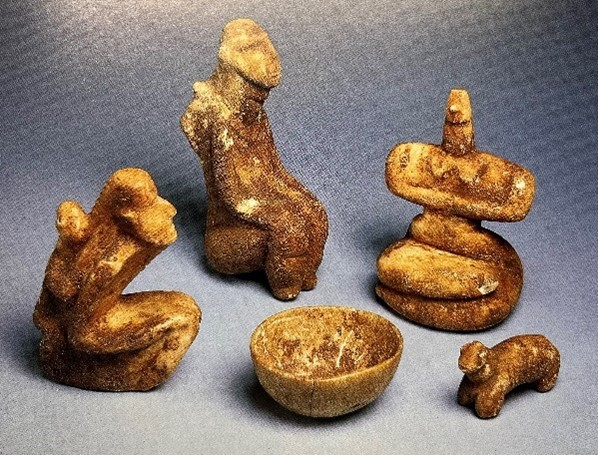
The Neolithic Family Group, which dates to 5000-3500 B.C.E and valued at $3 million. This group of objects compromises five human and animal figures carved from marble, and was looted from the island of Euboea by a Greek trafficker who smuggled the pieces into Switzerland. In 1982 dealer-trafficker Nicolas Koutoulakis sold the group to New York-based collectors Leon Levy and Shelby White. White loaned the group to the Metropolitan Museum of Art in 2000, where they remained on display until March of this year, when it was seized by the Office.
The group had been owned by Charles Gillet and Marion Schuster. They are "said to be from Euboea, or the east coast of Attica opposite, near Porto Raphti, perhaps from an islet attached to the mainland in prehistoric times" (Glories no. 8). It is interesting that the release emphasises the findspot on Euboea rather than Porto Raphti or more generally Attica preferred by Getz-Preziosi and Thimme. There are aspects of the group that make me wonder if they are ancient, a concern raised by Thimme back in 1977.

Next to the Late Neolithic group, but unmentioned in the release, was a double Cycladic figure: a small female figure standing on the head of a larger one. This appears to be the figure in the Shelby White collection (NAC no. 18; Glories no. 9; Katonah no. 15). Next to them was an Early Cycladic II bowl that also appears to be from the Shelby White collection (Glories no. 15).

Among the other items that appear to have been other items that formed part of the Shelby White collection:
  • Glories no. 76: A Late Geometric pair of horses 'said to have been found on Corfu, and for at least twenty years was in a collection in Austria. In October 1970, the group was lent to the Kunsthistorisches Museum in Vienna for restoration.'
  • Glories no. 80: an armlet, two lidded pyxides, and an oinochoe from a hoard of at least 40 pieces found in northern Greece.
  • Glories no. 141: a gold treasure consisting of a pair of coiled snake armbands, a pair of earrings with swans, a gold and carnelian necklace, a gold ring with carnelian intaglio, part of a gold wreath, and a gold diadem. 
The press release mentions that the Royal-Athena Galleries have co-operated with the investigation suggesting that some of the other items were from that source (perhaps including a fragment of wall-painting).

I note that Christos Tsirogiannis was involved with some of the identifications. 

We await for a full list of the return.

| |
Bookmark and Share so Your Real Friends Know that You Know

Saturday, 4 February 2023

Further returns to Italy from San Antonio Museum of Art and Shelby White

Oinochoe fragment
attributed to the Harrow painter
returned from
the San Antonio Museum of Art.
Source: San Antonio Museum of Art

The Manhattan DA has reportedly returned 14 more antiquities to Italy: though the objects and images presented at the press announcement counted 16 ("D.A. Bragg Returns 14 Stolen Antiquities to Italy", Manhattan DA February 2, 2023). Two sources were acknowledged: Shelby White and the San Antonio Museum of Art. The third, the source of a silver coin, was left anonymous in the press release.

At least three of the objects appear in the Glories of the Past catalogue of the Shelby White and Leon Levy collection. The release gives further information about the Attic black-figured hydria attributed to the Priam painter.
The piece first surfaced in Italy after being looted by Giovanni Franco Becchina, a well-known antiquities trafficker. From Italy, the piece was then smuggled and laundered by Paris-based Robert Hecht. Hecht ultimately sold the piece with false provenance to Shelby White in New York County in 1989.
These add to the 14 pieces featured in the catalogue that have been returned to Greece, Italy and Turkey.

The nine pieces featured in the images at the press statement are derived from the San Antonio Museum of Art. The objects are derived from several sources: Sotheby's in London; Christie's in London and Geneva; Galerie Palladion Antike Kunst; Galerie Günter Puhze; Royal Athena Galleries; Robin Symes. For example, the oinochoe fragment attributed to the Harrow painter surfaced through Galerie Palladion Antike Kunst, and was sold to Gilbert M. Denman, Jr. by Robert Hecht.  The nine objects may be added to other pieces that were handed over in 2022. We are also expecting further details about three other objects derived from Frederick Schultz that have been handed over by the museum. 

Three other objects featuring in the press statement have yet to be linked in a formal way to a specific collection though Christos Tsirogiannis has identified two of them in the Becchina archive and one in the Schinousa archive. 

The final piece is a silver coin.
The Sicily Naxos Coin. Minted circa 430 B.C.E in the Greek colony of Naxos, on Sicily, this silver coin features the bearded Dionysus on one side and his squatting drinking partner, Silenus, on the reverse. The Sicily Naxos Coin first surfaced on the international art market in 2013, when a known trafficker offered the coin for sale with no provenance whatsoever. Prior to its appearance at a London-based auction house, a co-conspirator of the trafficker supplied false provenance for the coin. The Sicily Naxos Coin is currently valued at $500,000 and was among a group of coins seized at JFK airport as it was being smuggled into New York pursuant to an ongoing joint investigation between this Office, HSI, and Italy. At least one individual has been arrested in the course of this investigation with more to follow.
Three Shelby White pieces, nine objects from San Antonio, one silver coin, and three other pieces equal 16 objects (not 14).

Objects from the San Antonio Museum of Art and in the Shelby White and Leon Levy collection were the subject of an extended discussion by Chippindale and Gill in the American Journal of Archaeology back in 2000. 
Chippindale, C., and D. W. J. Gill. 2000. "Material consequences of contemporary classical collecting." AJA 104: 463-511. [DOI]
LM expects to add further detail to this summary in due course.

| |
Bookmark and Share so Your Real Friends Know that You Know

Saturday, 3 December 2022

Identifications at Sotheby's in London

Image from the Becchina archive courtesy of Christos Tsirogiannis

Professor Christos Tsirogiannis has identified three objects from the Becchina, Medici and Symes archives that were due to be auctioned at Sotheby's in London on December 7, 2022. His identifications are covered in a report by Dalya Alberge, "Archaeologist urges Sotheby’s to cancel auction of ‘illicit’ artefacts", Daily Telegraph December 3, 2022.

Take for example the Roman bronze protome spout in the form of a dog or spout (lot 121). The history of the piece is provided:
  • Swiss private collection 
  • Royal-Athena Galleries, 
  • New York John W. Kluge, acquired from the above in 1989 (Christie's, New York, The Morven Collection of Ancient Art, December 10th, 2004, no. 590, illus.)
Notice on the image the annotation 'V[ia]/Jer[ome Eisenberg]' confirming the link with the Royal-Athena Galleries. The image is taken from the Becchina archive and records show that it was derived from Mario Bruno. Presumably one of these two sources is to be identified as the 'Swiss private collection'.

In the report in the Telegraph it is noted:
A Sotheby’s spokesman said that they “uphold the highest standards of due diligence”.
How did Sotheby's conduct a rigorous due diligence test on the anonymous Swiss private collection? Had they considered the possibility that Becchina or another such individual was the origin? 

Royal-Athena Galleries should also have raised an alert. Only in November three antiquities from this source were returned to Turkey: e.g. silver Apollo. Or in July this year an Attic krater from the Gallery was returned to Italy. This was among 60 antiquities from Royal-Athena Galleries. Again, had Sotheby's taken this into account as part of their rigorous due diligence process? 

In May 2017 a Paestan lekythos was provided with a nearly identical history to the bronze spout. Did this raise concern? Indeed it is clear that the Kluge collection has been linked to several antiquities that have been returned to Italy. This in itself should have alerted those preparing the catalogue entry for Sotheby's.

Will Sotheby's in London tighten up its processes? Is there a need to raise the standard of the due diligence approach to a more rigorous level?


| |
Bookmark and Share so Your Real Friends Know that You Know

Monday, 28 November 2022

Bronze Attis Returns to Turkey

L: Bronze returned to Turkey. R: Bronze in Royal-Athena Galleries


Among the objects returned to Turkey was a small bronze identified as Attis. This appears to be the bronze acquired from Galerie Nefer in July 1984 and then sold through Royal-Athena Galleries (Art of the Ancient World 4 [1985] no. 144) to the J.H. collection, Dearborn, Michigan. It was then placed on loan with Ohio State University; Picker Art Gallery, Colgate University; and Fitchburg Art Museum. It was then back on sale at the Royal-Athena Galleries (Art of the Ancient World 29 [2018] no. 18).

Note that the 2018 catalogue entry mentions the oriental 'costume and cap' but rather than identifying it as Attis suggests Orpheus.

What other material did the Royal-Athena Galleries acquire from Galerie Nefer? 

I presume that the Manhattan DA will at some point issue a list of material that has been returned to Italy and Turkey from the stock of the Royal-Athena Galleries. Should those museums and collectors that acquired material from this source now be checking the histories of the objects? 

| |
Bookmark and Share so Your Real Friends Know that You Know

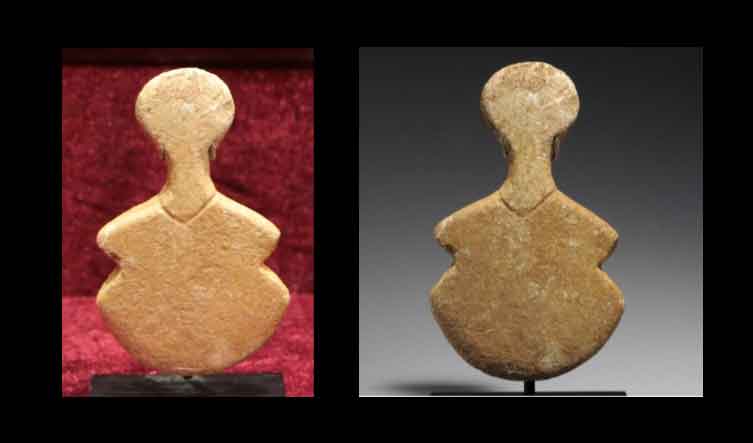
Kusura Type Figure Returned to Turkey

L: Figure Returned to Turkey. R: Figure from Royal-Athena Galleries

Among the recent items returned to Turkey was a Kusura type marble figure. Although there was no statement about the origin of the figure it seems to be the one offered by the Royal-Athena Galleries in New York in 2006 (Art of the Ancient World 17, no. 218) and 2017 (Art of the Ancient World 28, no. 166). It is said to have resided in an anonymous French private collection. 

It will be recalled that 60 items from the Royal-Athena Galleries were returned to Italy in July 2022. Was this Kusura type figure seized at the same time or has it been residing elsewhere? The Manhattan DA does not yet seem to have issued an informative press release about these latest returns to Turkey. 

| |
Bookmark and Share so Your Real Friends Know that You Know

Wednesday, 16 November 2022

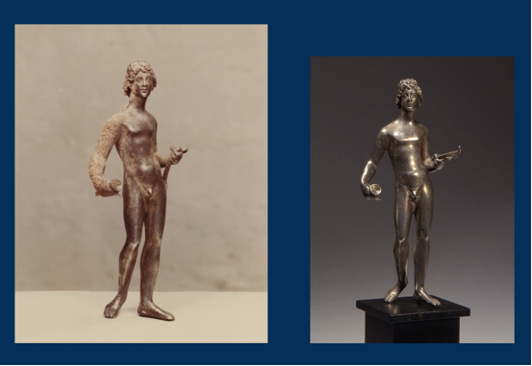
A Silver Apollo Returns to Turkey

Left: Symes-Michaelides archive; Right: Royal-Athena Galleries


In November 2022 the US authorities returned a silver statuette of Apollo to Turkey. This was recognised as the figure that had been identified by Christos Tsirogiannis in 2007 as appearing in the Symes-Michaelides archive. It receives a full discussion in his PhD thesis, Unravelling the Hidden Market of Illicit Antiquities: The Robin Symes - Christos Michaelides Network and its International Implications (Cambridge University, PhD Dissertation, 2012). 

The history can be traced through the various sale catalogues in which it appeared.

The figure seems to have surfaced in an exhibition organised by Marie-Louise Vollenweider, Musées de Genève in January 1987 (no. 274), and then featured in the exhibition for Numismatic Fine Arts, Treasures from an Ancient Jewelbox: Gold and Silver of the Ancient World (1992): the catalogue was prepared by Robert Hecht. 

The figure next appeared in the exhibition organised in memory of Michaelides by Robin Symes, Royal Portraits and Hellenistic Kingdoms (New York 1999) no. 24, and then passed into a New York private collection. It was offered at Sotheby’s (New York) on December 7, 2001, lot 76 but was unsold; it entered an Australian private collection in 2002, and was offered at Sotheby’s (New York) June 5, 2008, lot 22 but again was reportedly unsold. It was purchased by Jerome Eisenberg and appeared in Royal-Athena Galleries, Art of the Ancient World 20 (2009) no. 134; Art of the Ancient World 28 (2017) no. 27. It is not clear when the Apollo was seized.

The evidence used to associate the Apollo with a findspot in Turkey has not been disclosed as part of the return, but it has been associated with rulers from Pontus and Cappadocia.

Note. The label in the Antalya Museum states that the figure is bronze but this is incorrect. I am grateful to Christos Tsirogiannis who was able to confirm the material.

| |
Bookmark and Share so Your Real Friends Know that You Know

Tuesday, 20 September 2022

The Steinhardt hydria attributed to the Antimenes painter

Source of images: Manhattan DA.

Among the items seized from the Michael Steinhardt collection and returned to Italy was an Attic black-figured hydria attributed to the Antimenes painter. The hydria had been identified from an image in the Medici Dossier.

The Manhattan DA reports that the hydria had first surfaced with Robin Symes in 1983 (when it was advertised in Apollo). The statement then adds:
By 1987, Symes had transferred the object to the New York-based Atlantis Gallery, part-owned by Robert Hecht, who then loaned it to the Getty Museum. From 1987-1996, the object was on view at the Getty Museum prior to its sale to Steinhardt through Sotheby’s New York on December 17, 1996. 
Steinhardt is report to have purchased the hydria from Sotheby's for $169,411.

The Beazley Archive (BAPD 31596) provides the loan number for the Getty (L87.AE.4) as well as the details for the Sotheby's New York sale (17 December 1996, lot 49). It also suggests that the hydria passed through the Royal-Athena Galleries though this information may not be correct.

Christopher Chippindale and I had rehearsed the history of this specific hydria in our review article of The Medici Conspiracy (2007) [see here]. We clarify that the hydria was placed on loan at the Getty in January 1987, and returned in February 1996. This raises a question about the nature and purpose of loans that were placed at the Getty.

It should be recalled that one of the Attic black-figured neck-amphorae seized from Fordham University was attributed to the circle of the Antimenes painter (BAPD 24304).

It should be noted that the identification of the Steinhardt hydria was made by Associate Professor Christos Tsirogiannis. 

| |
Bookmark and Share so Your Real Friends Know that You Know

Saturday, 3 September 2022

Search Warrant for the Met

Castor and Pollux previously on loan to New York's Metropolitan Museum of Art
© David Gill


Some of the pieces on the search warrant have been discussed by LM in the past:

Bookmark and Share so Your Real Friends Know that You Know

Saturday, 23 July 2022

Myson krater returning to Italy

Back in 2014 I commented on an Attic column-krater attributed to Myson that had been identified by Christos Tsirogiannis from the Swingler collection of photographs (see here).  Tsirogiannis has subsequently published the krater and discussed its links with the Royal-Athena Galleries:
Source: Manhattan DA
Tsirogiannis, C. 2020. "The antiquities market we deserve: 'Royal-Athena Galleries' (1942-2020)." Acta ad archaeologiam et artium historiam pertinentia 32: 147–75. [Online]
Tsirogiannis has spotted that the same krater appears prominently in the Manhattan DA repatriation ceremony that took place this week. 

The krater itself surfaced in 1980 (Royal-Athena Galleries) and then had passed through the John Kluge collection (BAPD 9032028 [though without complete history]). The presence of its image in Swingler's photographic archive may suggest that it arrived in the US with consignments of pasta. Did Royal-Athena Galleries receive other consignments from this same source? 

Myson krater in Swingler archive
Image source: Christos Tsirogiannis
Is the krater one of the 60 pieces that are being returned from the stock of the now closed Royal-Athena Galleries? Or is it one of the 34 from other investigations? 

We look forward to the Manhattan DA listing the returned pieces.
| |
Bookmark and Share so Your Real Friends Know that You Know

Wednesday, 20 July 2022

New Returns to Italy Announced: Some Linked to Edoardo Almagià

Source: Manhattan DA

It was announced today that 142 antiquities will be returning to Italy (Press Release, "D.A. Bragg Returns 142 Antiquities Valued at Nearly $14 Million to the People of Italy", July 20, 2022). The returns consisted of 
"60 were recovered from Royal-Athena Galleries, 48 were recovered from STEINHARDT, and an additional 34 were seized pursuant to other ongoing investigations".
The Steinhardt material included:
Among the items being repatriated today is the Ercolano Fresco, which was seized as part of the investigation into STEINHARDT. Depicting an infant Hercules strangling a snake, the piece dates to 50 C.E. and was looted in 1995 from a villa in Herculaneum, an archaeological site that was buried for millennia under volcanic ash from the fiery eruption of Mount Vesuvius. STEINHARDT purchased the Ercolano in 1995 for $650,000 with no verifiable prior provenance. It is currently valued at $1,000,000.
Other items identified include:
Three fresco paintings dating to the 4th century B.C.E. from Paestum, an ancient Greek city located in southern Italy, which were seized pursuant to an ongoing investigation. These paintings depict scenes of mourning women, and were hacked from the wall of a tomb by looters.
An Archaic pithos (storage jar) dating back to 700 B.C.E. that was seized pursuant to an ongoing investigation into Edoardo ALMAGIÀ, an Italian native and former New York resident.
The press release also acknowledges the following museums and a single gallery:
Indiana University’s Eskenazi Museum of Art, the Museum of Fine Arts-Boston, Royal-Athena Galleries, and the Toledo Museum of Art
One wonders if the Indiana material is linked to Almagià. 

The Boston material includes 9 pots apparently derived from Crustumerium in Latium that was acquired in 1995:
Probably about 1993/1994, illicitly excavated from Crustumerium, Italy and sold to Edoardo Almagià, New York; 1995, sold by Almagià to Jonathan Kagan and Sallie Fried, New York; 1995, year-end gift of Jonathan Kagan and Sallie Fried to the MFA (Accession Date: January 24, 1996); December 16, 2021, deaccessioned by the MFA for transfer to the New York County District Attorney and return to the Republic of Italy.
So far Boston is the only museum that appears to have provided full information.

| |
Bookmark and Share so Your Real Friends Know that You Know

Friday, 31 December 2021

Three gorgons from an Etruscan brazier


Among the returns to Italy from the Michael Steinhardt collection are three bronze feet in the form of gorgons with outstretched arms. The three gorgons appear to have featured in the catalogue for the Royal-Athena Galleries (2012). They were presented with the following history:
One ex Leo Mildenberg collection, acquired in the 1960s; two ex private collection, Ticino, Switzerland, acquired in the 1960s.
According to the legal papers relating to the Steinhardt case, Jerome Eisenberg acquired the bronzes for $105,000 from Jurgen Haering Gallery of Freiberg at the Basel Ancient Art Fair (November 2010). 

But what about the earlier history? The bronzes are reported to feature in the Becchina archive. The legal paperwork suggests that Becchina sold them to Vincenzo Zuchetto for SF 100,000 (May 1, 1985). It is unclear when the bronzes moved to Freiberg. The legal papers suggests that Haering claimed that the feet came from the ‘collection Mildenberg, Zurich, Switzerland, since the 1960s’. 

The legal paperwork makes interesting reading. It is stated that while the gorgons were still in the hands of Royal-Athena Galleries, Erdal Dere, owner of Fortuna Fine Arts, contacted Steinhardt claiming that the feet were in the possession of Verena Brunner who would not part with them for $125,000 (September 4, 2014). The very next day the gorgons were sold to Fortuna Fine Art for $130,000 (September 5, 2014) and on the same day Fortuna Fine Arts sold them to Steinhardt for $150,000 (September 5, 2014). The invoice from Fortuna fine Arts is claimed to state:
Ex. Old Private European Collection (Ticino, Switzerland, 1960s). Ex. Dr. Leo Mildenberg Collection, Switzerland 1960s to Verena L. Brunner, Niece of Dr. Leo Mildenberg. Michigan 1980s to Present.

The story then gets more complicated. The Manhattan DA's investigation then discovered that Mildenberg's niece, Verena Brunner, had never apparently spoken to Erdal Dere, and that she had not seen the gorgons until she was shown a photograph as part of the Steinhardt investigation. The Manahttan DA also contacted the executor of the Mildenberg estate who stated that the gorgons had not formed part of the estate. It was also suggested that gorgons would not have been the sort of object that would have been collected by Mildenberg.

How did these gorgons enter the market? What is the evidence that they formed part of the Mildenberg collection? How and when did they pass, or were supposed to pass, from the Mildenberg and two private collections to Becchina? What is the authenticated documentary evidence?

I am grateful to Associate Professor Christos Tsirogiannis for discussing this with me.

| |
Bookmark and Share so Your Real Friends Know that You Know

Saturday, 12 June 2021

A Couchant Horned Goat from the Medici Dossier


The goat has surfaced (as was re-spotted by Tsirogiannis) as "Masterful Greek Hellenistic Ceramic Goat Vessel" in the Artemis Gallery in Louisville CO, as lot 0054. The history is given as "East Coast, USA collection; ex-Royal-Athena Galleries, New York, USA, acquired in the 2000s". The lot was "passed" on June 10, 2021. 

The Artemis catalogue does not mention any link with Italy, but the RAG catalogue of 2010 helpfully noted 'South Italy, 4th century BC'.  Will the Italian authorities be seeking its return?

This was one of 16 pieces identified on the New York market back in 2010, yet it has remained available for sale. 


Bookmark and Share so Your Real Friends Know that You Know

Monday, 27 May 2019

Renewed Italian claims on the Getty

Back in January 2013 LM noted that Fabio Isman had noted that two funerary lions in the J. Paul Getty Museum, acquired in 1958 (inv. 58.AA.7, 58.AA.8), had been photographed in an Italian collection in 1912. It now appears that the Italian authorities have requested clarity on the histories of the two lions [press release, May 22, 2019]. The lions were both acquired from Nicholas Koutoulakis.

In addition, a Roman mosaic with the head of Medusa has been included in the request. It is alleged that it was stolen from the Museo Nazionale Romano. The mosaic was acquired from the Royal Athena Galleries in 1971 (inv. 71.AH.110). It is noted that the mosaic was found on the Via Emanuele Filiberto, Rome, Italy and was first recorded in A. Pasqui 1911 ("Roma. Nuove scoperte nella citta e nel suburbio." Notizie degli Scavi 8 (1911), 338-339). Further details on the findspot can be found here.

What is so surprising is that it has taken the Getty more than six years to respond to the claims over the two lions.


UPDATE: The J. Paul Getty Museum has reminded me that the Italian authorities have not requested the return of the three items discussed in this post. Rather, they have invited further information and discussion, specifically on the "provenance": 'specifici negoziati per una verifica congiunta della provenienza di quattro reperti esposti sempre nel museo di Malibù'.

Bookmark and Share so Your Real Friends Know that You Know

Tuesday, 5 December 2017

An athlete, Robin Symes and the Paris market

Source: Schinoussa archive
Courtesy: Dr Christos Tsirogiannis
Dr Christos Tsirogiannis has identified a Roman marble athlete from the Robin Symes archive. The statue is due to be auctioned in Paris this Friday, 8 December 2017 (Drouot lot 292).

The history of the statue is provided:
  • Royal Athena Galleries, New York:  Art of the Ancient World 4 (1995), p.75-76, lot n°236.
This does not explain why the statue appeared in the confiscated Symes archive. 

Tsirogiannis has also spotted that the statue surfaced at Sotheby's in London Sotheby's on 5th of July 1982. lot 397. Who consigned the statue to that sale? Why does the Paris description fail to mention the Sotheby's information? Would it raise questions about how it surfaced?

Where was the statue between 1982 and 1995?

I understand that the French authorities have been informed about the sale.

Bookmark and Share so Your Real Friends Know that You Know

Monday, 11 September 2017

The Horse in Ancient Greek Art

Attic red-figured column-krater attributed to the Orestes painter.
Virginia private collection.
Source: NSLM
The exhibition, 'The Horse in Ancient Greek Art', will be on show at the National Sporting Library and Museum, and the Virginia Museum of Fine Arts. It will include a number of objects from private collections. I hope that the full collecting histories will be provided.

I looked up the Attic red-figured column-krater attributed to the Orestes painter (and featured on the exhibition website). It surfaced in the Fortuna gallery in Zurich in 1980 (and was re-offered in 1983), and then was for sale in the Royal-Athena Galleries, New York in 1983. It was then offered through the Old World Galleries, New York before being auctioned at Christies (June 8, 2004, lot 328) where it was sold for $47,800. It then passed into a Virginia private collection. What was the collecting history of this krater prior to 1980?

I note that other kraters attributed to this painter were found at Agrigento, Camarina (two), Chiusi and Spina. Where was the Virginia krater found? And when? Its fairly complete nature suggests a tomb is quite likely.

This exhibition reminds us of the material in the Virginia MFA that has been identified by Cambridge-based Dr Christos Tsirogiannis.

Bookmark and Share so Your Real Friends Know that You Know

Wednesday, 31 May 2017

Sardinian warrior from "old Swiss collection"

Source: New York County District Attorney's Office
Source: Google

One of the Sardinian bronzes of a warrior was seized from an as yet unnamed Manahattan gallery. It appears to be the one that passed through the Royal-Athena Gallery: Art of the Ancient World 23 (2012) no. 71. The collecting history for that warrior suggests that it was acquired in 1990 from a private collection in Geneva.

Other clues suggested that the warrior has resided in a New York private collection.

The identity of the private collection in Geneva will no doubt be telling.

The warrior also features in this news story: Jennifer Peltz, "Looted statues, pottery returned to Italy after probe in NYC", ABC News May 25 2017.

Bookmark and Share so Your Real Friends Know that You Know

Paestan lekythos from "an old Swiss collection"

Source: New York County District Attorney's Office
Paestan lekythos. Source: Google

One of the pieces seized from an as yet unnamed Manhattan gallery is a Paestan lekythos attributed to the Asteas-Python workshop. It has a stated collecting history:

  • Swiss private collection
  • Royal-Athena Galleries (1987-1988)
  • John Kluge private collection
  • Patricia Kluge private collection, Charlottesville, Virginia (1990-2010)
  • Royal-Athena Galleries: One Thousand Years of Ancient Greek Vases II ... Featuring the Patricia Kluge Collection (2010) no. 164

It would be interesting to learn the name of the anonymous Swiss private collection in which this lekythos once resided. (And note that this information is derived not from Royal-Athena Galleries but from the present vendor.)

We also note the appearance of the Kluge collection.

Bookmark and Share so Your Real Friends Know that You Know

Another Bürki object returns to Italy

Source: MMA A psykter column-krater attributed to the Troilos painter was deaccessioned by New York's Metropolitan Museum of Art in June...