Showing posts sorted by date for query apulian. Sort by relevance Show all posts

Wednesday, 15 July 2026

Two more Bothmer donations returned to Italy

Cup attributed to near Psiax. Source: MMA.


In February 2026 two fragmentary Attic cups that had been given to New York's Metropolitan Museum of Art by Dietrich von Bothmer were deaccessioned pending their return to Italy. Both were donated in 1984, and both had been acquired from Fritz Bürki. One was a bilingual cup attributed to near Psiax (1984.500.1; BAPD 44520) and the other cup was attributed to Epiktetos with a kalos inscription of Hip(p)archos (1984.500.2; BAPD 9055412).

We should note that the MMA has earlier returned a black-figured mastos attributed to Psiax (1975.11.6; BAPD 4525). Bürki was the source of other returns from the MMA including fragments from a Makron cup (1978.11.7a, d), and fragments of the Apulian dinos attributed to the Dinos painter (1984.11.7). He was also the source of some 11 per cent of the fragments in the sample selection of Bothmer fragment collection acquired by the MMA.


Bookmark and Share so Your Real Friends Know that You Know

Thursday, 5 February 2026

Drawing attention to "provenance" at the Met

Courtesy of Christos Tsirogiannis

One of largest group of repatriated material from New York's Metropolitan Museum of Art was dervied from Palladion Antike Kunst and from Mr & Mrs Gianfranco Becchina.

The items include:
  1. Attic bf lekythos, attributed to the manner of Elbows Out. Inv. 1985.11.3 [Until 1985, with Galerie Antike Kunst Palladion, Basel, Switzerland]; acquired in 1985, purchased from the Galerie Palladion. Deaccessioned for return to Italy in September 2022. Bibl. BAPD 16461.  
  2. Attic bf mastos, attributed to Psiax. Inv. 1975.11.6 [Until 1975, with Galerie Antike Kunst Palladion, Basel, Switzerland]; acquired in 1975, purchased from the Galerie Palladion. Deaccessioned for return to Italy in September 2022. Bibl. BAPD 4525; Mertens 1979, 23 n. 13, pl. 9.1–4; Mertens 2010, 28–29, fig. 14. 
  3. Attic bf amphora fragment, attributed to Lydos. Inv. 1985.11.1. [Until 1985, with Galerie Antike Kunst Palladion, Basel, Switzerland]; acquired in 1985, purchased from the Galerie Palladion. Deaccessioned for return to Italy in September 2022. Bibl. BAPD 14695; Bothmer 1985, 40–41, 56, fig. 25, n. 48.  
  4. Attic bf amphora fragment, attributed to the Amasis painter. Inv. 1985.11.2. [Until 1985, with Galerie Antike Kunst Palladion, Basel, Switzerland]; acquired in 1985, purchased from the Galerie Palladion. Deaccessioned for return to Italy in September 2022. Bibl. BAPD 14683; Bothmer 1985, 34, 108, no. 17.  
  5. Attic bf amphora fragment, attributed to the Amasis painter. Inv. 1985.53. [Until 1985, with Galerie Antike Kunst Palladion, Basel, Switzerland]; 1985, acquired by Dietrich von Bothmer, purchased from Galerie Antike Kunst Palladion; acquired in 1985, gift of Dietrich von Bothmer. This artwork was restituted in September 2022. Bibl. BAPD 14680; Bothmer 1985, 76, no. 2bis.  
  6. Attic wg cup, attributed to the Villa Giulia painter. Inv. 1979.11.15. [Until 1979, with Galerie Antike Kunst Palladion, Basel, Switzerland]; acquired in 1979, purchased from the Galerie Palladion. Deaccessioned for return to Italy in September 2022. Bibl. BAPD 5330; Bothmer and Mertens 1979/80, 14–15; Mertens 1987, 59, no. 41; Picón, C.A. et al. 2007, 118, 430, no. 129; Connelly 2007, 111–12, fig. 4.19, pl. 8. 
  7. Pair of gold Apulian cylinders. Inv. 1981.134.1, .2 [Until 1981, with Gianfranco Becchina]; acquired in 1981, gift of Mr. and Mrs. Gianfranco Becchina. Deaccessioned for return to Italy in September 2022. 
You would think that it would make the curatorial staff at the MMA sensitive to any other material with this association. Thus, it came as a bit of a surprise that the example used in the Cycladic symposium today to show how "provenance" is displayed on the MMA website used the Cycladic figure that Christos Tsirogiannis identified from the Becchina archive. And the slide used quoted the "public" statement of previous history:
[By 1981, collection of Noroyoshi Horiuchi, Tokyo]; [until 1983, with Ariadne Galleries, New York]; 1983, acquired by Leonard Stern, purchased from Ariadne Galleries, New York; 1983-2022, collection of Mr. and Mrs. Leonard Stern, New York; 2022, transferred to Greece; 2024-2034, on loan to the Metropolitan Museum of Art from the Hellenic Republic.
The mention of the Becchina association was left unmentioned in the presentation even though that particular individual has been associated with objects handled by Horiuchi.

This does not feel like a rigorous engagement with the origins of the Stern collection. 

| |
Bookmark and Share so Your Real Friends Know that You Know

Saturday, 13 December 2025

Returns to Italy from the San Antonio Museum of Art

Source: San Antonio Museum of Art
A series of deaccessions has been made in September 2025 by the San Antonio Museum of Art. They consist of mostly South Italian pots and one Etruscan terracotta:

  • South Italian oinochoe (inv. 97.8). Sold by Peter Sharrer.
  • Gnathian hydria (inv. 86.119.3.a–b). Surfaced at Sotheby's (London) December 1982; sold by Atlantis Antiquities.
  • Two Apulian epichyses (inv. 88.11.1.a–b). Surfaced at Sotheby's (London) December 1987.
  • Paestan bell-krater (inv. 2005.1.72). Surfaced at Sotheby's (London) December 1986; Charles Ede Ltd.
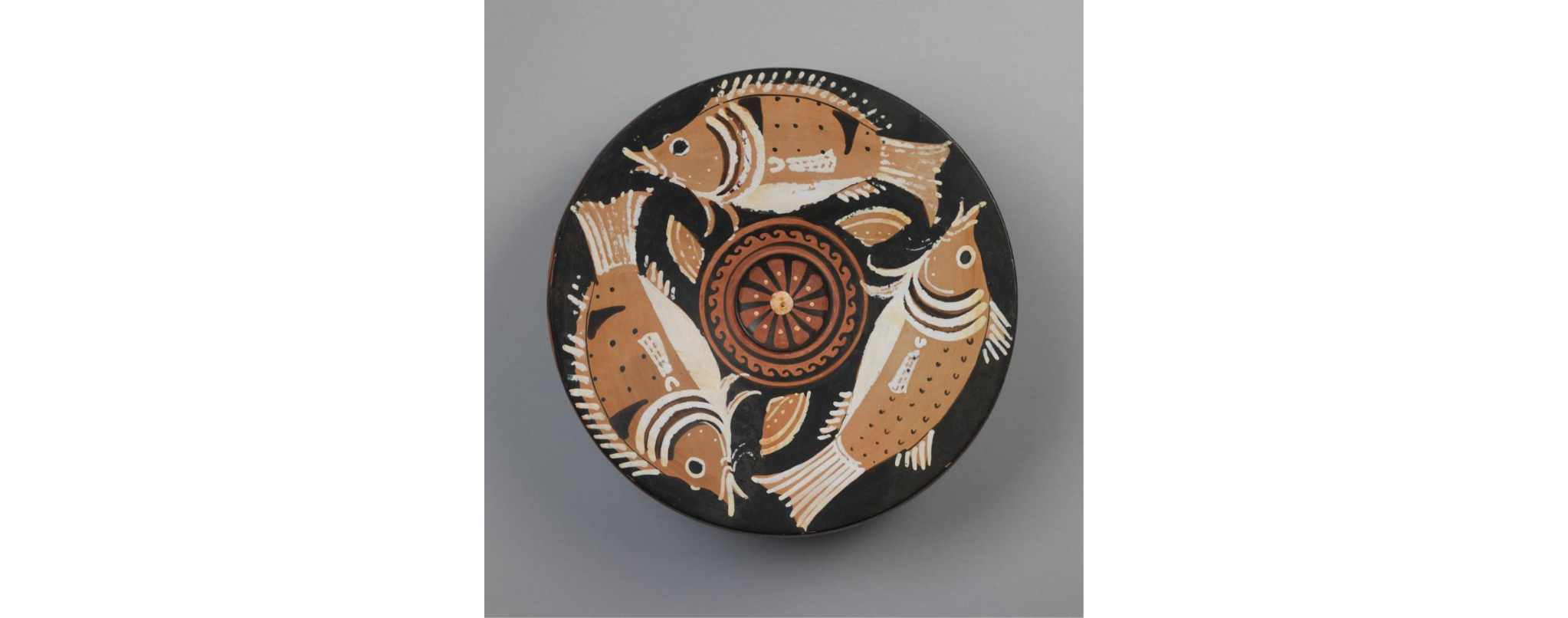
  • Paestan fishplate (inv. 87.17). Galerie Hydra, Geneva; Sotheby's (London) December 1986; Charles Ede Ltd.
  • Etruscan terracotta figure of a woman (inv. 88.11.2). Surfaced at Sotheby's (London) December 1987.
Other items were deaccessioned in February 2021, and January 2022. 

The way that many of these pieces surfaced through Sotheby's (London) is significant. (For others from these same auctions see here.) Galerie Hydra is associated with material linked to Giacomo Medici (see here).
| |
Bookmark and Share so Your Real Friends Know that You Know

Thursday, 7 December 2023

Gnathian Askos Returned from Virginia MFA

Gnathian Askos formerly in Virginia MFA 80.72

One of the announced returns from the VMFA is a Gnathian askos attributed to the Rose painter (inv. 80.72). This was identified from a photograph in the Medici Dossier by Christos Tsirogiannis ten years ago:
Tsirogiannis, C. 2013. "Nekyia. From Apulia to Virginia: An Apulian Gnathia askos at the Virginia Museum of Fine Arts." Journal of Art Crime 10: 81-86.
The museum purchased the askos from Fritz Bürki. One wonders what other pieces in the collection were derived from this source.

| |
Bookmark and Share so Your Real Friends Know that You Know

Virginia MFA Returns Antiquities

Apulian lekythos. Formerly Virginia MFA 80.162

It has been announced that the Virginia Museum of Fine Arts in Richmond will be returning 44 antiquities to their countries of origin, namely Egypt, Italy and Türkiye (see press release). The press release gives limited information and omits inventory numbers. One of the pieces is a bronze Etruscan warrior that was stolen from the Museo Civico Archeologico in Bologna in 1963 (apparently inv. 2014.217).

Other pieces that can be identified included an Attic marble funerary stele apparently handled by Gianfranco Becchina (inv. 79.148), and a pair of Apulian lekythoi attributed to the Underworld painter that were acquired from Fritz Bürki (inv. 80.162, 81.55; the one acquired in 1980 was a gift of the Council of the Virginia Museum of Fine Arts on the Occasion of its 25th Anniversary) [see earlier post]. A group of funerary terracottas from South Italy, and acquired in 1985, forms a large batch within the return.

Another piece is the marble statue of a boy (inv. 89.24) that was identified ten years ago by Christos Tsirogiannis:
Tsirogiannis, C. 2013. "A marble statue of a boy at the Virginia Museum of Fine Arts." Journal of Art Crime 9: 55-60.
The statue was purchased from Galerie Nefer (Freida Tchacos) though it can be traced back to Becchina. 

We look forward the VMFA releasing more details about  the returns. 

| |
Bookmark and Share so Your Real Friends Know that You Know

Friday, 10 November 2023

The Michael C. Carlos Museum and the Becchina Archive


Image from the Becchina photographic archive courtesy of Christos Tsirogiannis;
objects in the Michael C. Carlos Museum

The Michael C. Carlos Museum has issued details of the five items that will be handed over to Italy (and three of them will remain on loan). Three of the pieces—the Laconian cup, the Attic Band Cup, and the Apulian fishplate—feature in images from the Becchina archive. The implications of the images are clear: "the fact that the Carlos could not determine where the [cup] was before it was with Palladion, there is a high probability the cup was looted".

This makes us turn to two other pieces in the Carlos Museum that feature in the Becchina archive: the Minoan larnax and the Rhodian pithos. The larnax is now only said to have been with Nikolas Koutoulakis, whereas in 2022 it was said to be 'with' Koutoulakis. What is the basis of the evidence? Does the Becchina image and paperwork suggest that it passed to other collections? Note that the larnax later passed to Noriyoshi Horiuchi in Japan.

The history for the pithos that is placed on the Carlos Museum website makes no mention of it passing through the hands of Becchina or Palladion Antike Kunst. Has the history as it has been presented been fabricated? What is the authenticated documentation for the Carlos Museum version of events? Was it supplied by the vendor, Phoenix Ancient Art? 

The curatorial staff at the Carlos Museum are clearly wanting to do, and be seen to do, the professional thing by returning objects to their countries of origin when new information comes to light. (Incidentally the pithos and larnax were discussed in the Greek press in June 2007 after they had been identified in the Becchina archive by Christos Tsirogiannis.)

Where does this leave other Becchina material in the Carlos Museum?

I am grateful to Christos Tsirogiannis for sharing the images with me.

| |
Bookmark and Share so Your Real Friends Know that You Know

Tuesday, 31 October 2023

The Michael C. Carlos Museum and an Apulian Fishplate

Source: Michael C. Carlos Museum

The Michael C. Carlos Museum at Emory University has noted that it will be returning an Apulian fishplate attributed to the group of Karlsruhe 66/140 (inv. 1986.015). The website provides the so-called 'provenance':
Probably with Gianfranco Becchina, Zurich, Switzerland. Ex coll. William Knight Zewadski, United States, purchased from Sotheby's London, 17 May 1983, lot 261. Deaccessioned by MCCM for repatriation to the Italian Republic, August 29, 2023.
What does 'probably with' mean? What is the basis for returning the fishplate? Who consigned the piece to Sotheby's in London in 1983? 

What other ex-Becchina pieces in the Carlos Museum need explaining?

I am grateful to Dr Cynthia Patterson for drawing my attention to this piece of information.

| |
Bookmark and Share so Your Real Friends Know that You Know

Monday, 30 October 2023

Michael C. Carlos Museum and Italy

Source: Michael C. Carlos Museum


There have been unannounced developments at the Michael C. Carlos Museum at Emory University (no mention in the press releases). At least three items have had their title transferred to Italy on 29 August 2023 and now appear as loans. I am grateful to Dr Cynthia Patterson who spotted the changes to the records.

The objects include:
  • a Laconian cup attributed to the Rider painter (L2023.004.003). Surfaced via Palladion Antike Kunst, Basel (from at least 1988; first published by Conrad Stibbe in 1990); purchased from Palladion.
  • an Attic black-figured Band Cup (L2023.004.001). Surfaced via Palladion Antike Kunst, Basel (from at least 1975 when it appeared in an advertisement in Apollo); Brian T. Aitken, Acanthus Gallery, New York.
  • an Apulian volute-krater attributed to the Underworld painter (L2023.004.002). Surfaced in Galerie Hydra (Christian Boursaud), Geneva (by 1986); Pierre Sciclounoff (1926-1997), Geneva; purchased through Christoph Leon. 
Galerie Hydra is discussed in Peter Watson's, Sotheby's: Inside Story (1997). The Apulian krater appeared in: C. Aellen, A. Cambitoglou, and J. Chamay, Le Peintre de Darius et son Milieu: Vases grecs d'Italie méridionale (Hellas et Roma, vol. 4. Geneva: Association Hellas et Roma, 1986), 190–99 (Sciclounoff collection); A. D. Trendall, Red Figure Vases of South Italy and Sicily; A Handbook (London: Thames and Hudson, 1989), 261, fig. 210.

Can we presume that the Minoan larnax, known from the Becchina dossier, will be transferred to Greece in the near future? And what about the other material handled by Palladion Antike Kunst? 

| |
Bookmark and Share so Your Real Friends Know that You Know

Saturday, 15 July 2023

A pair of Nereids from an old Swiss collection

Two Nereids in the Louvre.
Source: Louvre


Two Apulian terracotta reliefs showing the Nereids were acquired by the Louvre in 1982 (CA 6823, CA 6824). They are alleged to have been derived from "une ancienne collection suisse" prior to 1939. However, the official museum website fails to mention this prior history.

What is key about these two Nereids is that they feature in the Becchina archive. Will the Louvre disclose the identity of the "old Swiss collection"? And what is the nature of the authenticated documentation that can demonstrate that the Nereids were known prior to 1939? 

Presumably this pair of terracottas form part of the Italian claims. Will the Louvre seek to be co-operative with the request?

What other items were acquired from Becchina or Palladion Antike Kunst?

I am grateful to Christos Tsirogiannis for advising me on the Becchina archive. The identifications were first made by Daniela Rizzo and Maurizio Pellegrini.

Besques, S. 1988. "Deux reliefs apuliens en terre cuite." Monuments et mémoires de la Fondation Eugène Piot 69: 1–28.

| |
Bookmark and Share so Your Real Friends Know that You Know

Saturday, 3 December 2022

Apulian Dinos Seized from NYC Private Collection

Source: Manhattan DA.

It seems that another piece displayed in the exhibition, Glories of the Past, was seized from a NYC private collection in June 2021 (though the information has only just been made available). The object is an Apulian dinos attributed to the painter of Louvre MNB 1148 (Glories no. 128). The catalogue entry by Dietrich von Bothmer notes that the dinos 'has been broken into many fragments and repaired'. Who restored the piece?

This adds to the 14 other pieces from the exhibition that have been returned to Greece, Italy or Turkey.

I am grateful to Jason Felch for pointing me in the direction of the relevant Search Warrant. 

| |
Bookmark and Share so Your Real Friends Know that You Know

Thursday, 1 December 2022

Returning Glories of the Past

Source: Manhattan DA.
The return of the marble sarcophagus fragments and the bronze statue of Lucius Verus from Bubon highlight how far the Leon Levy and Shelby White collection has been the source of returns to Greece, Italy and Turkey.

Many of these identifications were made by Christos Tsirogiannis.

Returned items that appeared in Glories of the Past include:
87: Bronze statue of naked youth. [Italy]
97: Fragment of an Attic funerary stele. [Greece]
102: Chalcidian neck-amphora, attributed to the painter of the Cambridge Hydria Cavalcade. [Italy]
104: Attic black-figured neck-amphora of Panathenaic shape, attributed to the painter of Louvre F6. [Italy]
107: Attic black-figured neck-amphora, attributed to the painter of the Medea group. [Italy]
112: Attic black-figured psykter. [Italy]
113: Attic black-figured skyphos. [Italy]
117: Attic red-figured calyx-krater, A: Zeus and Ganymede, B: Herakles and Iolaos, attributed to the Eucharides painter. [Italy]
129: Apulian guttus with ram's head spout. [Italy]
131: Apulian fishplate attributed to the Cuttlefish painter. [Italy]
142: Fragment of Roman fresco. [Italy]
143: Fragment of Roman fresco. [Italy]
169: Four fragments of Roman sarcophagus. [Turkey]
174: Bronze statue of Lucius Verus from Bubon. [Turkey]

Concerns about the Shelby White and Leon Levy collection were discussed in:
Chippindale, C., and D. W. J. Gill. 2000. "Material consequences of contemporary classical collecting." AJA 104: 463-511. [DOI]

There appear to be other returned items that do not feature in Glories.

| |
Bookmark and Share so Your Real Friends Know that You Know

Thursday, 13 October 2022

Cycladic Figure in the Stern Collection Identified from the Becchina Archive

Image courtesy of Christos Tsirogiannis

Christos Tsirogiannis has identified one of the Cycladic figures in the Leonard Stern collection from the Becchina archive. The figure appears in a longer discussion about the agreement to display the Stern collection at the Museum of Cycladic Art in Athens and to place the collection on long-term loan at New York's Metropolitan Museum of Art (Michael Kaplan, "Critics ‘angry’ over Greece’s deal with art collector Leonard Stern", New York Post October 12, 2022). 

The identification was first discussed in: Migdou, E. 2022. "Συλλογή Στερν και Αρχαιοκαπηλία." Athens Voice September 30, 2022.

The Early Spedos figure appears in P. Getz-Gentle, Personal Styles in Early Cycladic Sculpture, pl. 32. The shape of the feet is put down to 'damage during manufacture or soon after'. A reconstruction of the feet is provided in figure 22.

The appearance of the figure in the Becchina archive is a reminder of the unstated sources behind this collection. It raises issues about the due diligence process that was undertaken by the Greek Government prior to the formal agreement. Would the Met want to 'acquire' (on long-term loan) or display something derived from this particular dealer especially as earlier this year a pair of Apulian gold cylinders from the same source had to be returned to Italy?
| |
Bookmark and Share so Your Real Friends Know that You Know

Friday, 7 October 2022

From Geneva to the Steinhardt Collection


Source: Manhattan DA

Five objects (Attic head aryballos; Protocorinthian duck and owl; Corinthian bull's head; Ionian ram's head; Apulian head vase) in the seizure of antiquities from the collection of Michael Steinhardt have something in common: they were placed on loan with Geneva's Musée d'Art et d'Histoire (1978–81). And all of them were subsequently placed on loan with the J. Paul Getty Museum (1984–96). And all of them were sold by Robin Symes to the Beierwaltes in 1996. All but the Apulian head vase appear in images from the Medici Dossier: the head vase itself appears in the Becchina archive (with an Attic skyphos now returned from the Shelby White collection).

Such loans to these two museums were used as a response to seizures  in 2018 from another dealer. It is almost as if the loans created an acceptable collecting history. This raid seems to relate to another group of material. 

The Geneva museum has associations with other loans such as the Ka-Nefer-Nefer mummy mask (though the museum does not have a record of the loan). And the Getty accepted loans of fragments from some of these same individuals, as well as complete pots such as the Steinhardt hydria.

It should be noted that the same Geneva museum appears to be linked to the Apulian grave group acquired by Berlin. 

What part did Geneva play in handling recently surfaced antiquities and providing them with a history? What other objects passed this way? The papers relating to the Steinhardt seizure expand on this aspect.

And how many of these objects were then placed on loan with the J. Paul Getty Museum? 

Note: Identifications from the Medici Dossier and the Becchina Archive were made by Christos Tsirogiannis.

| |
Bookmark and Share so Your Real Friends Know that You Know

Monday, 19 September 2022

Robert Hecht and the Princeton painter

Neck-amphora fragments attributed to the Princeton painter
Formerly New York MMA inv. 1991.11.2.

In 1991 the Metropolitan Museum received a gift of a fragmentary black-figured neck-amphora showing Herakles, Athena and Hermes, from Dietrich von Bothmer (inv. 1991.11.2). It was attributed to the Princeton painter by von Bothmer (according to Mary B. Moore); BAPD suggests that the person who attributed the fragments was 'unknown'. Moore observes that the amphora was 'broken and mended with significant parts missing'. The restorer of the amphora is not indicated. The amphora was among a batch of antiquities seized from the museum in 2022 and returned to Italy.

Although the Beazley Archive suggests that the amphora had formed part of the Bothmer collection (BAPD 9023766), the MMA  online catalogue entry suggests that it was in fact purchased from Atlantis Antiquities in 1991. This implies that Bothmer had supplied the funds to purchase the fragments from the gallery that was part owned by Robert Hecht. 

Atlantis Antiquities has already been associated with a number of returns from North American collections that include:
  • An Attic black-figured lekythos attributed to the Diosphos painter from Boston, Museum of Fine Arts
  • An Attic black-figured amphora attributed to the painter of Berlin 1686 from The J. Paul Getty Museum
  • An Attic black-figured amphora attributed to the Antimenes painter from the Steinhardt collection
  • An Apulian amphora attributed to the Darius painter from Boston, Museum of Fine Arts
  • An Apulian loutrophoros attributed to the Metope group from The J. Paul Getty Museum
In some of these cases the restorations had been undertaken by Fritz Bürki. 

It is known that Hecht was the source for some of the pot fragments in Bothmer's collection. 

| |
Bookmark and Share so Your Real Friends Know that You Know

Tuesday, 13 September 2022

Classical Antiquities Returned to Italy from the Metropolitan Museum of Art

Source: Manhattan DA (September 6, 2022) / Lynda Albertson (on Twitter)

21 classical antiquities have been returned to Italy following their seizure from New York's Metropolitan Museum of Art. LM has listed some of the key people associated with the material. 

The objects appear to include (though no definitive list seems to have been issued by the museum):

Sculpture 
b. A marble head of Athena. Inv. 1996.178. 
e. Marble head of a horned youth wearing a diadem. Inv. 2012.479.10. The work has been on loan to, and on display at, The Metropolitan Museum of Art since 2007.  
q. A marble head of a bearded man. Inv. 1993.342. 
t. Castor and Pollux.

Silver Plate 
f. Gilded silver phiale. Inv. 1994.57.

Gold 
l. Pair of gold Apulian cylinders. Inv. 1981.134.1, .2 

Bronzes 
a. A bronze plate. Inv. 1986.322.2.  
s. Bronze statuette of Jupiter. Inv. 1997.159. 1987-1997, on loan to the San Antonio Museum of Art, Texas.

Armour 
m. Bronze helmet of Corinthian type. Inv. 2003.407.3. 
n. Bronze helmet of Italian -Corinthian type. Inv. 2003.407.5. 
o. Bronze helmet of Apulian-Corinthian helmet. Inv. 2003.407.4.  

Athenian Pottery 
Black-figured 
c. Attic bf neck-amphora, attributed to the Princeton painter. Inv. 1991.11.2. 
h. Attic bf lekythos, attributed to the manner of Elbows Out. Inv. 1985.11.3 
j. Attic bf amphora fragment, attributed to Lydos. Inv. 1985.11.1.  
k. Attic bf amphora fragment, attributed to the Amasis painter. Inv. 1985.11.2.  
u. Attic bf amphora fragment, attributed to the Amasis painter. Inv. 1985.53.  

White Ground 
p. Attic wg cup, attributed to the Villa Giulia painter. Inv. 1979.11.15.  

Red-figured 
d. Attic rf cup, signed by Hieron and attributed to Makron. Inv. 1979.11.8, 1988.11.4, 1990.170. 

Terracottas 
r. Terracotta statuette of a draped goddess. Inv. 2000.163. Gift of Robin Symes, in memory of Christo Michailidis, 2000.

Glass 
g. A glass situla with silver handles. Inv. 2000.277. 

| |
Bookmark and Share so Your Real Friends Know that You Know

Saturday, 3 September 2022

Search Warrant for the Met

Castor and Pollux previously on loan to New York's Metropolitan Museum of Art
© David Gill


Some of the pieces on the search warrant have been discussed by LM in the past:

Bookmark and Share so Your Real Friends Know that You Know

Thursday, 26 May 2022

Developments in Sicily: Gianfranco Becchina


It has been reported that the assets of Gianfranco Becchina have been confiscated by a court in Sicily (Francesco Patanè, "Commercio illegale di reperti archeologici, confiscato il patrimonio al mercante d'arte Becchina", La Repubblica 25 May 2022). The report suggests that the reason was that Becchina had benefitted from the trade in recently surfaced antiquities. There is a specific link to activity at Selinunte in Sicily. 

This has implications for museums that purchased antiquities from Becchina or his gallery Palladion Antike Kunst in Basel such as the Getty where over 800 items can be identified in the online catalogue. The Metropolitan Museum of Art also has a pair of Apulian gold cylinders that were received as a gift in 1981. Other material from Palladion Antike Kunst was given by Robert Hecht (e.g. cup fragments attributed to the Colmar painter; ) or purchased directly from the gallery (e.g. a black-figured lekythos; the white ground cup attributed to the Villa Giulia painter). Moreover, the confiscation gives fresh impetus for the identification of objects that can be recognised from the Becchina archive. This includes the Minoan larnax and a pithos in the Michael C. Carlos Museum at Emory University. 

Among recent returns from north America are three Etruscan gorgon feet from a brazier that were seized from the Steinhardt collection. 

| |
Bookmark and Share so Your Real Friends Know that You Know

Monday, 28 February 2022

Apulian grave group in Berlin subject to Italian court order

Apulian grave group currently in Berlin
© David Gill

The apparent grave group consisting of Apulian pottery now in Berlin is the subject of a court order from the Tribunale di Roma ("Scoppia la "guerra" dell'arte Italia-Germania. Il tribunale di Roma confisca 21 vasi al museo di Berlino", ItTempo.it February 25, 2022). The group has been the subject of discussion by LM back in 2007. Three of the volute-kraters are attributed to the Darius painter. This painter was the subject of an exhibition in Geneva: 
Aellen, Christian, Alexandre Cambitoglou, and Jacques Chamay. 1986. Le Peintre de Darius et son Milieu: Vases grecs d'Italie méridionale. Hellas et Roma, vol. 4. Geneva: Association Hellas et Roma.
The Berlin pots were acquired in 1983 (and accessioned in 1984), and they appear in the Medici Dossier. 

The acquisition record links the group to Jacques Chamay of Geneva's Museum of Art and History. 
«l’organo giudicante evidenziava una complicità con Medici degli indagati Jacques Chamay, all’epoca direttore del museo archeologico di Ginevra, e Fiorella Cottier Angeli, restauratrice, nella vendita al museo archeologico di Berlino dei 21 vasi».
It has been suggested that the grave group had once resided in a 19th century collection but there does not appear to be any authenticated documentation to support this claim. 

Will Berlin finally return this group to Italy?

| |
Bookmark and Share so Your Real Friends Know that You Know

Monday, 17 January 2022

The ownership trail of an Apulian krater

Apulian volute-krater
attributed to the Virginia Exhibition painter
Source: Fordham University

In February 2018 I drew attention to the Fordham Apulian volute-krater, attributed to the Virginia Exhibition painter, and its association with Edoardo Almagià (formerly inv. 8.001). I subsequently asked the question, 'Has the curatorial team at Fordham contacted the Italian authorities to check the history of the Apulian krater?' One of my concerns was that the name of the pot-painter is derived from the display, at Virginia, of five pieces all said, according to Dale Trendall, 'to come from the same tomb'. We do not, however, know the location of that tomb.

The krater was presented to Fordham in 2006 by William D. Walsh. Walsh had declared that it had been purchased from Arte Primitivo in 1994. Yet Trendall and Cambitoglou recorded the krater in 1992 as residing with Almagià on the New York market.

What other pieces from the Walsh collection were acquired from Arte Primitivo? When did the Apulian krater pass from Almagià to Arte Primitivo?

| |
Bookmark and Share so Your Real Friends Know that You Know

The Afrati Armour in Harvard

Source: Harvard Art Museums The repatriation of the Afrati armour from New York's Metropolitan Museum of Art has implications for other ...